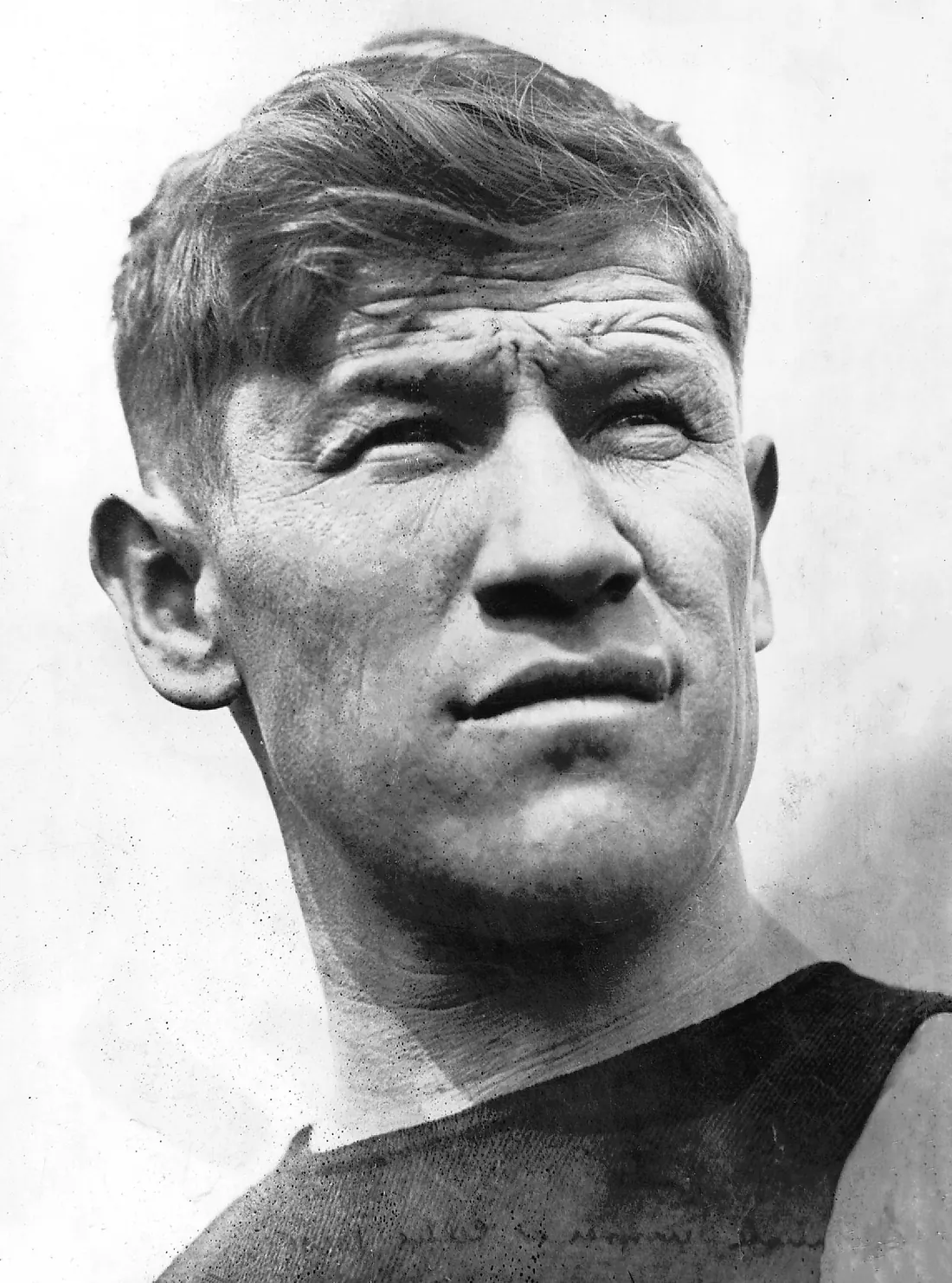
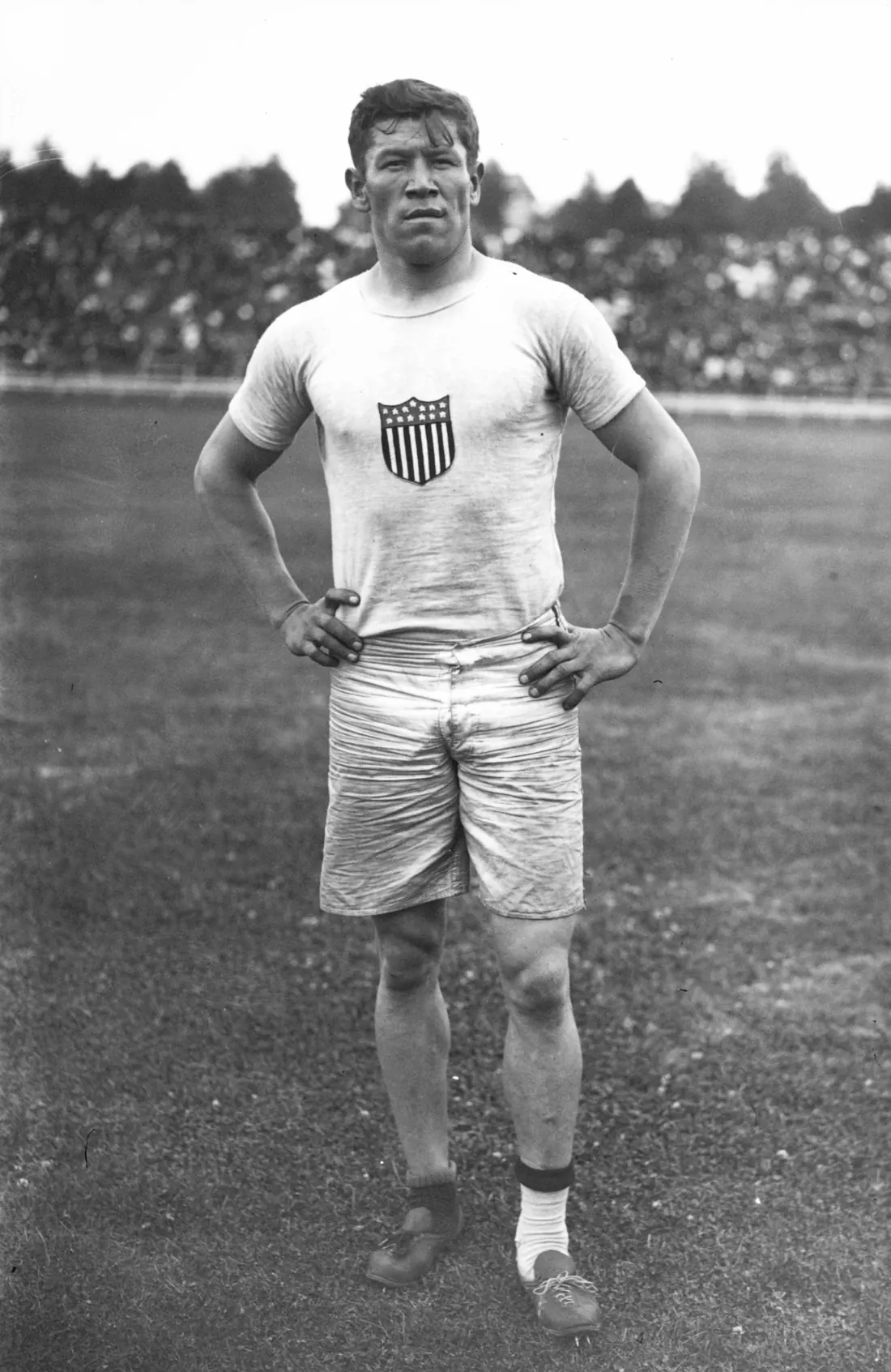
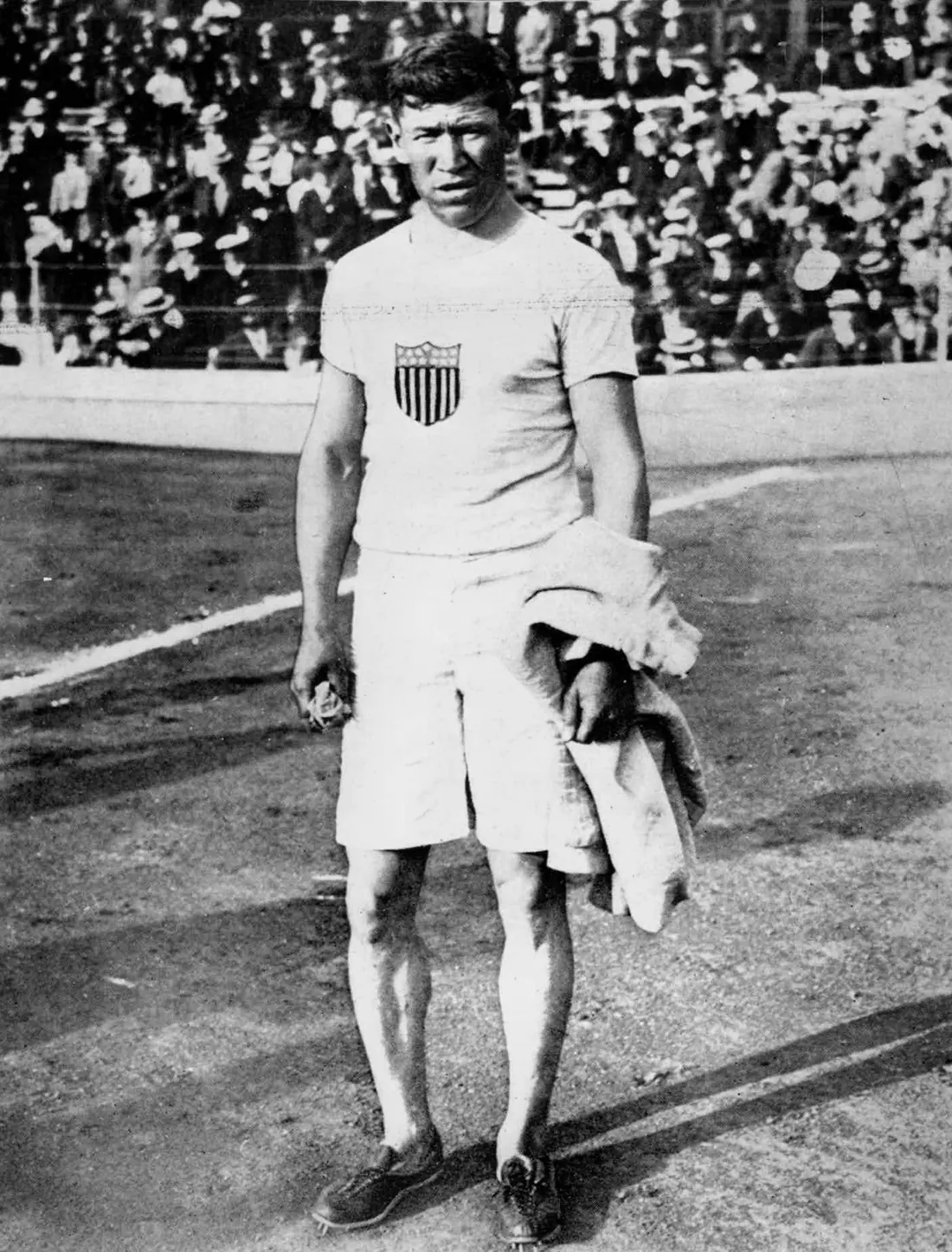
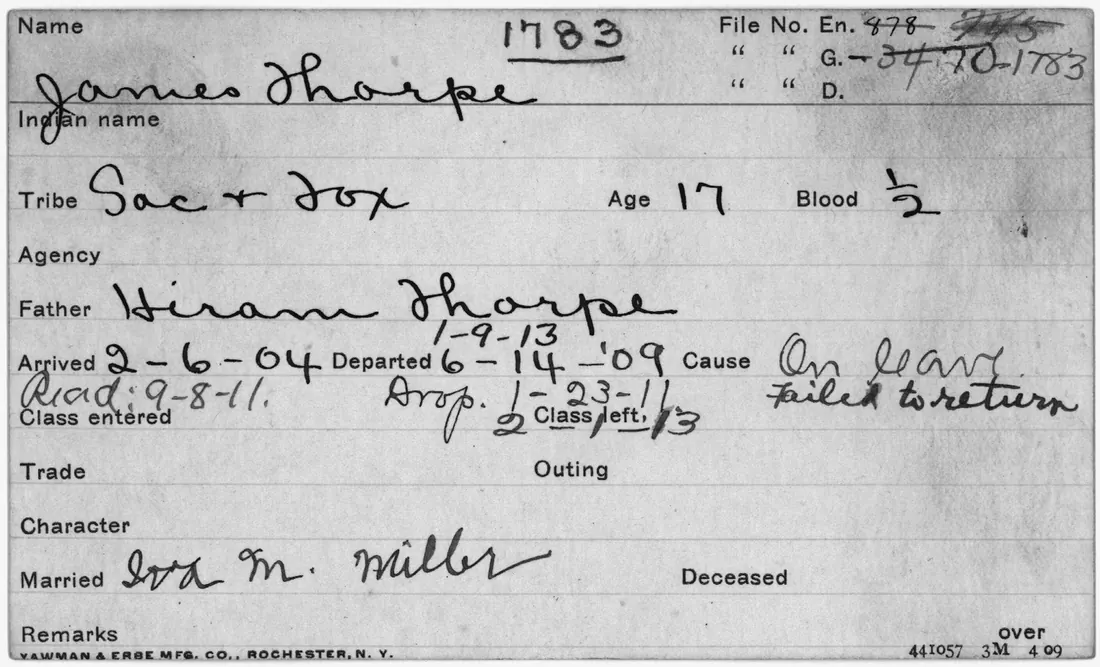
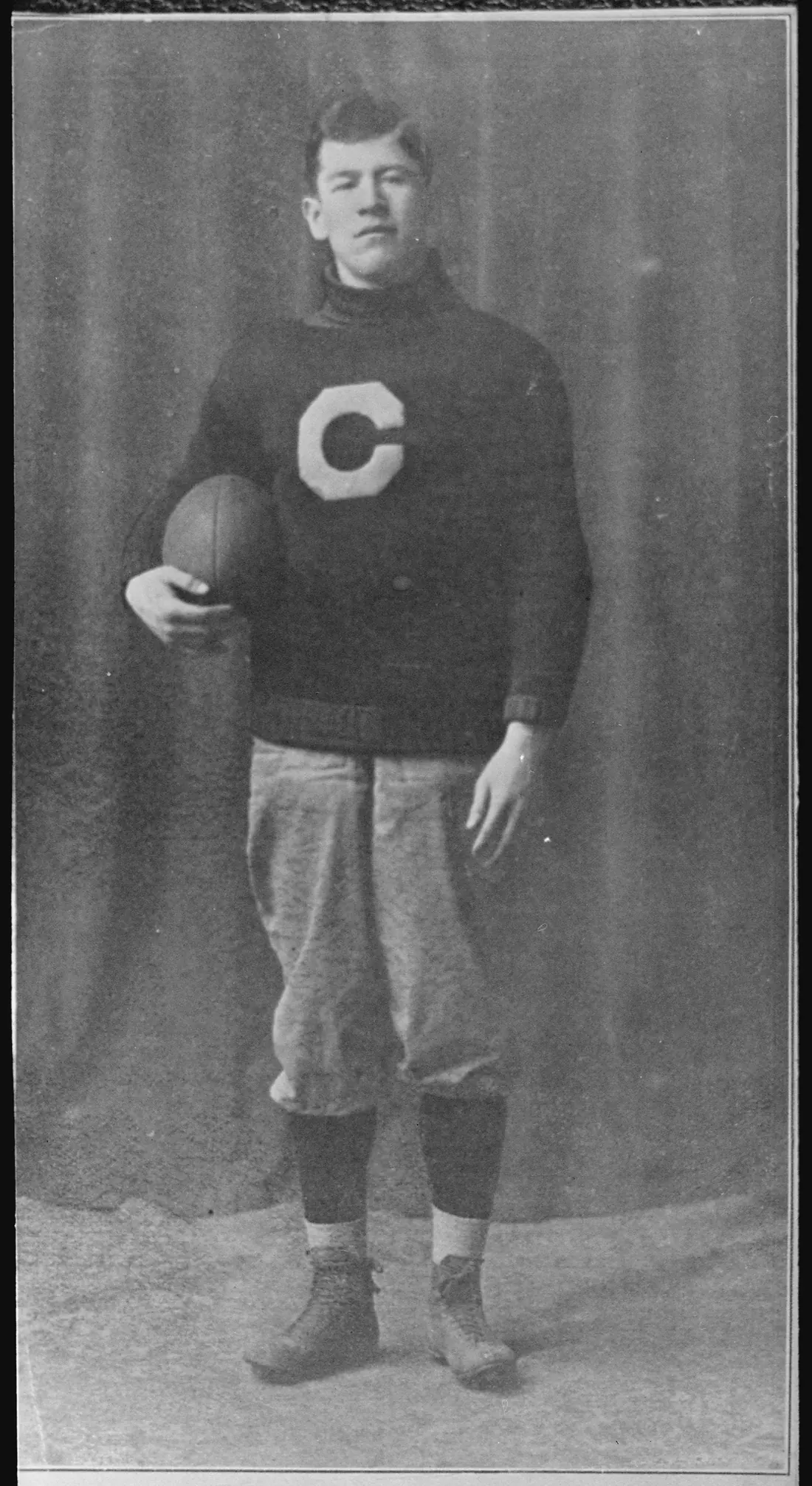
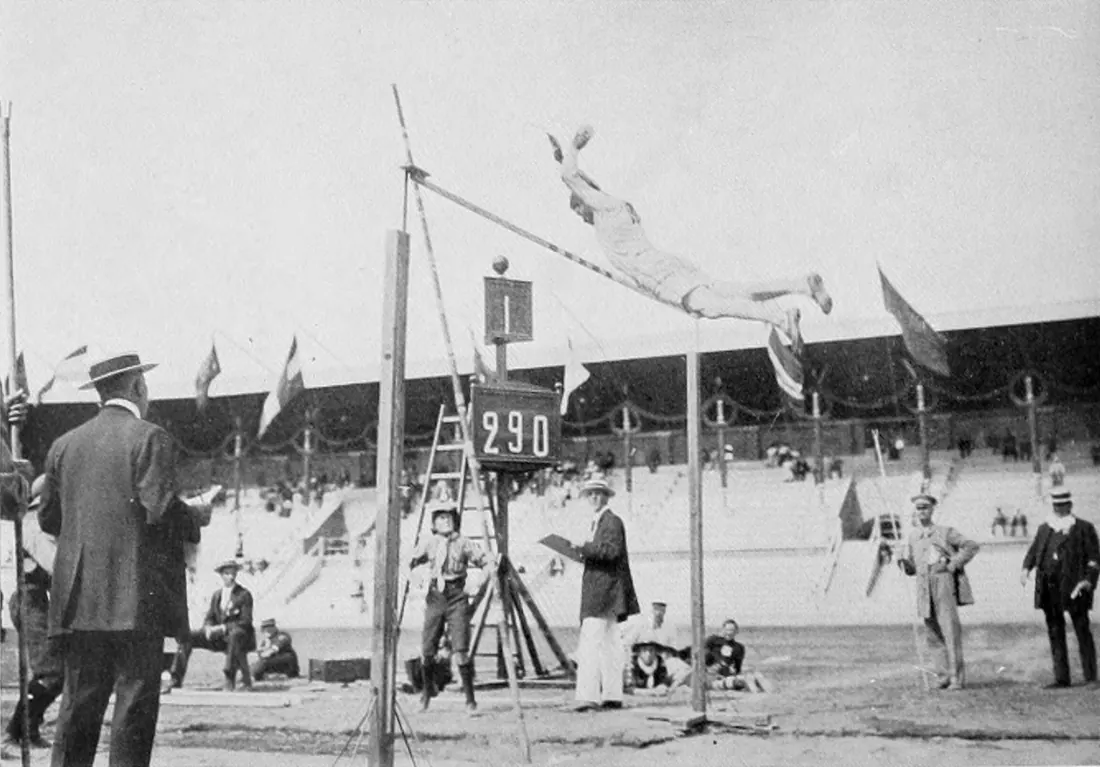
Jim Thorpe was a citizen of the Sac and Fox Nation; his Carlisle Indian School student card gives his tribe as “Sac & Fox.” At the 1912 Olympics in Stockholm, his shoes went missing before he was due to compete. Reportedly, he found a mismatched pair of replacements, one of them from a trash can, and a photo from Stockholm shows him in shoes and socks that don’t match.
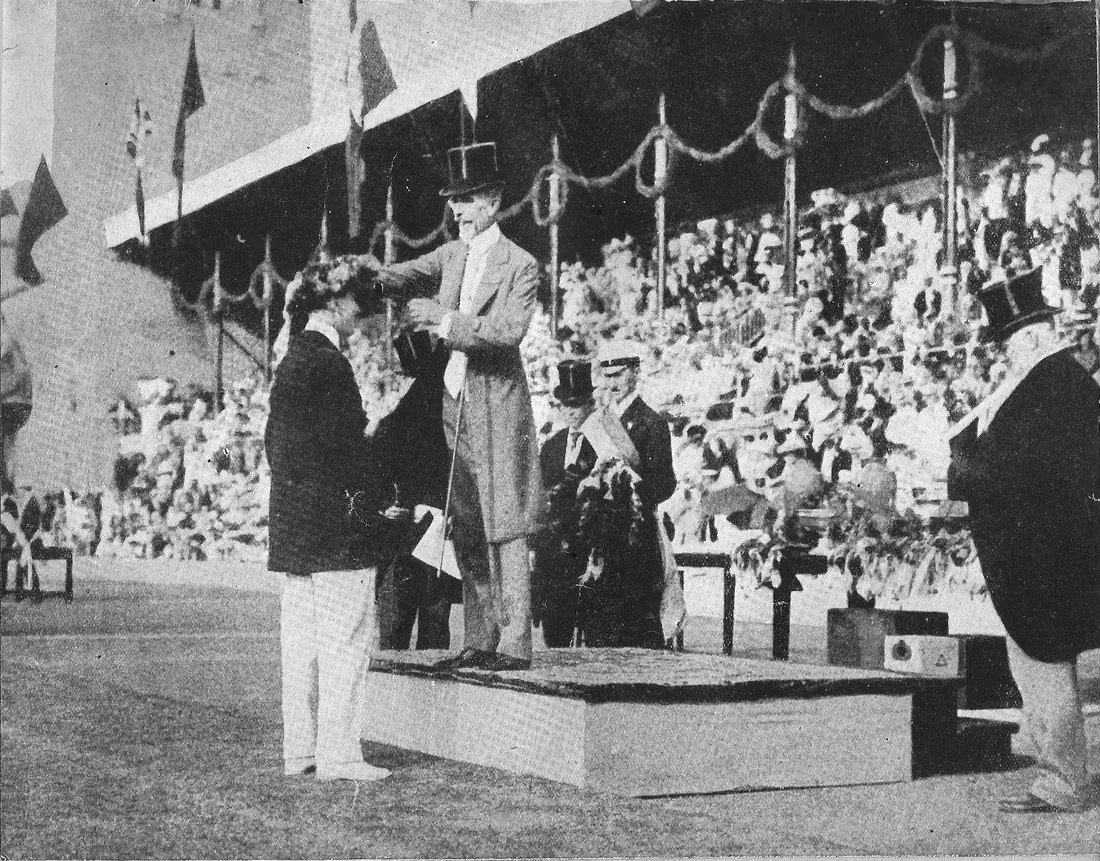
He won the pentathlon on July 7, and then the decathlon, by 688 points. King Gustaf V of Sweden told him he was the greatest athlete in the world.
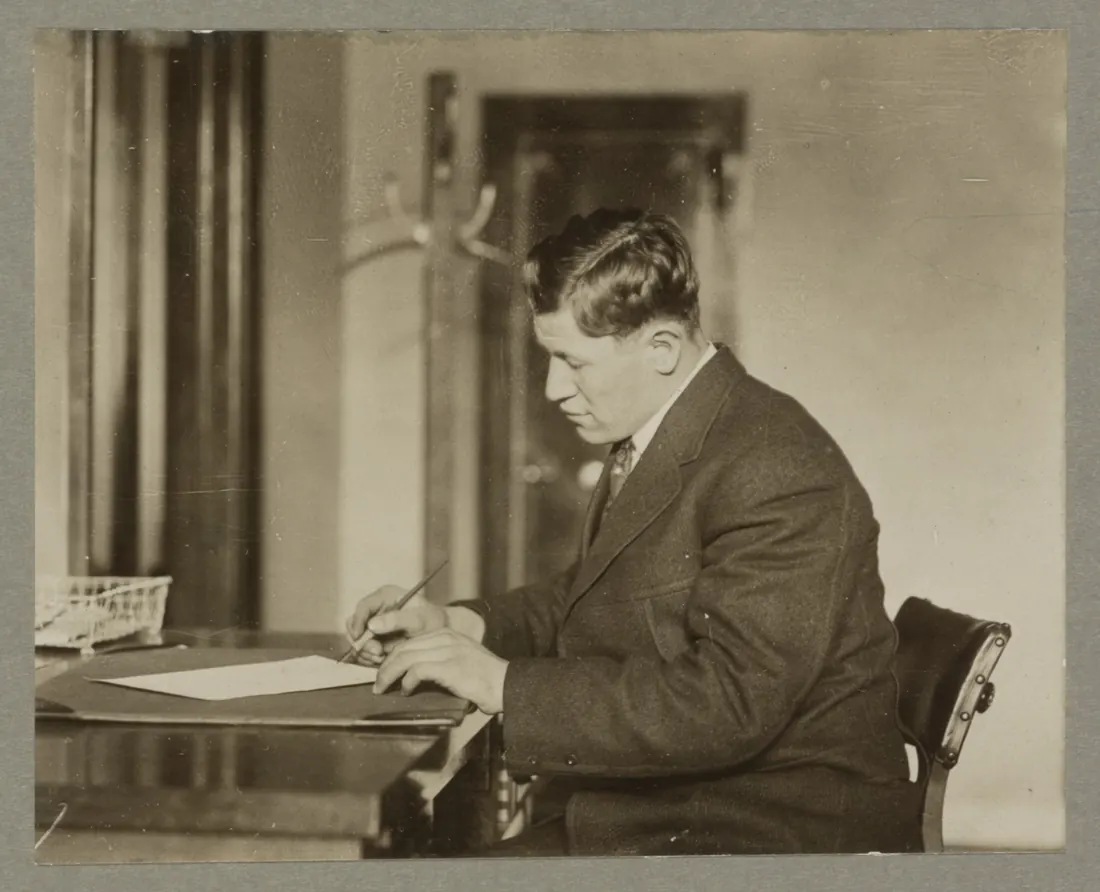
But in 1913 it came out that in 1909 and 1910 he had been paid to play minor-league baseball in Rocky Mount, North Carolina, for a few dollars a game. A letter to the Amateur Athletic Union, in his hand, pleaded that he had been just an Indian schoolboy who didn’t know better. It didn’t help. The International Olympic Committee stripped him of his Olympic titles and medals. Even the runners-up, Hugo Wieslander in the decathlon and Ferdinand Bie in the pentathlon, refused to accept his gold.
Thorpe went on to play professional baseball and football and was named the first president of the league that became the NFL. But he lived his last years in failing health and poverty, and he died in 1953, still without his titles. In October 1982 the IOC restored him, but only as co-champion with Bie and Wieslander. In July 2022, 110 years after Stockholm, the IOC reinstated him as the sole winner of both events.
Fact check
The facts and where they come from
- He was “A citizen of the Sac and Fox Nation” (Wikipedia); his Carlisle Indian School student card gives his tribe as “Sac & Fox.” 12
- At the 1912 Stockholm Olympics he won the pentathlon on July 7: “The first competition was the pentathlon on July 7 … Thorpe won the gold medal” (Wikipedia). 1
- His shoes went missing before he competed: “someone had stolen his shoes just before he was due to compete” (Wikipedia, citing Dodge 2013); “Thorpe’s shoes went missing from his duffel before his track events, and he had to scrounge replacements” (American Indian Magazine, 2012). 13
- Reportedly, he competed in odd shoes, one pulled from the trash: “he found a mismatched pair of replacements, including one from a trash can, and won the gold medal wearing them” (Wikipedia); “One was lent by a fellow competitor, and one he found in the trash” (American Indian Magazine). A 1912 Stockholm photo shows him in mismatched shoes and socks. 134
- He won the decathlon too, by 688 points: “Thorpe, however, defeated Wieslander by 688 points” (Wikipedia); Hugo Wieslander finished “688 points behind Jim Thorpe.” 15
- King Gustaf V of Sweden told him he was the greatest athlete in the world. The wording differs: “You, sir, are the greatest athlete in the world” (Wikipedia, which says “the compliment from King Gustav is confirmed in the September 1912 publication of The Red Man”); “Sir, you are the greatest athlete in the world” (AP); “Sir, you are now the greatest athlete in the world” (American Indian Magazine). 173
- In 1913 it came out that he had been paid a few dollars a game to play baseball in 1909 and 1910, at Rocky Mount, North Carolina. Wikipedia: “In late January 1913, the Worcester Telegram reported that Thorpe had played semi-professional baseball … in 1909 and 1910, receiving meager pay; reportedly as little as US$2 … per game and as much as US$35 … per week.” American Indian Magazine: “Thorpe had earned $5 a game.” The AP: “paid to play minor league baseball over two summers.” 137
- His letter to the AAU, in his hand, pleaded that he was just an Indian schoolboy who didn’t know better (paraphrased). American Indian Magazine: “The next day, Thorpe signed a letter admitting the charge.” 13
- They took his medals anyway. The AAU withdrew his amateur status, and, in Wikipedia’s words, “His letter did not help … the International Olympic Committee (IOC) unanimously decided to strip Thorpe of his Olympic titles, medals and awards.” 1
- Even the runners-up refused to take his gold. Hugo Wieslander, second in the decathlon, was “awarded the gold medal, which he refused to accept”; “Bie was declared Olympic champion, but refused to accept the gold medal from the IOC”; Wieslander refused “as he felt that Thorpe was the legitimate owner.” 561
- He died poor on March 28, 1953, in Lomita, California, still without his titles: he “lived his last years in failing health and poverty”; “He ran out of money sometime in the early 1950s”; “He died on March 28 at the age of 65” (Wikipedia). 1
- In 1982 the IOC restored him, but only as co-champion: “In October 1982, the IOC Executive Committee approved Thorpe’s reinstatement … they declared that Thorpe was co-champion with Ferdinand Bie and Hugo Wieslander” (Wikipedia). The AP: “In 1982 — 29 years after Thorpe’s death — the IOC gave duplicate gold medals to his family but his Olympic records were not reinstated.” The commemorative medals went to his children in January 1983. 17
- In July 2022, 110 years after Stockholm, he was named sole champion of both events again. The AP: “Jim Thorpe has been reinstated as the sole winner of the 1912 Olympic pentathlon and decathlon in Stockholm,” announced “on the 110th anniversary of Thorpe winning the decathlon” (July 15, 2022). Wikipedia: “the IOC voted to reinstate Thorpe as the sole winner of both events on July 14, 2022.” 71
- He went on to play pro baseball and football and was the first president of the league that became the NFL: “Thorpe was nominally their first president” (Wikipedia); “In 1920, when the National Football League was organized, the charter members named Thorpe league president” (Pro Football Hall of Fame). 18
Sources
- Jim Thorpe Wikipedia
- Student Information Card for Jim Thorpe (National Archives 595341) Wikimedia Commons
- The Jim Thorpe Backlash: The Olympic Medals Debacle and the Demise of Carlisle American Indian Magazine (Smithsonian National Museum of the American Indian), Summer 2012
- Jim Thorpe at the 1912 Summer Olympics (Agence Rol) Wikimedia Commons
- Hugo Wieslander Wikipedia
- Ferdinand Bie Wikipedia
- Jim Thorpe reinstated as sole winner for 1912 Olympic golds New Hampshire Public Radio (Associated Press), July 15, 2022
- Jim Thorpe Pro Football Hall of Fame
Notes
The shoes: the story comes from secondary sources (Dodge 2013, cited by Wikipedia; American Indian Magazine, 2012), and they differ: one shoe from a trash can and one lent by a competitor, or both found. The photo of his mismatched shoes and socks is real. We say “reportedly,” and that the shoes went missing, not that they were stolen.
The King’s words differ from source to source (“You, sir, are…,” “Sir, you are…,” “Sir, you are now…”), so we paraphrase. Thorpe’s famous reply, “Thanks, King,” first appeared in newspapers in 1948, and his biographer Kate Buford doubts it (Wikipedia); left out.
The pay: $2 a game (Wikipedia), $5 a game (American Indian Magazine), up to $35 a week; the History News Network says “the exact amount isn’t clear.” We say a few dollars a game.
When the story broke: late January 1913 (Wikipedia), or early January in the Worcester Telegram, with national coverage weeks later (American Indian Magazine). We say 1913.
The letter: a sworn statement made about a year later by his friend and fellow student Gus Welch says Pop Warner wrote it and Thorpe copied it out in his own hand, to protect Warner and the school’s superintendent, Moses Friedman (“Jim was not really the author of it”). So we say his letter pleaded, not that he did.
1982 or 1983: the IOC decided in October 1982 and presented the medals in January 1983. The Pro Football Hall of Fame page says “1992,” an error.
Wieslander’s medal: Wikipedia also says he later “was uncomfortable with keeping the 1912 gold medal” and gave it to a museum in 1951; the AP says his family and the Swedish Olympic Committee say he never accepted it. We say only that the runners-up refused to accept his gold.
His NFL presidency was nominal (Wikipedia), so we say he was named president. His birthplace and birth date (May 22 or 28, 1887, in what was then Indian Territory, not “Oklahoma Territory,” which didn’t exist until 1890) are not used.
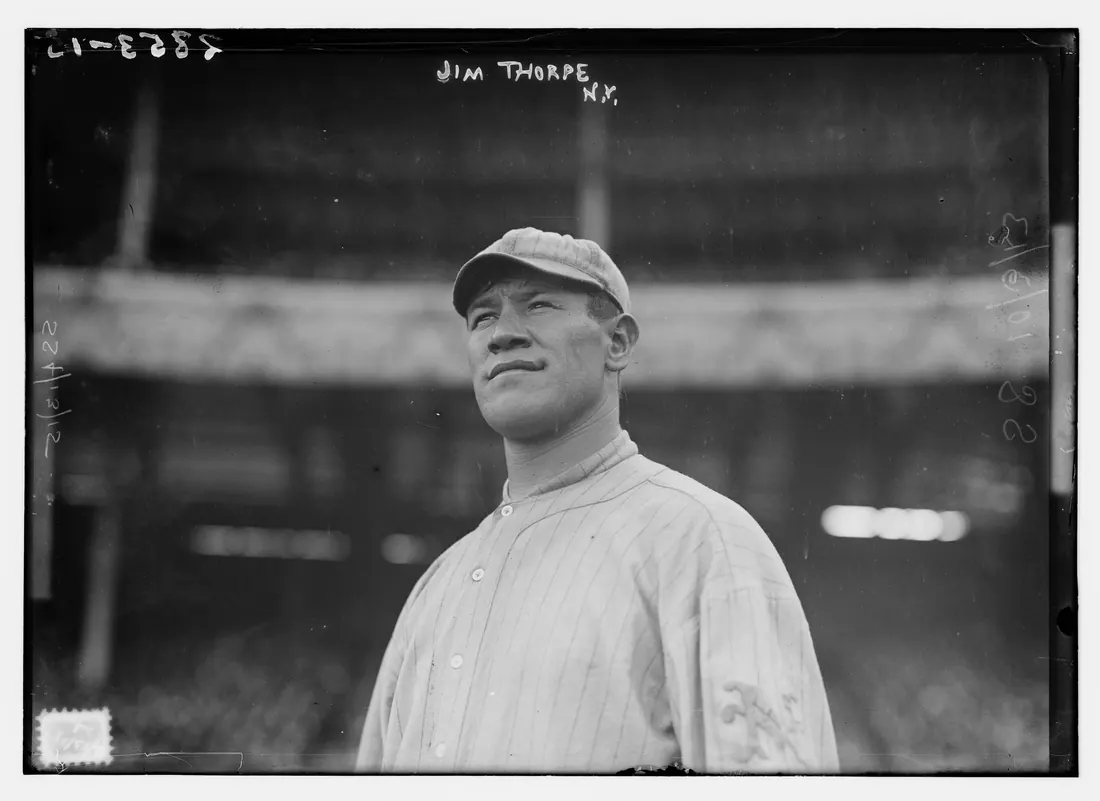
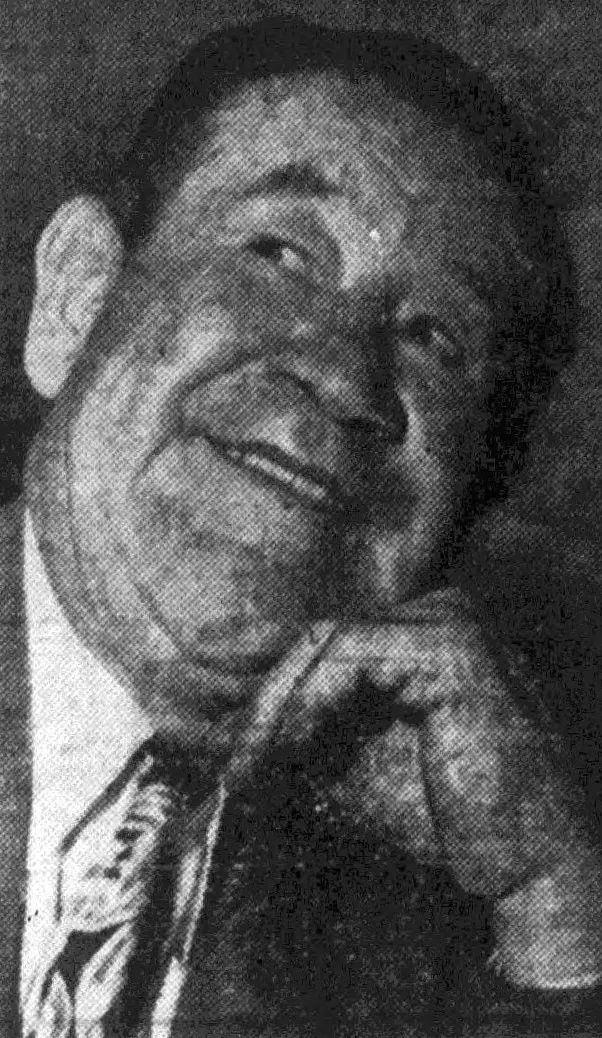
Photos: the baseball photo shows Thorpe with the New York Giants in 1913, not the 1909–1910 games, of which no photo was found. The 1913 desk photo isn’t known to show the letter. The photo of King Gustaf V shows the 1912 prize-giving, but the athlete being crowned isn’t identified, so we never call him Thorpe. The Stockholm photo’s date on Wikimedia Commons (July 23, 1912) is the print’s.
Photo credits
The archive photos in this story
The photographs and illustrations in this story are in the public domain or shared under open licenses; each one is credited below with its license. Tap one to enlarge it, or follow the link to its Wikimedia Commons page for the full record. The narration, music, captions and graphics in the Short are our own.