
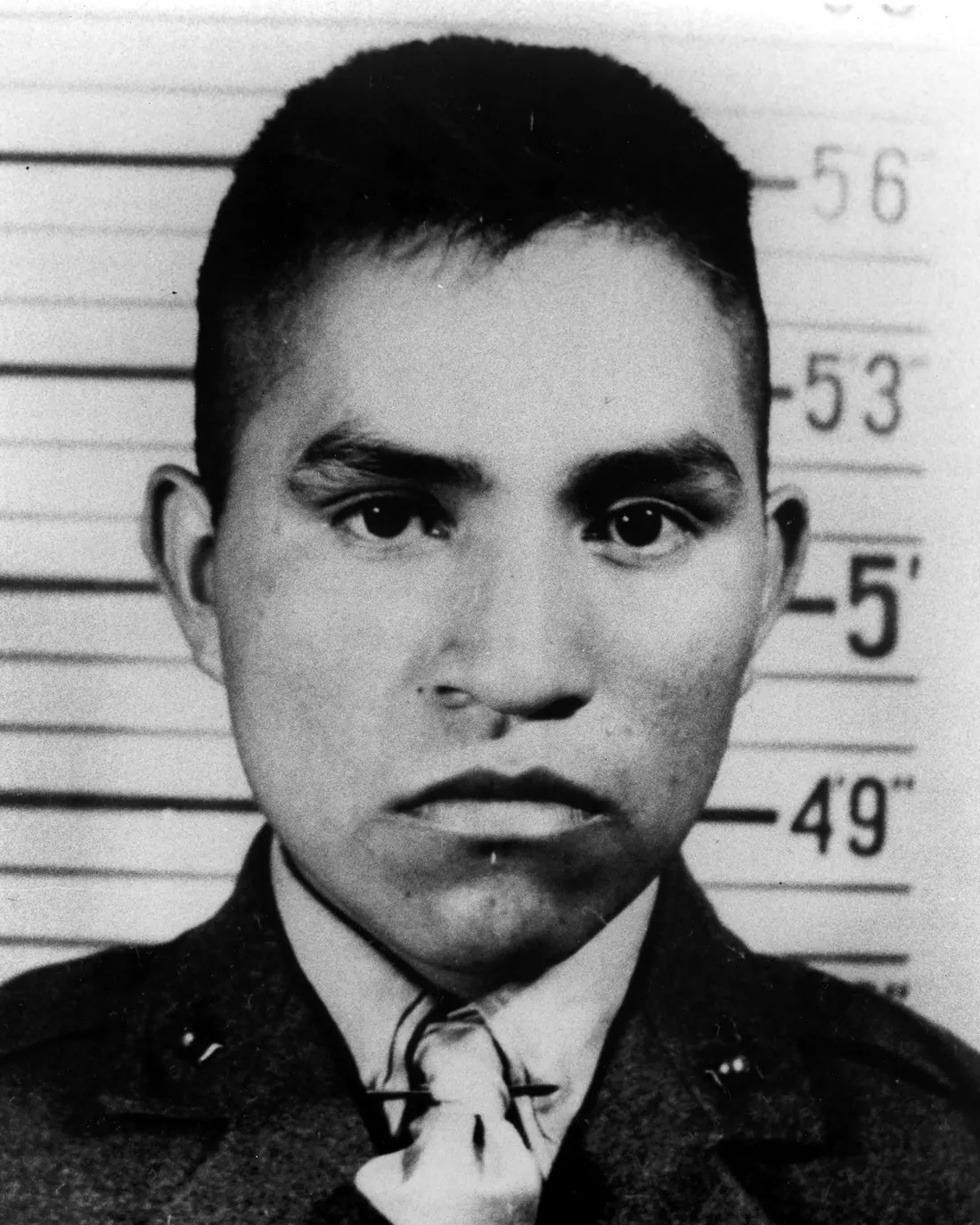
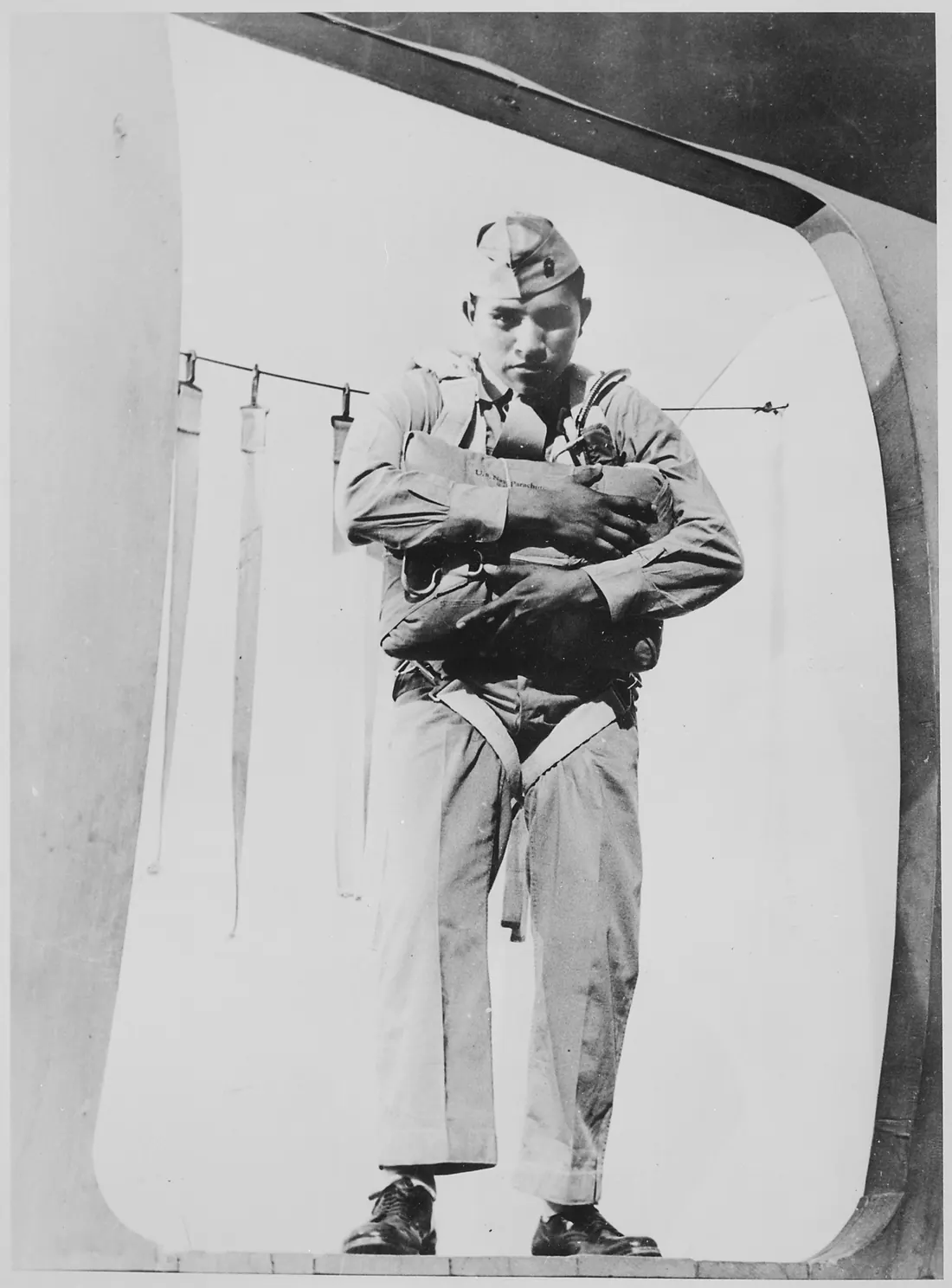
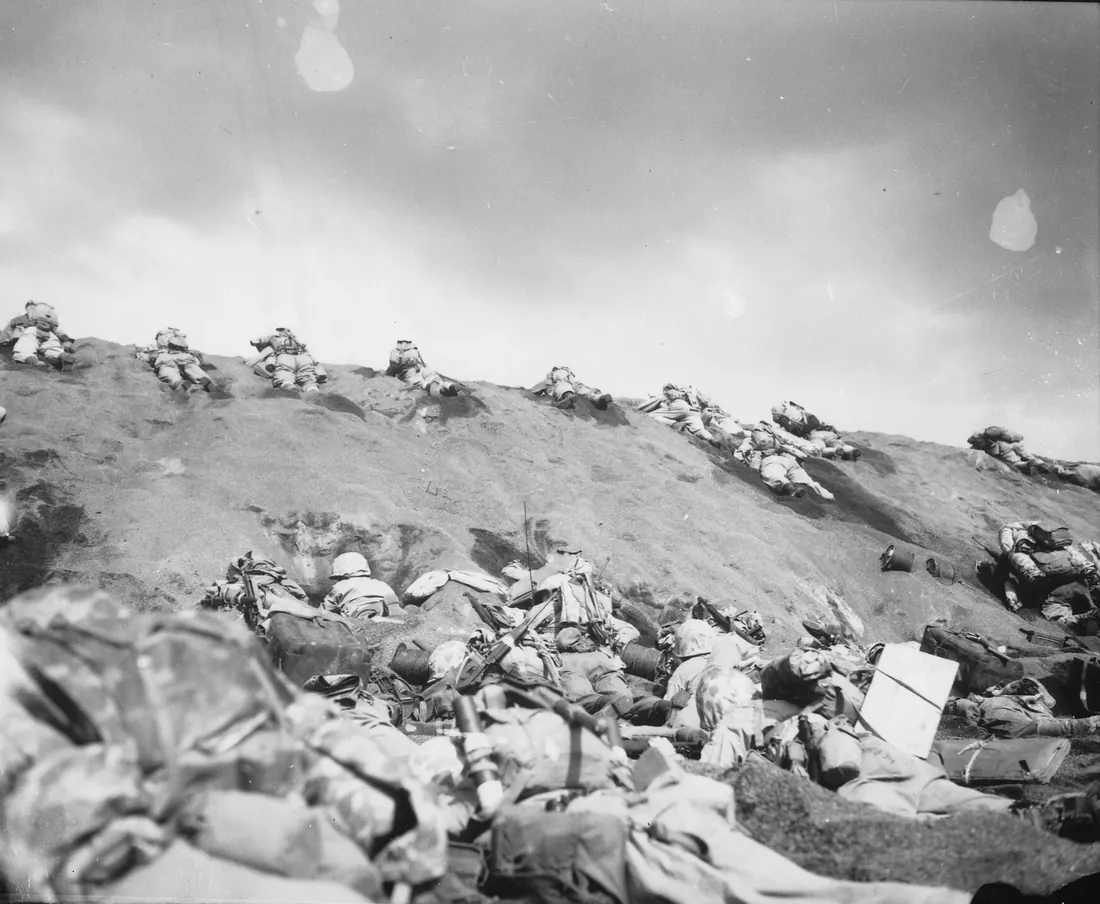
Ira Hayes was a Pima Indian, born at Sacaton, Arizona, on January 12, 1923. In the Marine Corps he was assigned to the Parachute Training School at Camp Gillespie, and on November 30, 1942, he qualified as a parachutist. With Company E, 2nd Battalion, 28th Marines, of the 5th Marine Division, he landed on Iwo Jima on D-day, February 19, 1945.
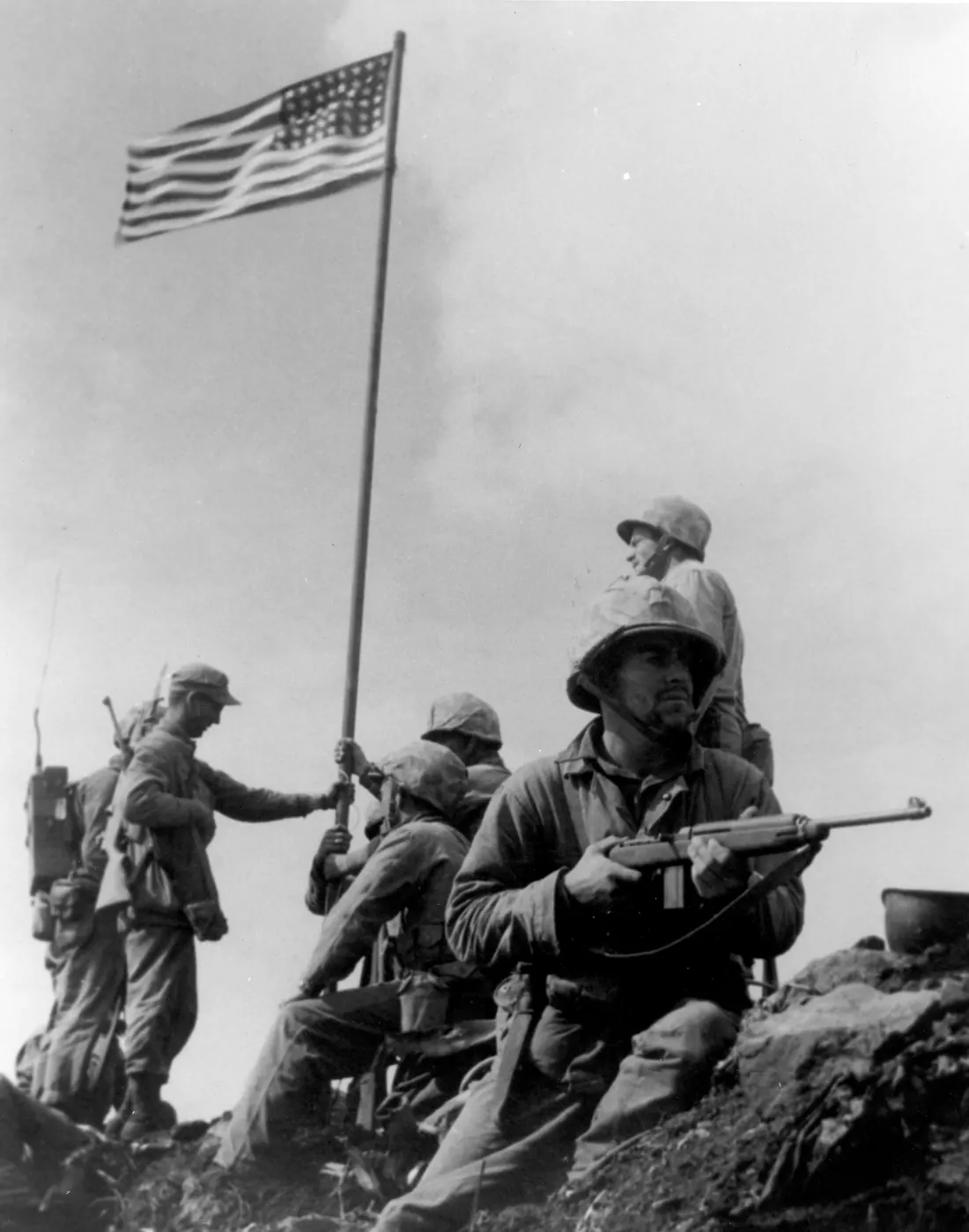
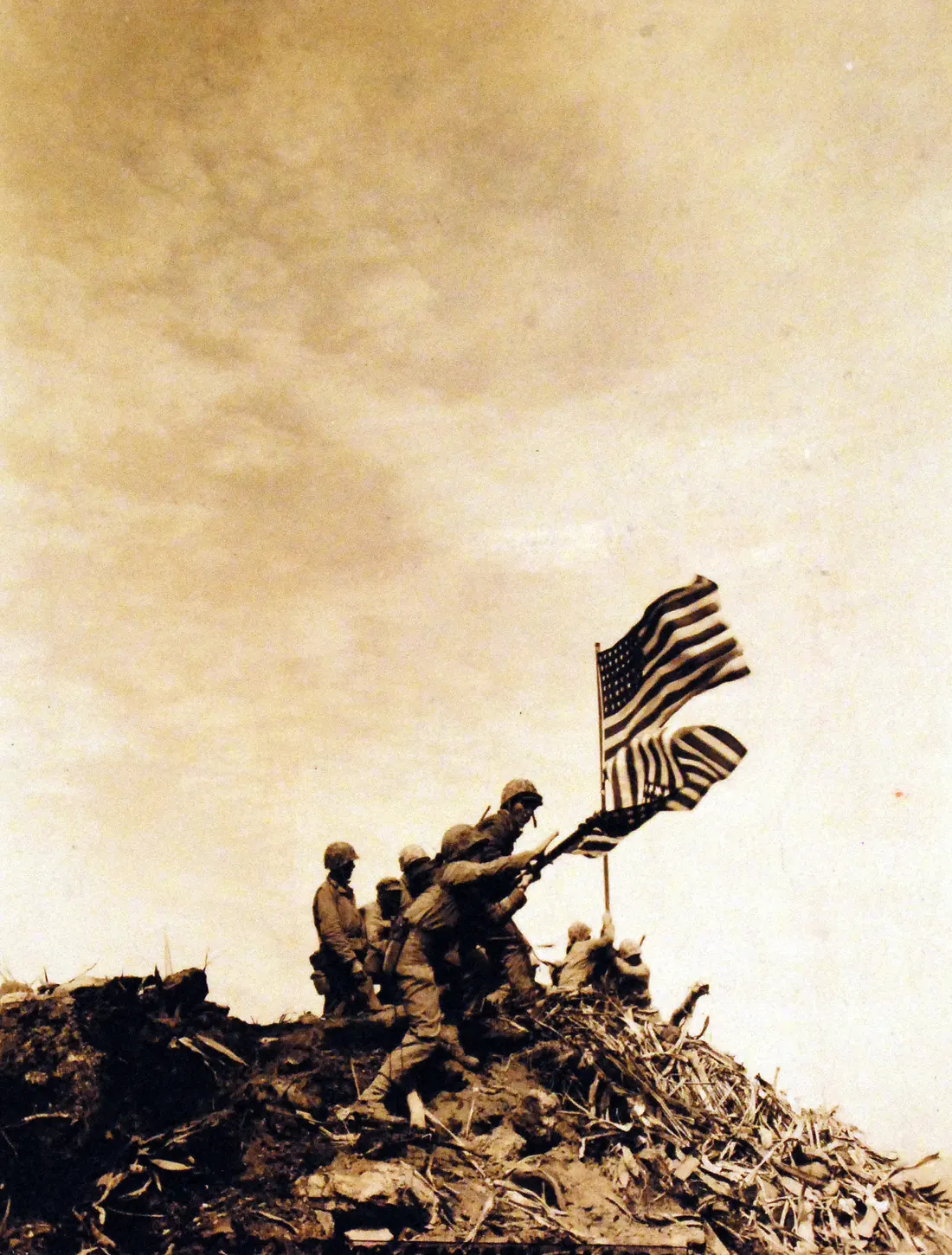
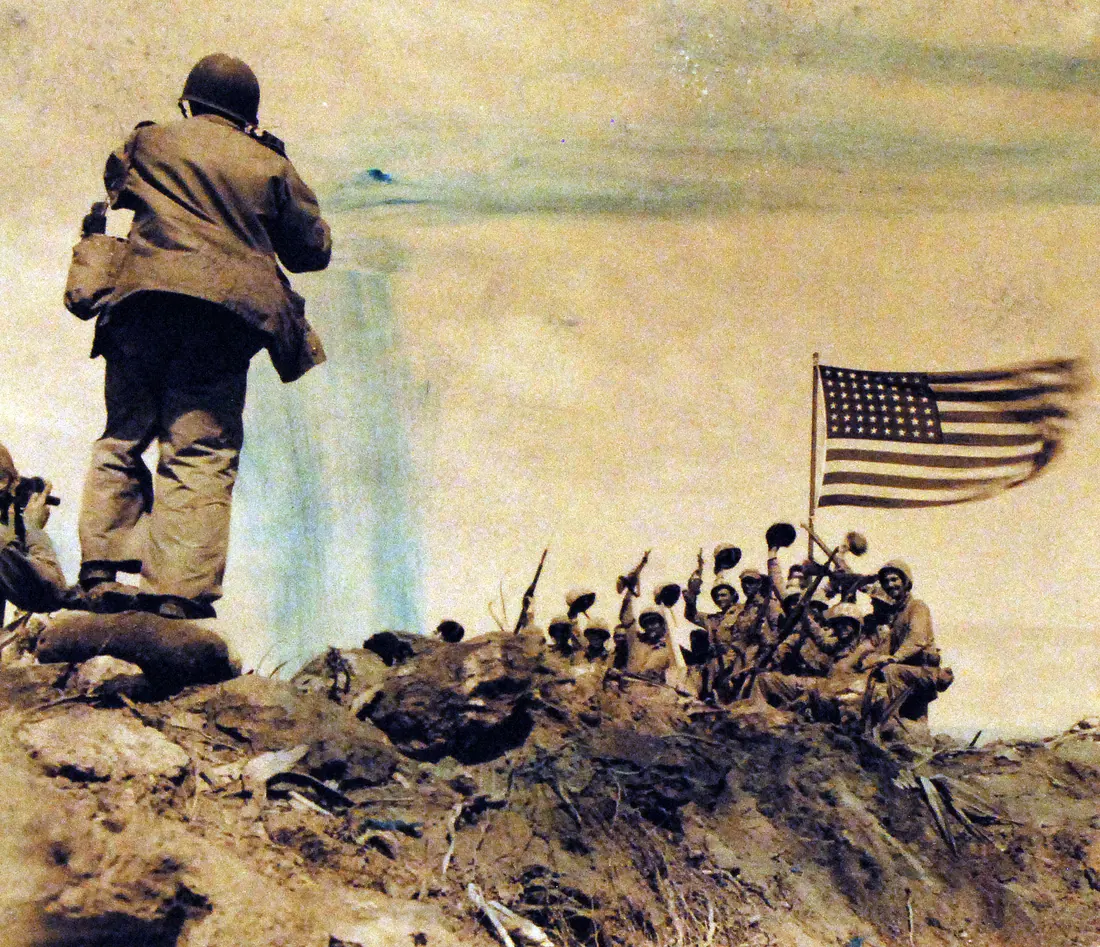
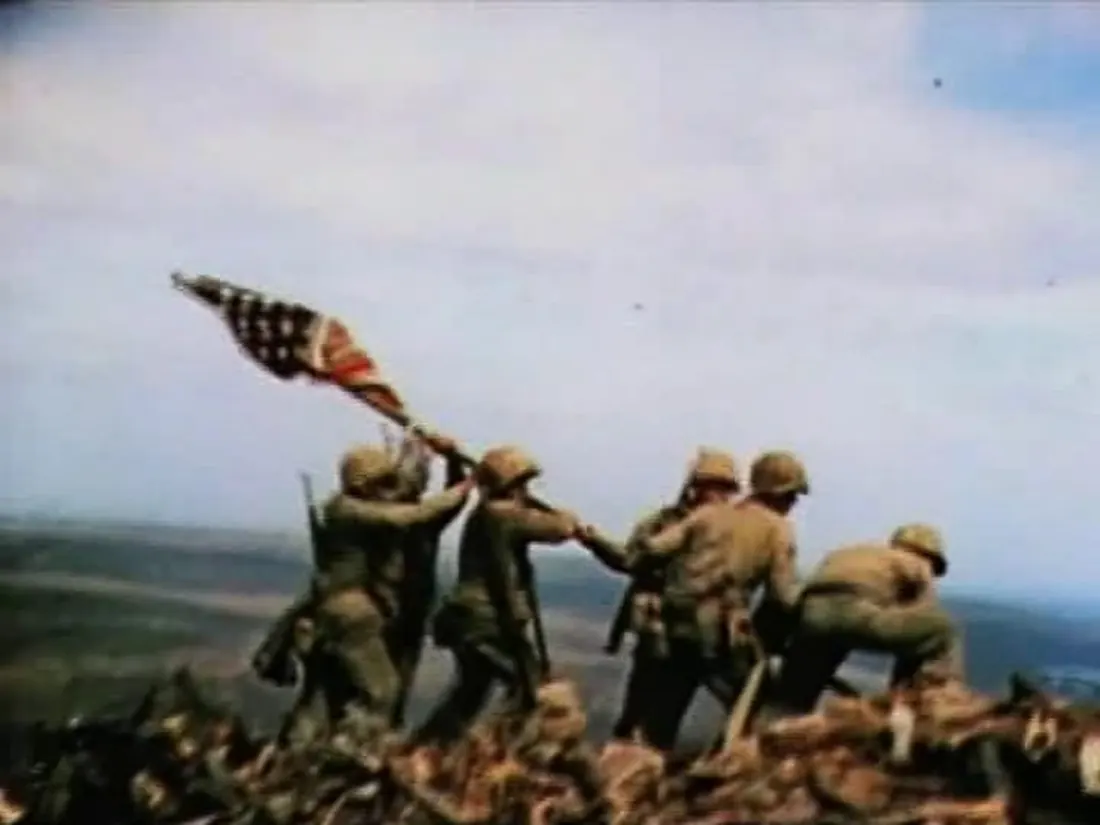
On the morning of February 23, Marines of Company E climbed Mount Suribachi, and at about 10:30 a.m. men all over the island were thrilled by the sight of a small American flag flying from the top. That afternoon, when the slopes were clear of enemy resistance, a second, larger flag was raised in the same place, and Hayes was one of the six men who raised it. Joe Rosenthal of the Associated Press caught the moment in a photograph that eventually won a Pulitzer Prize. Within a month three of the six were dead: Sgt. Michael Strank and Cpl. Harlon Block were killed on March 1, and Pfc. Franklin Sousley on March 21.
Hayes boarded a plane for the United States on April 15, and on May 10 he left on a war bond tour. The men on the tour “were lionized from coast to coast,” Time reported, but “Ira Hayes, a shy and bewildered Pima Indian, found the hero’s role hard to play.” In 1946 he visited Harlon Block’s father, Ed, in Weslaco, Texas, and told him that his son was indeed in the photograph. He reportedly walked and hitchhiked 1,300 miles from the Gila River Indian Community in Arizona to get there.
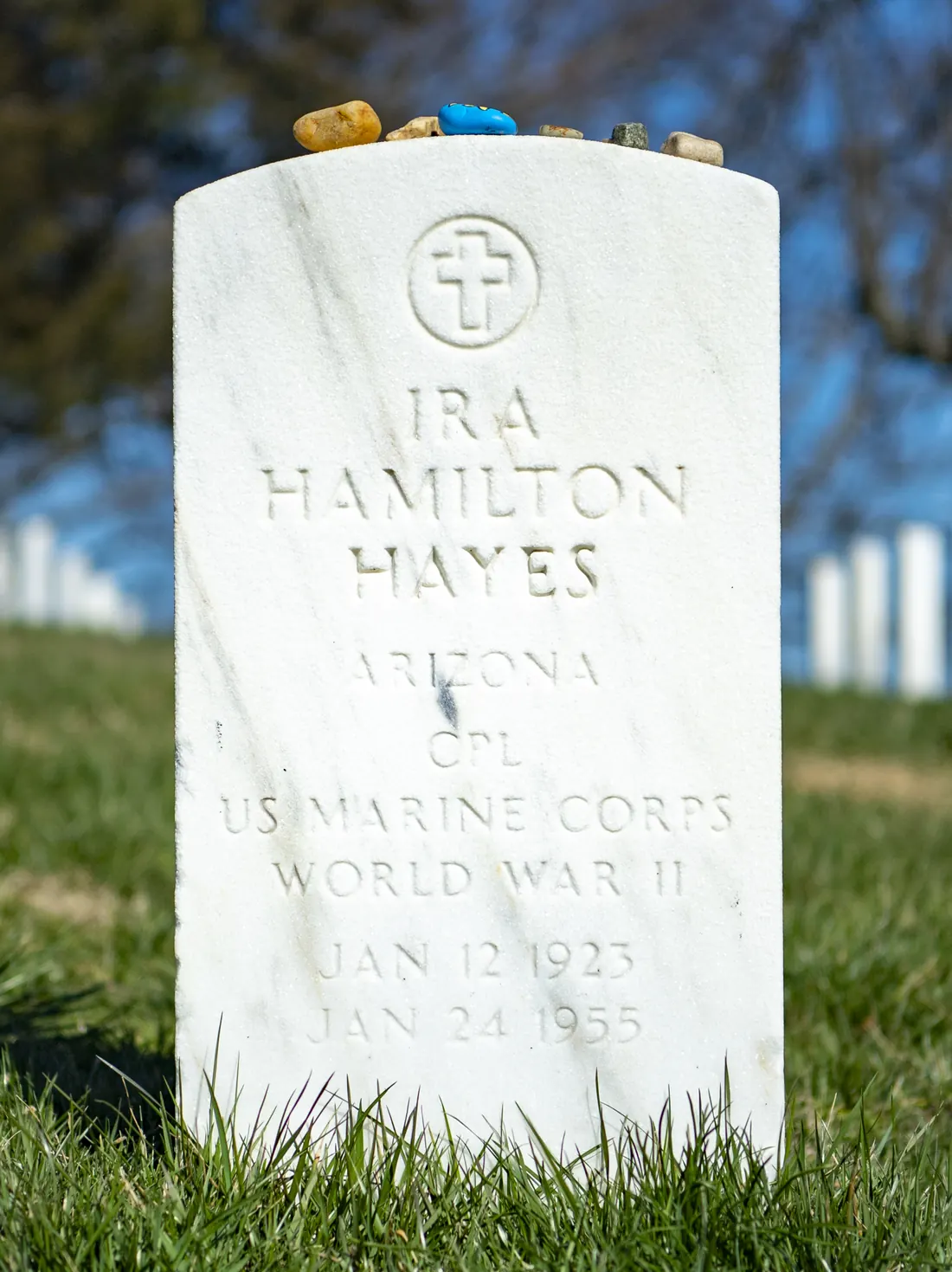
Increasingly, Time wrote, he “sought escape in drinking, drifted from job to job.” After the war he said: “I was sick. I guess I was about to crack up thinking about all my good buddies. They were better men than me and they’re not coming back. Much less back to the White House, like me.” On the morning of January 24, 1955, he was found dead near an abandoned adobe hut close to where he lived, at Bapchule. Time reported that he “was found frozen on the sand,” and the Pinal County coroner concluded that he had died of exposure and alcohol poisoning. He was 32.
He was buried at Arlington National Cemetery on February 2, 1955. He had posed for the sculptor of the Marine Corps War Memorial, and on it he is the bronze figure farthest from the flagpole, with both hands reaching up. Said a Phoenix policeman who had arrested him many times: “He was a hero to everyone but himself.”
Fact check
The facts and where they come from
- He helped raise the flag on Iwo Jima, but he never felt like a hero. The National Park Service lists “Private First Class Ira Hayes” among the six flag raisers. Time: “Ira Hayes, a shy and bewildered Pima Indian, found the hero’s role hard to play.” Department of Defense: “But Ira didn’t feel pride.” USA Today: the picture “transformed a troubled Indian kid into an unwilling national celebrity.” 2347
- His name was Ira Hayes, a Pima Marine. US Marine Corps History Division: he “was a Pima Indian, born at Sacaton, Arizona, on 12 January 1923.” 1
- A shy Pima from Arizona, he became a Marine paratrooper. Time: “a shy and bewildered Pima Indian.” US Marine Corps History Division: “Hayes was assigned to the Parachute Training School at Camp Gillespie”; “the Arizonan was qualified as a parachutist on 30 November” 1942. 31
- In 1945, his company landed on Iwo Jima. US Marine Corps History Division: “Hayes was transferred to Company E, 2d Battalion, 28th Marines, of the 5th Marine Division”; “he landed on D-day (19 February 1945).” 1
- On February 23, Marines raised a small flag on Mount Suribachi. National Park Service: “On the morning of February 23, Marines of Company E, 2nd Battalion, started the tortuous climb up the rough terrain to the top. At about 10:30 am men all over the island were thrilled by the sight of a small American flag flying from atop Mount Suribachi.” 2
- That afternoon, Hayes and five others raised a bigger one. National Park Service: “That afternoon, when the slopes were clear of enemy resistance, a second, larger flag was raised in the same location”; “Thus the six flag raisers were Corporal Harlon Block, Corporal Harold P. Keller, Private First Class Ira Hayes, Private First Class Harold Schultz, Private First Class Franklin Sousley, and Sergeant Michael Strank.” 2
- A photo of that moment won a Pulitzer Prize. National Park Service: “Joe Rosenthal of the Associated Press caught the afternoon flag-raising in an iconic photograph that eventually won a Pulitzer Prize.” 2
- Within a month, three of the six were dead. Time: “Three of the six flag-raisers were killed in the battle for Iwo Jima.” Wikipedia: “Sgt. Strank and Cpl. Block were killed on Iwo Jima on March 1, and PFC Sousley was killed on March 21,” 26 days after the flag raising. 35
- He was flown home to sell war bonds as a hero. US Marine Corps History Division: “he boarded a plane for the U.S. on 15 April”; “On 10 May, Hayes, Private First Class Gagnon, Pharmacist’s Mate Second Class Bradley … left on the bond selling tour.” Time: “Hayes and the other two survivors were ordered back to the U.S. by President Roosevelt. They were lionized from coast to coast.” 13
- He said, “They were better men than me and they’re not coming back.” The Department of Defense and Wikipedia: “I was sick. I guess I was about to crack up thinking about all my good buddies. They were better men than me and they’re not coming back. Much less back to the White House, like me.” 45
- He reportedly hitchhiked 1,300 miles to tell a fallen Marine’s father his son was in that photo. Wikipedia: “In May 1946, Hayes walked and hitchhiked 1,300 miles from the Gila River Indian Community in Arizona to the farm of Edward Frederick Block, Sr., in Weslaco, Texas, to reveal the truth to Block’s parents about their son Harlon being in Rosenthal’s flag raising photograph.” Texas Co-op Power: “Ira Hayes, a surviving flag raiser, visited Harlon’s father, Ed Block, in Weslaco and told him that his son was indeed in the photograph.” But Wikipedia, on the book Shadow of Suribachi: “The authors do not mention Hayes hitchhiking to Texas to tell them the truth, a feature of other Hayes biographies.” 568
- He turned to drinking. Time: “Increasingly, he sought escape in drinking, drifted from job to job.” Wikipedia: “After the war, Hayes suffered from post-traumatic stress disorder and descended into alcoholism.” 35
- In January 1955, they found him frozen near his home. Time: “Early the next morning he was found frozen on the sand.” Wikipedia: “On the morning of January 24, 1955, Hayes was found dead lying near an abandoned adobe hut near where he lived”; “The Pinal County coroner concluded that Hayes’s death was caused by exposure and alcohol poisoning.” US Marine Corps History Division: “The former Marine died at Bapchule on 24 January 1955.” 351
- He was 32. Time: “flabby and sad-eyed at 32.” The Marine Corps History Division gives his birth as January 12, 1923, and his death as January 24, 1955, the dates on his gravestone. 31
- A policeman said, “He was a hero to everyone but himself.” Time: “Said a Phoenix policeman, who had arrested Hayes many times: ‘He was a hero to everyone but himself.’” 3
- He is the bronze figure reaching for the flag on the Marine Corps War Memorial, and he is buried at Arlington. National Park Service: “Rene Gagnon, Ira Hayes, and John Bradley posed for the sculptor as he modeled their faces in clay”; “Ira Hayes is the figure farthest from the flagpole with both hands reaching up.” The Marine Corps History Division: buried at Arlington on February 2, 1955. 21
Sources
- Who’s Who in Marine Corps History: Corporal Ira Hamilton Hayes, USMCR (archived copy) US Marine Corps History Division
- History of the Marine Corps War Memorial National Park Service, George Washington Memorial Parkway
- Then There Were Two (February 7, 1955; archived copy) Time
- Iwo Jima Flag Raiser (archived copy) US Department of Defense
- Ira Hayes Wikipedia
- A Texan at Iwo Jima Texas Co-op Power
- Iwo Jima flag raiser’s body ‘was never sent to rest’ (USA Today, April 12, 2009) History News Network
- Shadow of Suribachi Wikipedia
Notes
Joe Rosenthal’s Associated Press photograph isn’t shown on this page. The flag raisings are shown in US Marine Corps photos by SSgt. Louis R. Lowery (the first flag) and Pfc. Bob Campbell (the second flag going up, and Marines cheering under it, with Rosenthal himself in the left foreground), and in a frame of Sgt. Bill Genaust’s Marine Corps color film of the second raising.
The hitchhike: Hayes’s 1946 visit to Ed Block in Weslaco is in Wikipedia and Texas Co-op Power, but the 1,300-mile hitchhike comes from biographers and isn’t in every book (Shadow of Suribachi leaves it out), so we say “reportedly.” Hayes also confirmed it to Block’s mother by letter in July 1946.
Who was in the photo: the two men who toured with Hayes, Rene Gagnon and John Bradley, were later found not to be in it, Bradley in 2016 and Gagnon in 2019 (National Park Service); Hayes was always correctly identified.
“I wish that guy had never made that picture”: this quote appears only on the archived Defense Department page, which also has two errors (it says three men were killed while raising the flag, and that he died at 33). We leave it out.
His death: his brother Kenneth believed he died after a fight, and there was no autopsy (Wikipedia); we leave it out. His arrests: 51 (Time) or 52 (Wikipedia); we give no number.
“Flown home”: he was flown from Hawaii to Washington, not to Arizona; we mean home to the United States.
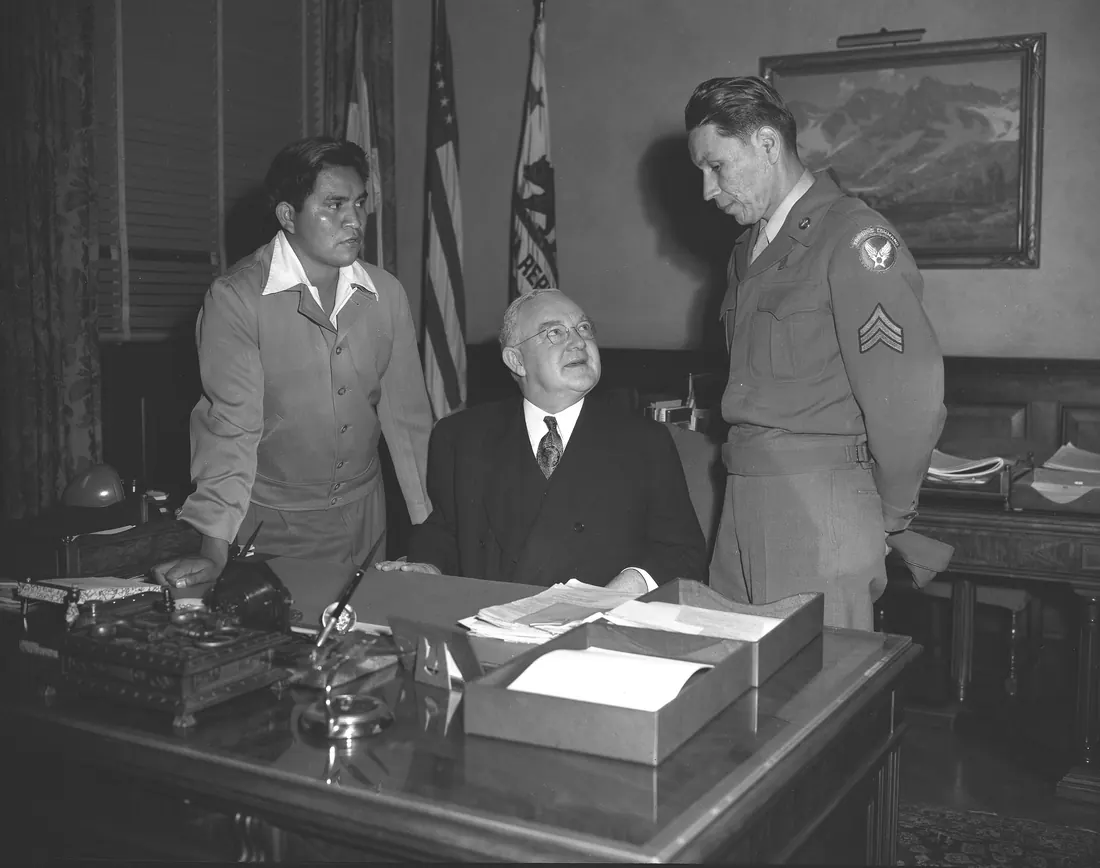
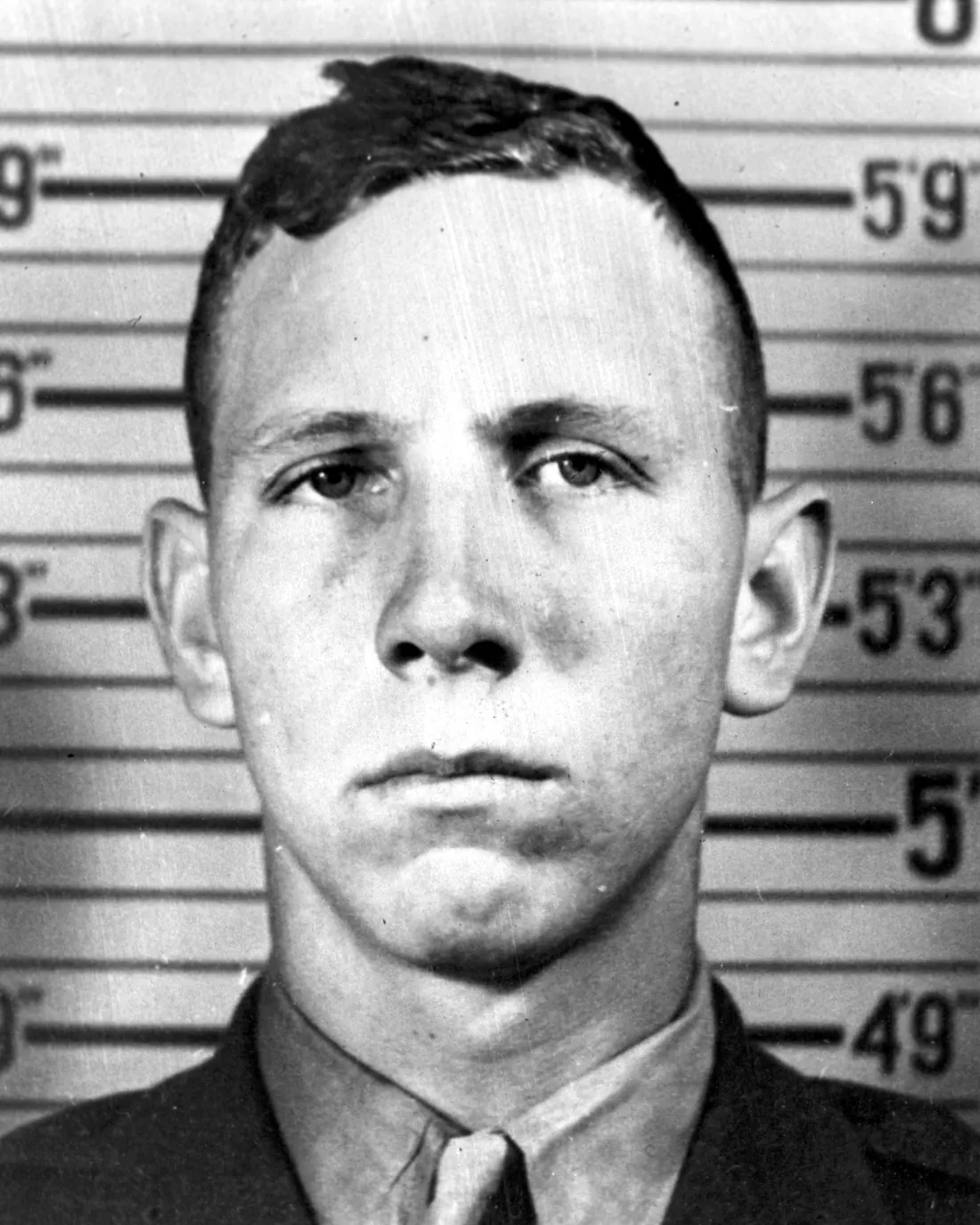
Pictures: Hayes himself is in his Marine Corps recruit photo, at the parachute school in 1943 and in Los Angeles on March 23, 1947, a year after his trip to Texas. Red Beach is the 5th Division’s landing beach on D-day, his division and day, but it isn’t a photo of him. Harlon Block is in his own recruit photo. The gravestone was photographed at Arlington in 2020.
Photo credits
The archive photos in this story
The photographs and illustrations in this story are in the public domain or shared under open licenses; each one is credited below with its license. Tap one to enlarge it, or follow the link to its Wikimedia Commons page for the full record. The narration, captions and graphics in the Short are our own; its music and sound effects are credited below.
Music and sound effects
Music: Brahms, Symphony No. 1 in C minor, Op. 68: I. Un poco sostenuto - Allegro (Musopen Symphony Orchestra, CC0); Traditional, Taps (US Navy Band, Ceremonial Band, public domain, US government work).
Sound effects: Freesound, CC0.










































































