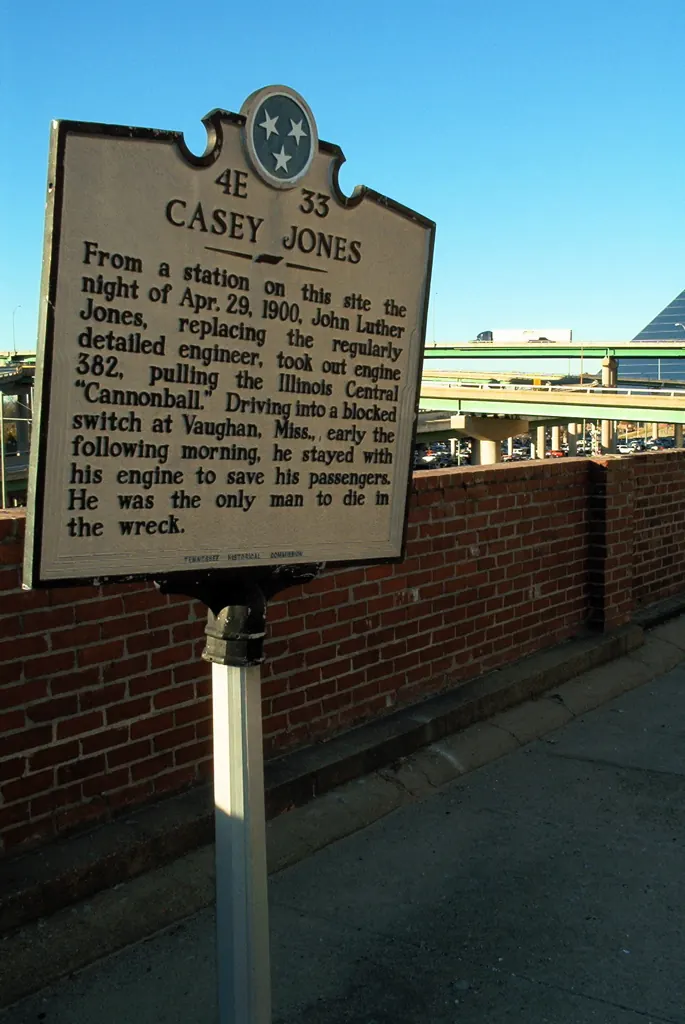
John Luther “Casey” Jones “worked as a locomotive engineer for the Memphis-based Illinois Central Railroad,” Wikipedia says. His last run began “from a station on this site the night of Apr. 29, 1900,” in the words of the Tennessee Historical Commission marker in Memphis. Train No. 1 “departed Memphis at 12:50 a.m., 75 minutes behind schedule,” according to Wikipedia (an hour and a half, says its article on his engine, Illinois Central 382), but “by the time he got to Durant, Mississippi, Jones was almost on time.”
Near Vaughan, Mississippi, “The Cannonball rounded the next curve at seventy miles an hour,” the Mississippi Encyclopedia says; Wikipedia says about 75. “In front of him, too close to avoid a collision, were the rear four cars of a freight train that had been unable to pull completely onto a side track.” His fireman, Sim Webb, “was first to see the red lights of the caboose on the main line,” Wikipedia says. “He alerted Jones, who ordered him to jump from the train.” Jones “reversed the throttle and slammed the airbrakes into emergency stop.” Webb leapt out about 300 feet before impact and was knocked unconscious. “The last thing he heard as he jumped was the long, piercing whistle used by Jones to warn anyone still in the freight train looming ahead.”
“He stayed with the Cannonball up to the moment of collision, although he might have had time to jump,” the Mississippi Encyclopedia says. He had been able to reduce his speed to about 40 miles per hour before impact (Wikipedia), and the train crashed at 3:52 a.m. “Jones was the only fatality of the collision.” “His body was found in the wreckage of his cab, but all of his passengers and crew survived.” A passenger, Adam Hauser, told The Times-Democrat of New Orleans: “Engineer Jones did a wonderful as well as a heroic piece of work, at the cost of his life.” At the time of Casey’s death, the Casey Jones museum says, “son Charles was 12, daughter Helen was 10 and son John Lloyd was 4.”
The Illinois Central’s final report said “Engineer Jones was solely responsible having disregarded the signals given by Flagman Newberry.” Webb always disagreed: “We saw no flagman or fusees, we heard no torpedoes. Without any warning we plowed into that caboose” (Wikipedia). Webb died in Memphis on July 13, 1957, at age 83.
Wallace Saunders, “a black engine wiper at the Canton roundhouse who cleaned up the Cannonball’s locomotive after the wreck, wrote the first song about Jones,” the Mississippi Encyclopedia says; Wikipedia calls Saunders “an African-American engine wiper for the ICRR and a personal friend of Jones.” Jones’s heroism “was immortalized in ‘The Ballad of Casey Jones’, which quickly became a popular folk song” (Wikipedia), and the songs “have made him one of the major figures in Mississippian and American folklore.”
Fact check
The facts and where they come from
- He told his fireman to jump, but he stayed on the speeding train. Wikipedia: “He alerted Jones, who ordered him to jump from the train.” Historic Casey Jones Home & Railroad Museum: “Sim Webb was Casey’s fireman who Casey told to jump moments before the wreck occurred.” Wikipedia (Illinois Central 382): “Jones told Webb to jump out, and so Webb did.” Mississippi Encyclopedia: “He stayed with the Cannonball up to the moment of collision.” 1423
- His name was Casey Jones, an Illinois Central engineer. Wikipedia: “John Luther ‘Casey’ Jones … worked as a locomotive engineer for the Memphis-based Illinois Central Railroad.” 1
- In April 1900, his train left Memphis over an hour late. Wikipedia: “train No. 1 departed Memphis at 12:50 a.m., 75 minutes behind schedule.” Wikipedia (Illinois Central 382): “an hour and a half behind schedule.” The Tennessee Historical Commission marker in Memphis: “From a station on this site the night of Apr. 29, 1900.” 125
- He made up nearly all of it. Wikipedia: “By the time he got to Durant, Mississippi, Jones was almost on time,” and at the crash, “At that point, Jones was only two minutes behind schedule.” 1
- Near Vaughan, Mississippi, he rounded a curve at about 70 miles an hour. Mississippi Encyclopedia: “The Cannonball rounded the next curve at seventy miles an hour.” Wikipedia: “running at about 75 miles per hour (120 km/h) toward Vaughan” through a left-hand curve. 31
- Freight cars were stuck on the main line. Mississippi Encyclopedia: “In front of him, too close to avoid a collision, were the rear four cars of a freight train that had been unable to pull completely onto a side track.” Wikipedia: “leaving the last four cars of No. 83 on the main line.” 31
- His fireman, Sim Webb, saw them first. Wikipedia: “he was first to see the red lights of the caboose on the main line.” 1
- Casey slammed on the brakes and told Webb to jump. Wikipedia: “Jones reversed the throttle and slammed the airbrakes into emergency stop”; “He alerted Jones, who ordered him to jump from the train.” Mississippi Encyclopedia: “Jones applied the emergency brake.” 13
- As he jumped, Webb heard Casey’s whistle scream. Wikipedia, from Webb’s account: “The last thing he heard as he jumped was the long, piercing whistle used by Jones to warn anyone still in the freight train looming ahead.” 1
- Casey might have had time to jump. Mississippi Encyclopedia: “He stayed with the Cannonball up to the moment of collision, although he might have had time to jump.” 3
- He stayed, braking hard. Wikipedia: “He had been able to reduce his speed to about 40 miles per hour (60 km/h) before impact.” 1
- They hit at 3:52 in the morning. Historic Casey Jones Home & Railroad Museum: “Casey was killed in a train wreck in Vaughan, Mississippi, April 30, 1900 at 3:52 a.m.” Wikipedia (Illinois Central 382): “Jones’ train crashed at 3:52 am.” 42
- Casey was killed, the only one. Wikipedia: “Jones was the only fatality of the collision.” Historic Casey Jones Home & Railroad Museum: “He was the only one killed in the wreck.” Tennessee Historical Commission marker: “He was the only man to die in the wreck.” 145
- Every passenger lived, and so did Webb. Mississippi Encyclopedia: “His body was found in the wreckage of his cab, but all of his passengers and crew survived.” Wikipedia: “Webb leapt out about 300 feet (90 m) before impact, and was knocked unconscious”; Webb “died in Memphis on July 13, 1957, at age 83.” 31
- A railroad worker wrote a song about him, and it made him a legend. Wikipedia: the ballad was “originally written by Wallace Saunders, an African-American engine wiper for the ICRR and a personal friend of Jones”; “His heroism was immortalized in ‘The Ballad of Casey Jones’, which quickly became a popular folk song.” Mississippi Encyclopedia: “Wallace Saunders, a black engine wiper at the Canton roundhouse who cleaned up the Cannonball’s locomotive after the wreck, wrote the first song about Jones”; the songs “have made him one of the major figures in Mississippian and American folklore.” 13
- A passenger said, “Engineer Jones did a wonderful as well as a heroic piece of work, at the cost of his life.” The passenger was Adam Hauser, in The Times-Democrat of New Orleans in 1900, quoted word for word by Wikipedia. 1
Sources
- Casey Jones Wikipedia
- Illinois Central 382 Wikipedia
- Casey Jones (William Vaughan) Mississippi Encyclopedia (Center for Study of Southern Culture)
- Casey Jones facts (archived) Historic Casey Jones Home & Railroad Museum, Jackson, Tennessee
- Tennessee Historical Commission marker 4E 33, Casey Jones, Memphis (photo by Jeremy Atherton, 2002) Wikimedia Commons
Notes
How late: 75 minutes (Wikipedia) or an hour and a half (Wikipedia, Illinois Central 382), so the Short says over an hour. The Memphis marker dates the start to “the night of Apr. 29, 1900”; Wikipedia gives the departure as 12:50 a.m., and the crash came at 3:52 a.m. on April 30.
The speed: seventy miles an hour (Mississippi Encyclopedia) or about 75 (Wikipedia) on the curve, so the Short says about seventy. At impact it was about 40 (Wikipedia; other retellings say 35), which the Short does not give.
The blame: the Illinois Central’s report blamed Jones; Webb and some railroad historians disputed it (Wikipedia). The Short leaves blame out; this page gives both sides.
Injuries: the Mississippi Encyclopedia says all of his passengers and crew survived; Wikipedia lists bruises to two passengers and injuries to the express messenger and two postal clerks, and its article on Illinois Central 382 says “injuring dozens more” without a source. So the Short says only that every passenger lived, and so did Webb.
Whose train he was driving (a double shift for the sick Sam Tate, or his regular run) is told three ways (Wikipedia), so it is left out.
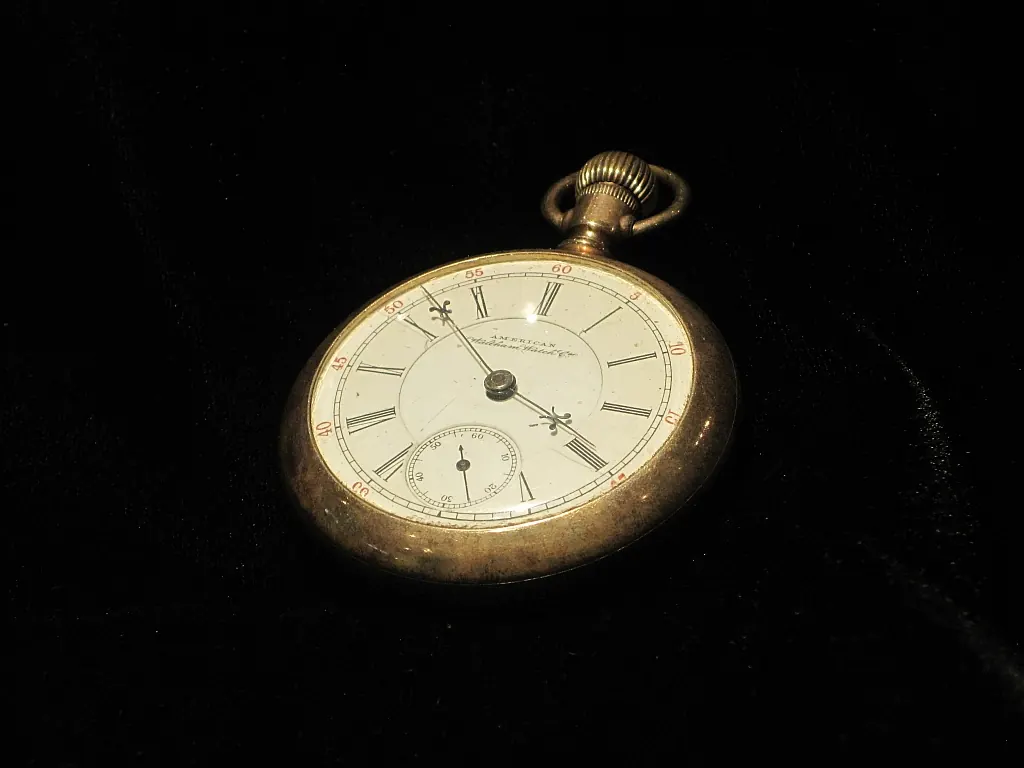
Legend left out: his “last words” (retellings vary; there is no reliable record), his hands still on the whistle cord and brake (“Popular legend,” Wikipedia), a watch stopped at the moment of the crash (the museum’s own placard for his watch says “It was not damaged in the wreck.”), “nearly 100 miles per hour” and the name “Cannonball Express” (“Cannonball” was a generic term for fast trains, Wikipedia; the Mississippi Encyclopedia says the train was “popularly known as the Cannonball”).
The song: Wallace Saunders wrote the first song; the best-known version, of 1909, is by the vaudevillians T. Lawrence Siebert and Eddie Newton (Mississippi Encyclopedia).
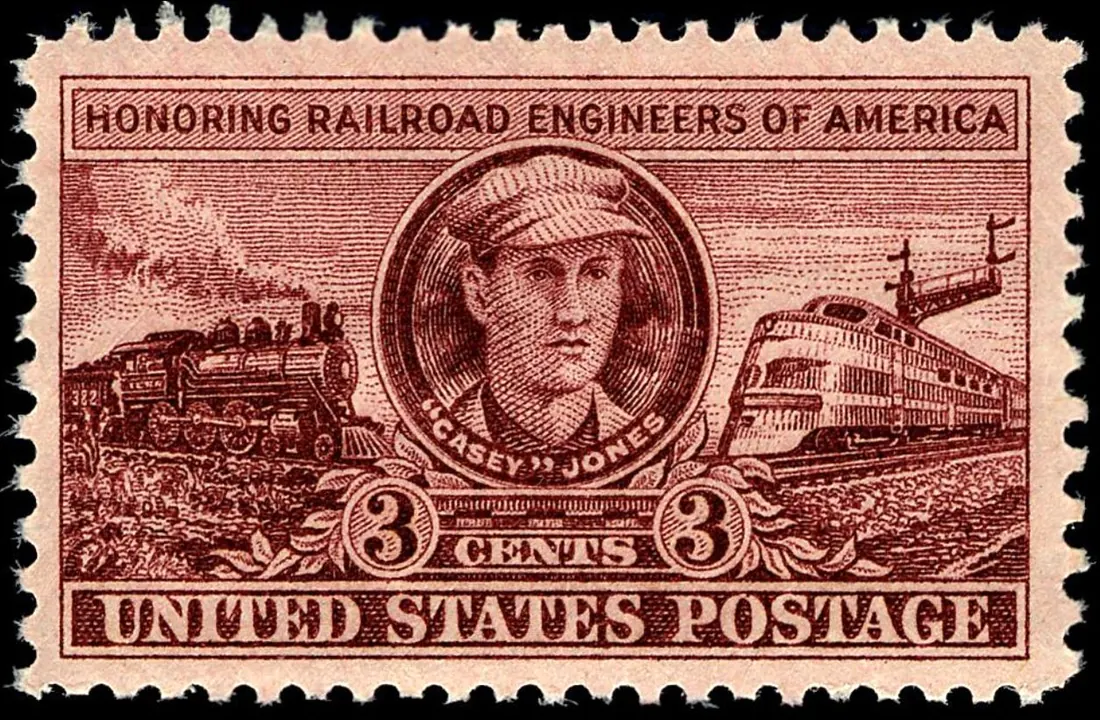
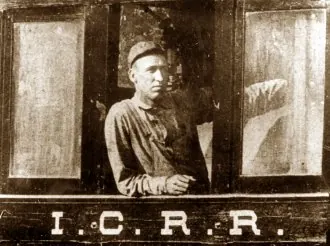
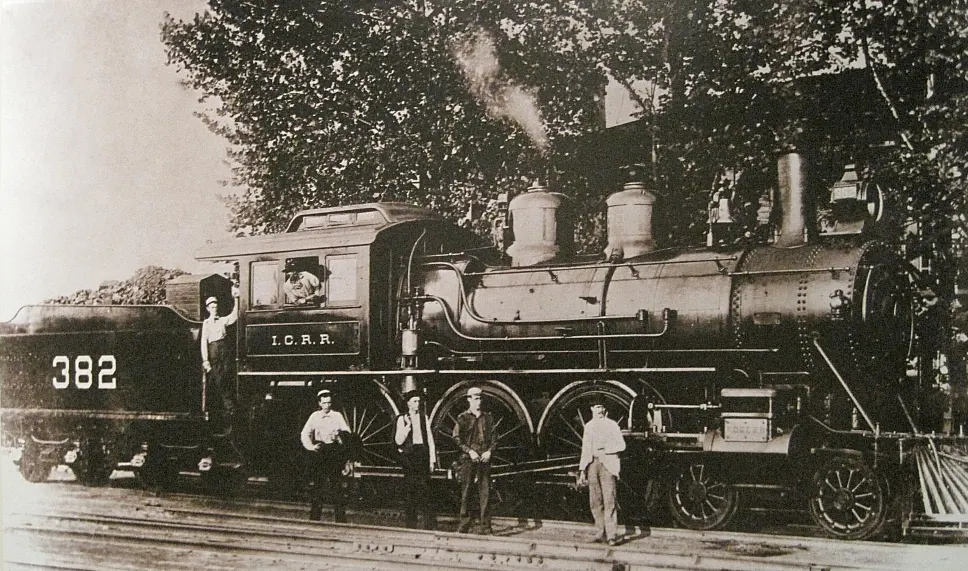
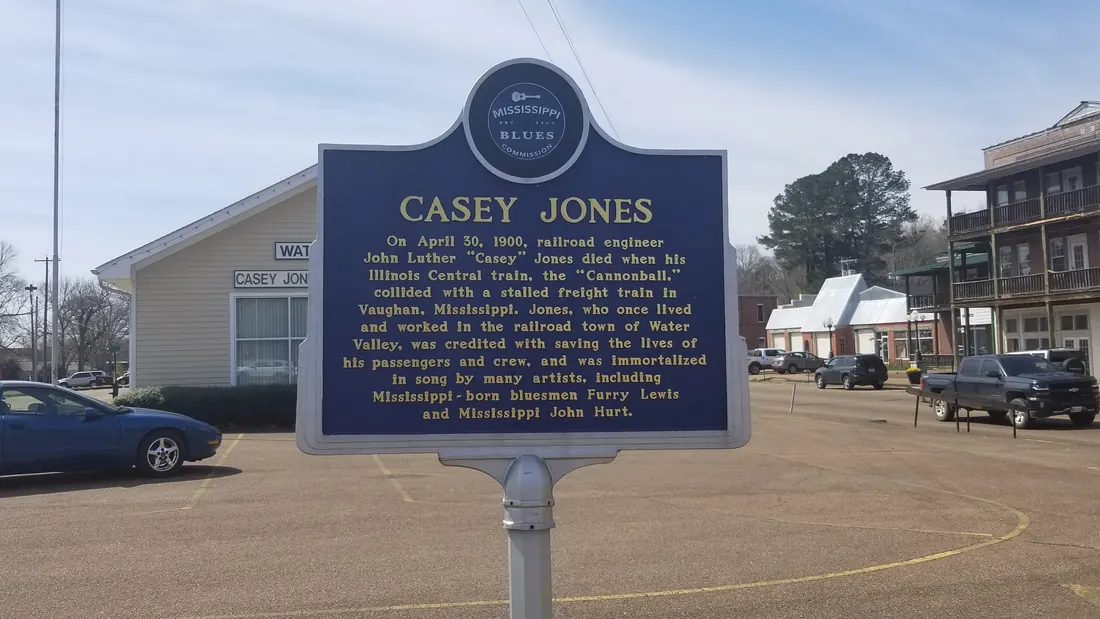
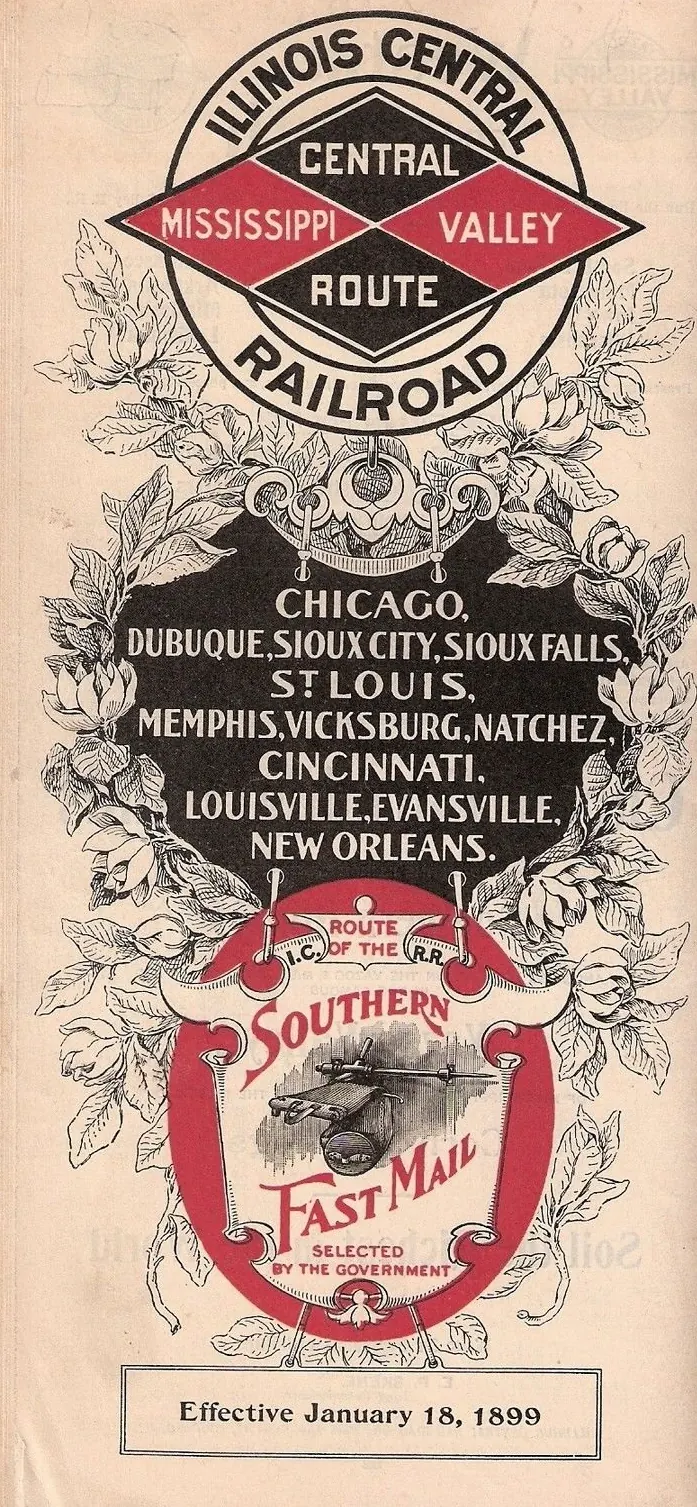
Pictures: the only images of Casey Jones himself here are the engraved portrait on the 3-cent “Honoring Railroad Engineers of America” stamp of 1950 and the small photo of him at the cab window of an Illinois Central engine, taken before 1900 (credited to J. E. France by the Water Valley Casey Jones Railroad Museum). No free photo of Sim Webb is known, and “There are no clearly authentic photographs of the wreck in existence” (Wikipedia), so neither is shown. The period print of Illinois Central No. 382, the engine of his last run, is undated and not from the night of the wreck, and its crew are not identified; it was photographed at the Casey Jones Railroad Museum in Jackson, Tennessee, in 2012, as was his Waltham pocket watch, which the museum’s placard says “was in his pocket at the time of his crash and death on April 30,1900.” The 1899 timetable is the railroad’s timetable of a year before, not his train’s. The Memphis marker stands where his last run began (photographed in 2002), and the Mississippi Blues Trail marker is in Water Valley, Mississippi, where he once lived (2019).
Photo credits
The archive photos in this story
The photographs and illustrations in this story are in the public domain or shared under open licenses; each one is credited below with its license. Tap one to enlarge it, or follow the link to its Wikimedia Commons page for the full record. The narration, captions and graphics in the Short are our own; its music and sound effects are credited below.
Music and sound effects
Music: Grieg, Peer Gynt Suite No. 1, Op. 46: IV. In the Hall of the Mountain King (Musopen Symphony Orchestra, public domain); Grieg, Peer Gynt Suite No. 1, Op. 46: I. Morning Mood (Musopen Symphony Orchestra, public domain).
Sound effects: Freesound, CC0.