“In the summer of 1846 Blackwell applied to several New England medical schools. She was rejected by all of them,” says the history of Hobart and William Smith Colleges, Geneva Medical College’s founding institution. “In May of 1847 Blackwell traveled to Philadelphia.” “When Blackwell received only rejection letters from the schools to which she had applied, she became frustrated.” “In August, Blackwell mailed out another round of applications to twelve lesser-known medical schools.” In Wikipedia’s words, “She was rejected from each medical school she applied to, except Geneva Medical College in New York.”
At Geneva the dean, Dr. Lee, “opposed the idea of accepting Blackwell.” “Convinced that his students would agree with him, the dean decided to place the onus for rejecting Blackwell onto them, by allowing them to vote on the matter,” the college history says. “The students did not know whether or not to take Dr. Lee seriously and many of them suspected that he was playing a practical joke.” Blackwell herself wrote: “I learned later that some of them had been inclined to think my application for admission a hoax, perpetrated at their expense by a rival college.” Her classmate Stephen Smith remembered that “a perfect Babel of talk, laughter, and catcalls followed,” and then “the whole class arose and voted ‘Aye’ with waving handkerchiefs, throwing up of hats, and all the manner of vocal demonstrations.” Her memoir prints the class resolution, dated “October 20, 1847,” and “unanimously adopted.”
The students “were surprised, to say the least, when she arrived at the school ready to learn how to heal,” Smithsonian Magazine writes. Smith remembered: “A hush fell on the class as if each member had been stricken with paralysis. A death-like stillness prevailed during the lecture, and only the newly arrived student took notes.” In town, “Blackwell noticed that the women would draw their skirts aside as she passed them on her daily walks through town,” and she wrote of “all this gossip”: “I had so shocked Geneva propriety that the theory was fully established either that I was a bad woman, whose designs would gradually become evident, or that, being insane, an outbreak of insanity would soon be apparent.”
“On 23 January 1849, Blackwell became the first woman to earn a medical degree in the United States,” Wikipedia says; the college history dates the ceremony, “at the Presbyterian church in Geneva,” to January 29 and says that she “graduated at the top of her class.” Her brother wrote that “our Sis came off with flying colours and the reputation of being altogether the leader of the class,” and when the dean, Charles Lee, conferred her degree, “he stood up and bowed to her.” In June, Wikipedia says, she enrolled at La Maternité in Paris, and on “Sunday, November 4,” she wrote in her diary, “whilst syringing the eye of one of my tiny patients for purulent ophthalmia, some of the water had spurted into my own eye.” Afterwards she still wrote, “I still mean to be at no very distant day the first lady surgeon in the world.” But, Wikipedia says, “She lost sight in her left eye, requiring its surgical extraction and leaving her without hope of becoming a surgeon.”
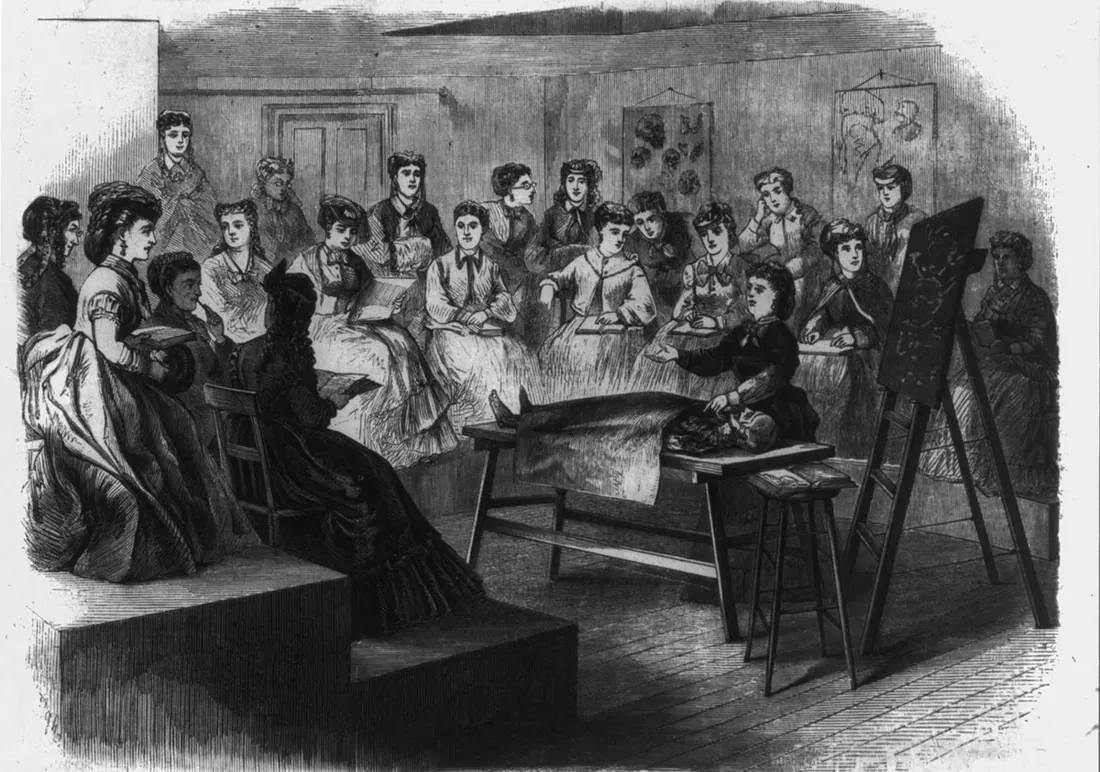
“When Blackwell lost sight in one eye, she returned to New York City in 1851, giving up her dream of becoming a surgeon,” the National Library of Medicine says, and “she opened her own dispensary in a single rented room.” “In 1857 her sister, Dr. Emily Blackwell, joined Elizabeth Blackwell at her clinic in New York. Together they opened a charity hospital, the New York Infirmary for Indigent Women and Children,” the college history says; Wikipedia adds that Marie Zakrzewska was one of its founders. “Women served on the board of trustees, on the executive committee and as attending physicians,” and, in the National Library of Medicine’s words, “This institution and its medical college for women (opened 1867) provided training and experience for women doctors and medical care for the poor.”
Fact check
The facts and where they come from
- She was let into medical school as a joke, but graduated at the top of her class. Smithsonian Magazine: “The First Woman in America to Receive an M.D. Was Admitted to Med School as a Joke.” National Library of Medicine: “As a joke, they voted ‘yes,’ and she gained admittance, despite the reluctance of most students and faculty.” Hobart and William Smith Colleges: “Blackwell graduated at the top of her class.” Her brother’s letter, in her memoir: “the reputation of being altogether the leader of the class.” 4231
- Her name was Elizabeth Blackwell, the first woman M.D. in America. National Library of Medicine: “Elizabeth Blackwell became the first woman in America to earn the M.D. degree.” 2
- In 1847, school after school turned her down. Hobart and William Smith Colleges: “In the summer of 1846 Blackwell applied to several New England medical schools. She was rejected by all of them.” … “In May of 1847 Blackwell traveled to Philadelphia” … “In August, Blackwell mailed out another round of applications to twelve lesser-known medical schools.” Wikipedia: “She was rejected from each medical school she applied to, except Geneva Medical College in New York.” 35
- Then one college in New York let its students vote. Hobart and William Smith Colleges: the dean decided “to place the onus for rejecting Blackwell onto them, by allowing them to vote on the matter.” National Library of Medicine: the faculty “allowed them to vote on her admission.” 32
- The dean was sure they would say no. Hobart and William Smith Colleges: the dean “opposed the idea of accepting Blackwell”; “Convinced that his students would agree with him, the dean decided to place the onus for rejecting Blackwell onto them.” National Library of Medicine: “The faculty, assuming that the all-male student body would never agree to a woman joining their ranks, allowed them to vote on her admission.” 32
- Some thought it was a hoax from a rival college. Her memoir: “I learned later that some of them had been inclined to think my application for admission a hoax, perpetrated at their expense by a rival college.” Hobart and William Smith Colleges: “The students did not know whether or not to take Dr. Lee seriously and many of them suspected that he was playing a practical joke.” 13
- So, laughing and cheering, the whole class voted yes. Hobart and William Smith Colleges, quoting her classmate Stephen Smith: “a perfect Babel of talk, laughter, and catcalls followed” … “the whole class arose and voted ‘Aye’ with waving handkerchiefs, throwing up of hats, and all the manner of vocal demonstrations.” Her memoir prints the class resolution of “October 20, 1847,” “unanimously adopted.” Smithsonian Magazine: “the students thought the request was little more than a silly joke and voted unanimously to let her in.” 314
- Then she actually showed up. Smithsonian Magazine: “they were surprised, to say the least, when she arrived at the school ready to learn how to heal.” 4
- The room went dead silent. Hobart and William Smith Colleges, quoting Stephen Smith: “A hush fell on the class as if each member had been stricken with paralysis. A death-like stillness prevailed during the lecture, and only the newly arrived student took notes.” 3
- Townspeople whispered she was a bad woman, or insane. Her memoir: “I had so shocked Geneva propriety that the theory was fully established either that I was a bad woman, whose designs would gradually become evident, or that, being insane, an outbreak of insanity would soon be apparent.” She calls it “all this gossip.” Hobart and William Smith Colleges: “Blackwell noticed that the women would draw their skirts aside as she passed them on her daily walks through town.” 13
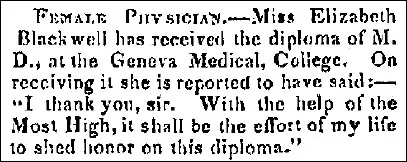
- In 1849, she became the first woman in America with a medical degree. Wikipedia: “On 23 January 1849, Blackwell became the first woman to earn a medical degree in the United States.” National Library of Medicine: “When she graduated from New York’s Geneva Medical College, in 1849, Elizabeth Blackwell became the first woman in America to earn the M.D. degree.” The Star and Banner, March 9, 1849: “Female Physician.—Miss Elizabeth Blackwell has received the diploma of M. D., at the Geneva Medical, College.” 526
- In Paris, while treating a baby’s eye, she caught the infection herself. Her diary, “Sunday, November 4”: “whilst syringing the eye of one of my tiny patients for purulent ophthalmia, some of the water had spurted into my own eye.” Wikipedia: “On 4 November 1849, when Blackwell was treating an infant with ophthalmia neonatorum, she accidentally squirted some contaminated fluid into her own eye and contracted the infection”; “In June, Blackwell enrolled at La Maternité.” 15
- She lost that eye, and her dream of becoming a surgeon. Wikipedia: “She lost sight in her left eye, requiring its surgical extraction and leaving her without hope of becoming a surgeon.” National Library of Medicine: “When Blackwell lost sight in one eye, she returned to New York City in 1851, giving up her dream of becoming a surgeon.” Her letter after the infection: “I still mean to be at no very distant day the first lady surgeon in the world.” 521
- So with her sister Emily, she opened a hospital for poor women and children. Hobart and William Smith Colleges: “In 1857 her sister, Dr. Emily Blackwell, joined Elizabeth Blackwell at her clinic in New York. Together they opened a charity hospital, the New York Infirmary for Indigent Women and Children.” Wikipedia: “In 1857, Marie Zakrzewska, along with Blackwell and her sister Emily, who had also obtained a medical degree, expanded Blackwell’s original dispensary into the New York Infirmary for Indigent Women and Children.” 35
- Run by women, it trained the women doctors who came after her. Wikipedia: “Women served on the board of trustees, on the executive committee and as attending physicians.” National Library of Medicine: “This institution and its medical college for women (opened 1867) provided training and experience for women doctors and medical care for the poor.” 52
Sources
- Pioneer Work in Opening the Medical Profession to Women (Elizabeth Blackwell’s memoir, 1895) Project Gutenberg
- Dr. Elizabeth Blackwell (Changing the Face of Medicine) US National Library of Medicine
- Woman Attends Medical School Hobart and William Smith Colleges (History)
- The First Woman in America to Receive an M.D. Was Admitted to Med School as a Joke Smithsonian Magazine
- Elizabeth Blackwell Wikipedia
- “Female Physician,” The Star and Banner, Gettysburg, March 9, 1849 (clipping) Wikimedia Commons
Notes
Whose joke? The National Library of Medicine and Smithsonian Magazine say the students voted yes as a joke; the college history says many of them suspected the dean “was playing a practical joke”; Blackwell’s own memoir says “some of them” thought her application “a hoax … by a rival college.” The Short uses her words.
“If one student objected, she would be turned away”: Wikipedia and Smithsonian Magazine say so, but her memoir, the dean’s letter she prints, the college history and the National Library of Medicine don’t, so we leave it out and say only that the dean expected a no.
The laughing, cheering vote and the silent room come from her classmate Stephen Smith’s recollections, written long afterwards and quoted in the college history. Her memoir confirms the unanimous resolution, but not the scene.
Her graduation: January 23, 1849 (Wikipedia, Smithsonian Magazine; her brother’s letter is dated that day) or January 29 (the college history). The words “at the top of her class” are the college history’s; her brother called her “the leader of the class.”
The hospital’s founders: Elizabeth Blackwell, her sister Emily and Marie Zakrzewska (Wikipedia, the National Library of Medicine); the college history and the Short name the two sisters. Its medical college opened in 1867 (National Library of Medicine) or 1868 (Wikipedia, the college history).
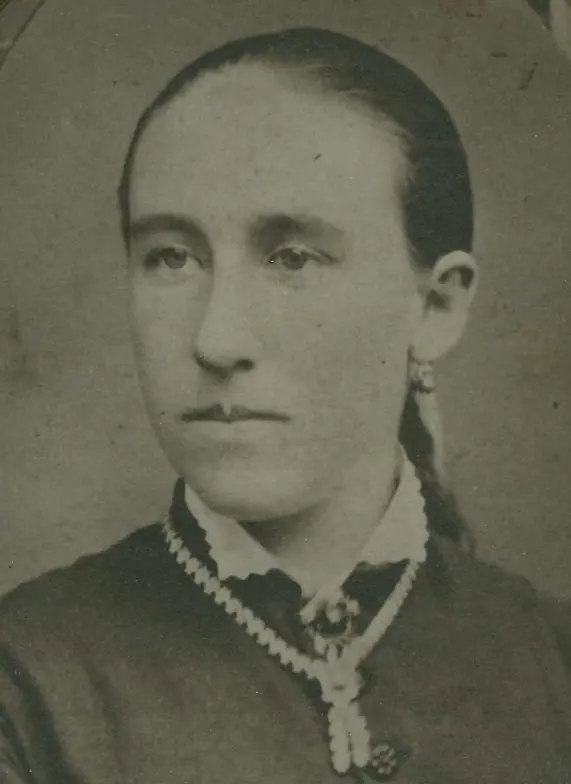
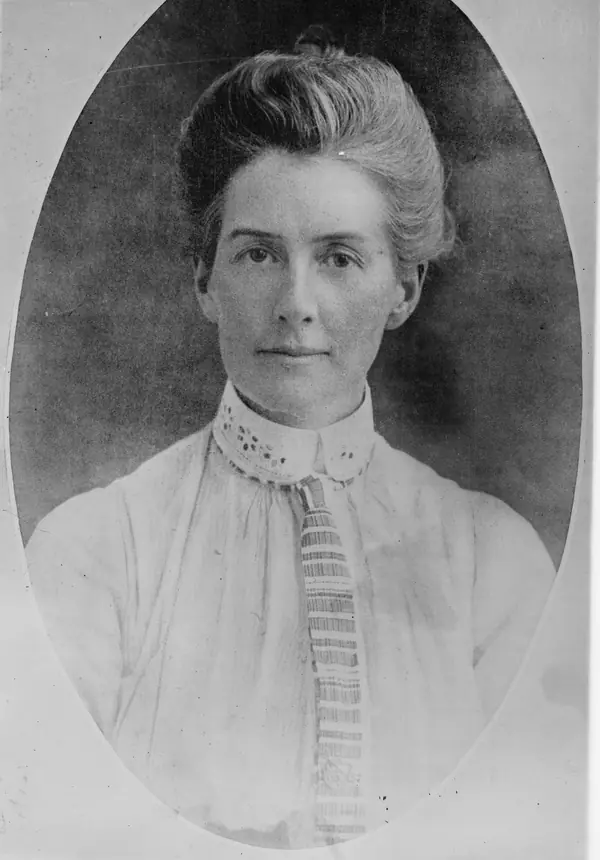
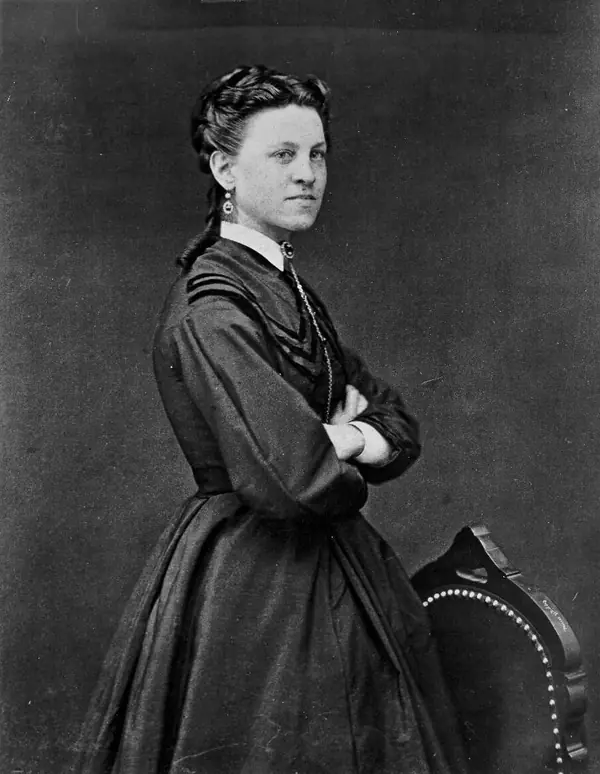
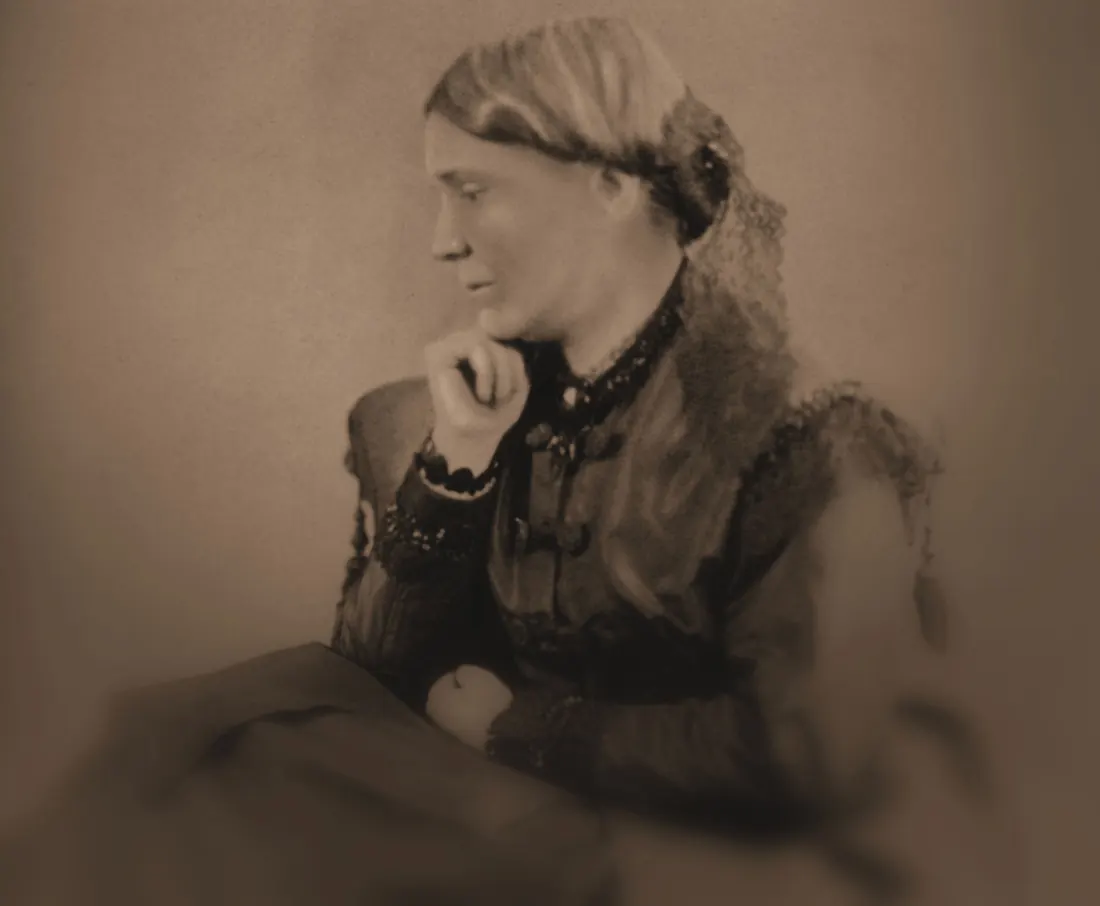
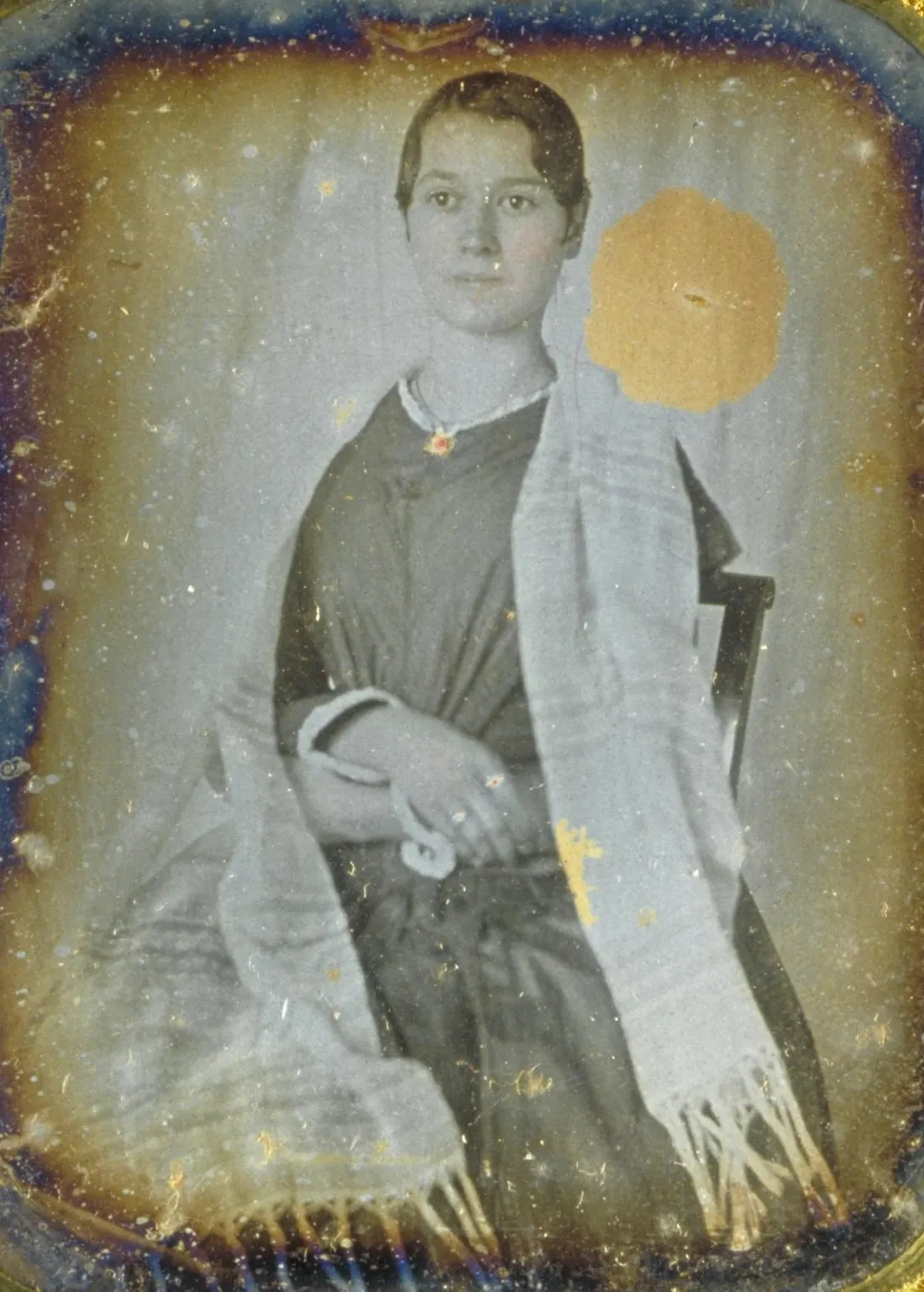
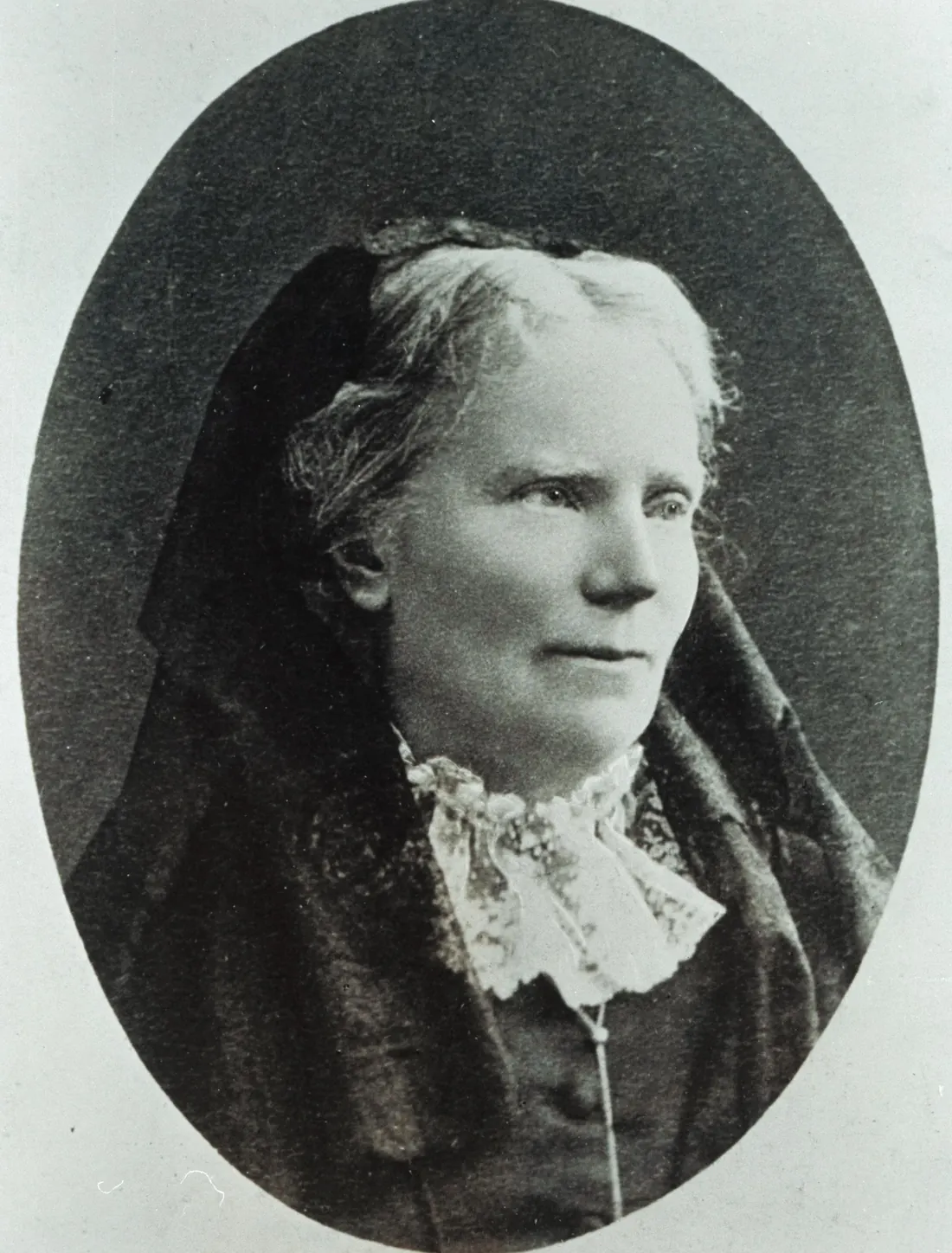
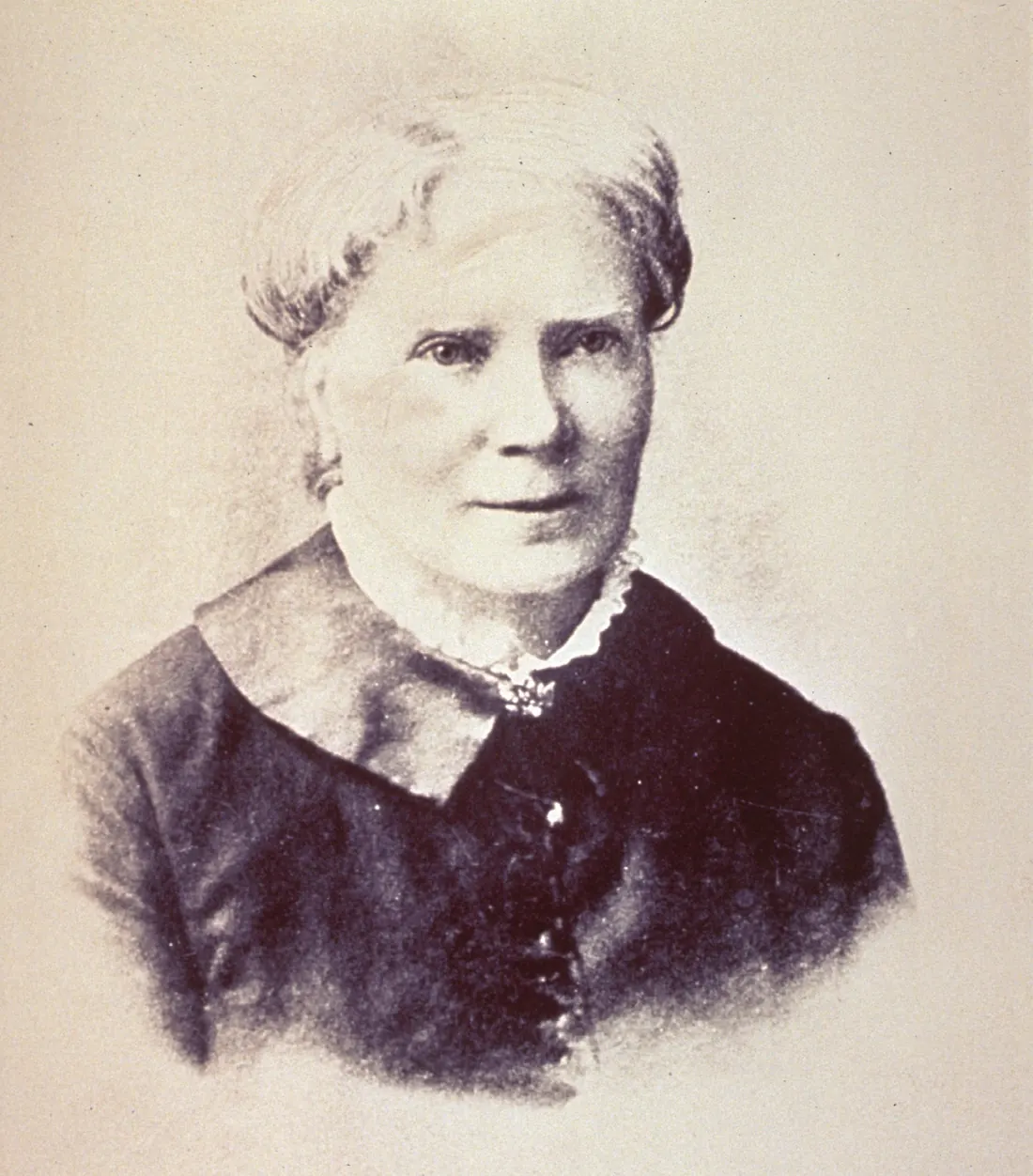
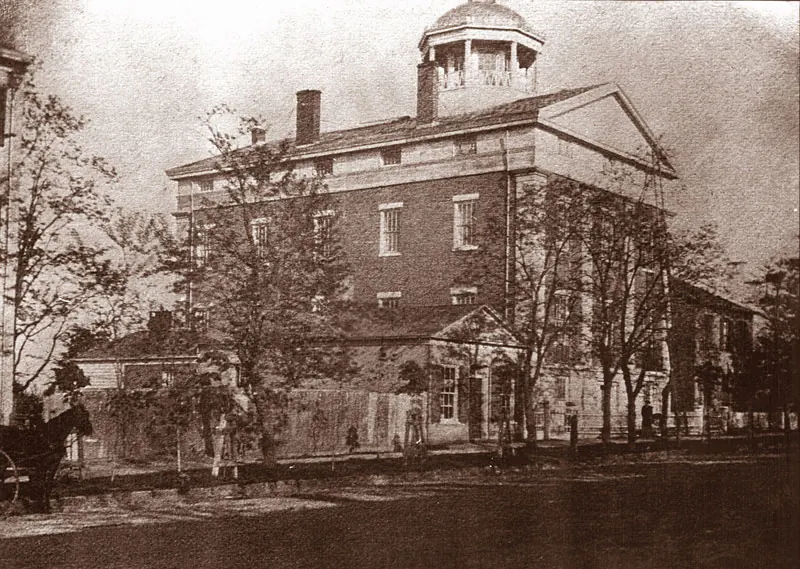
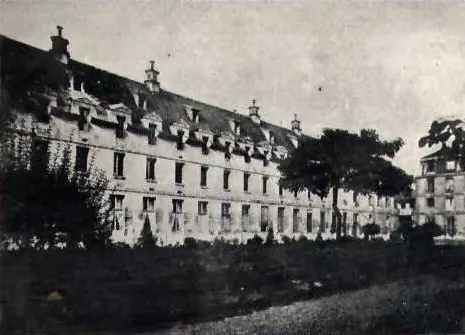
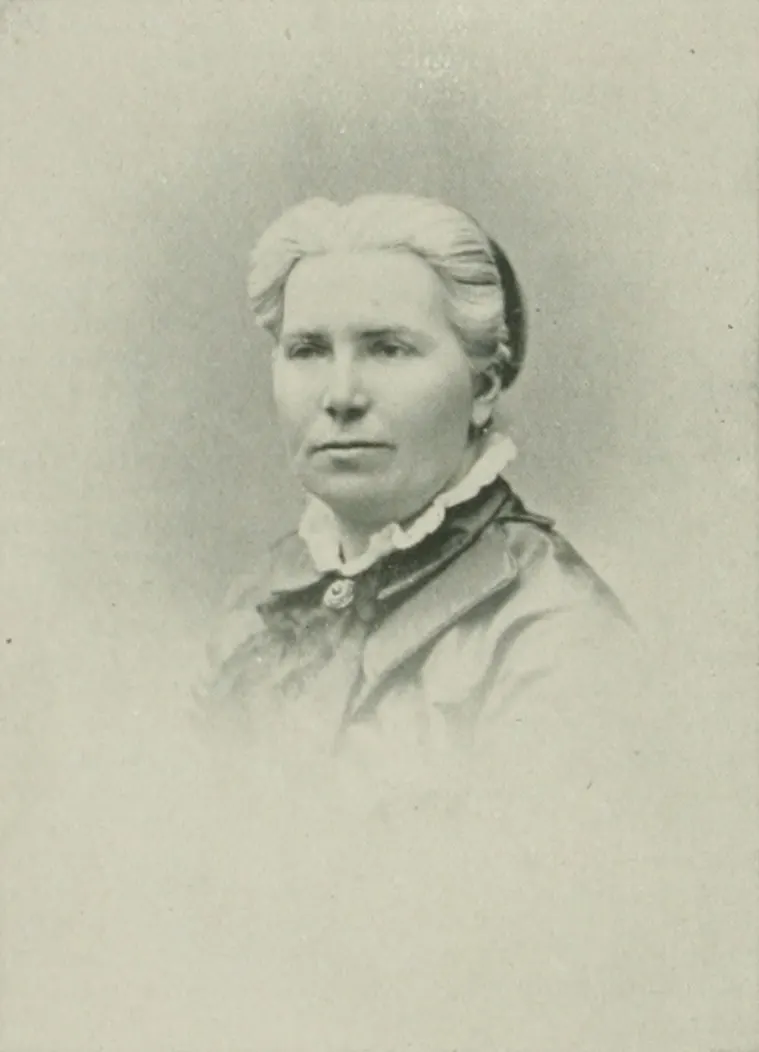
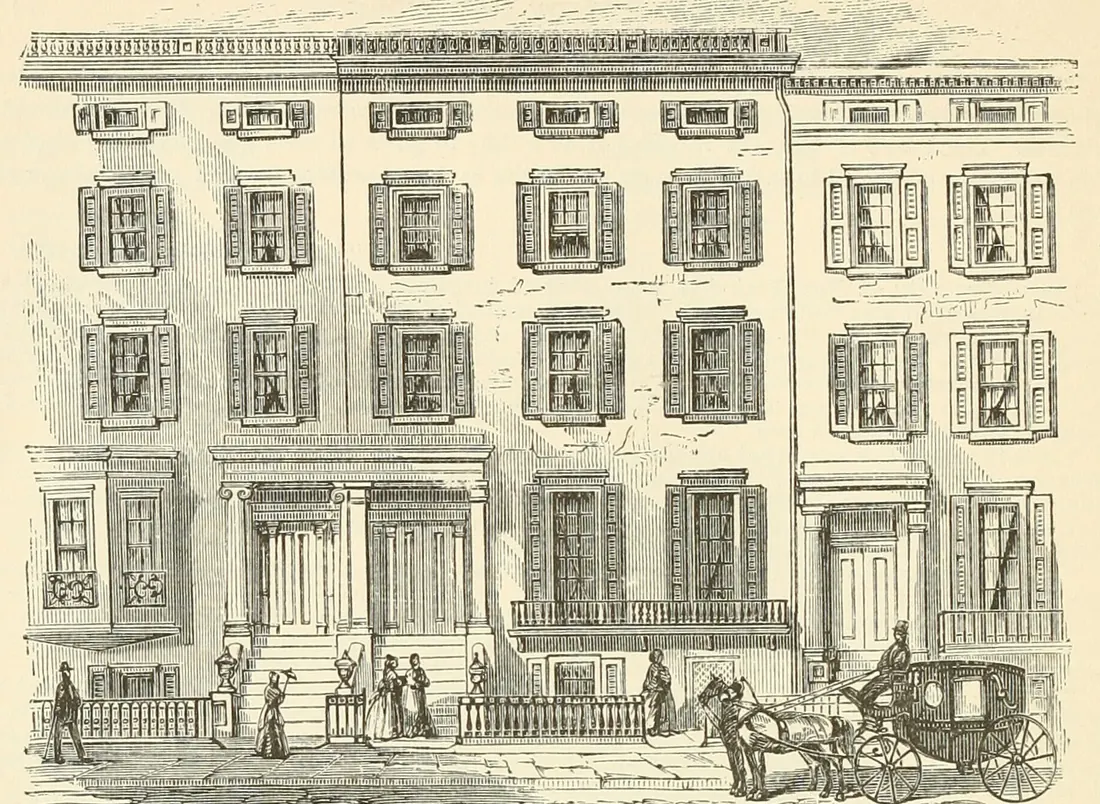
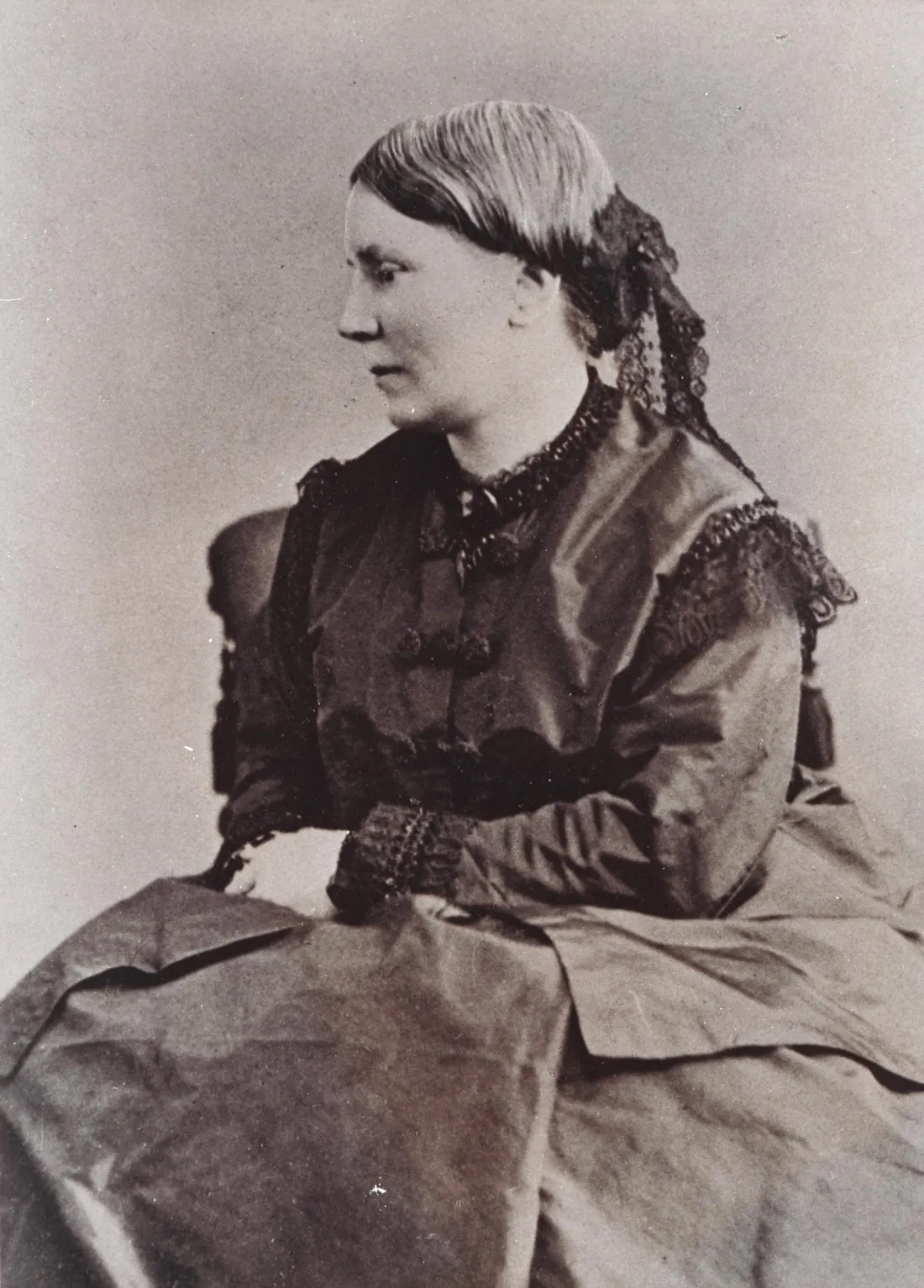
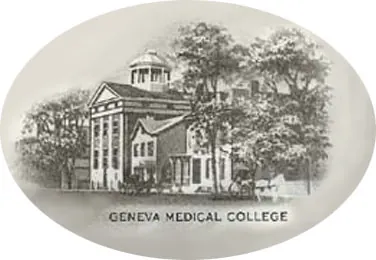
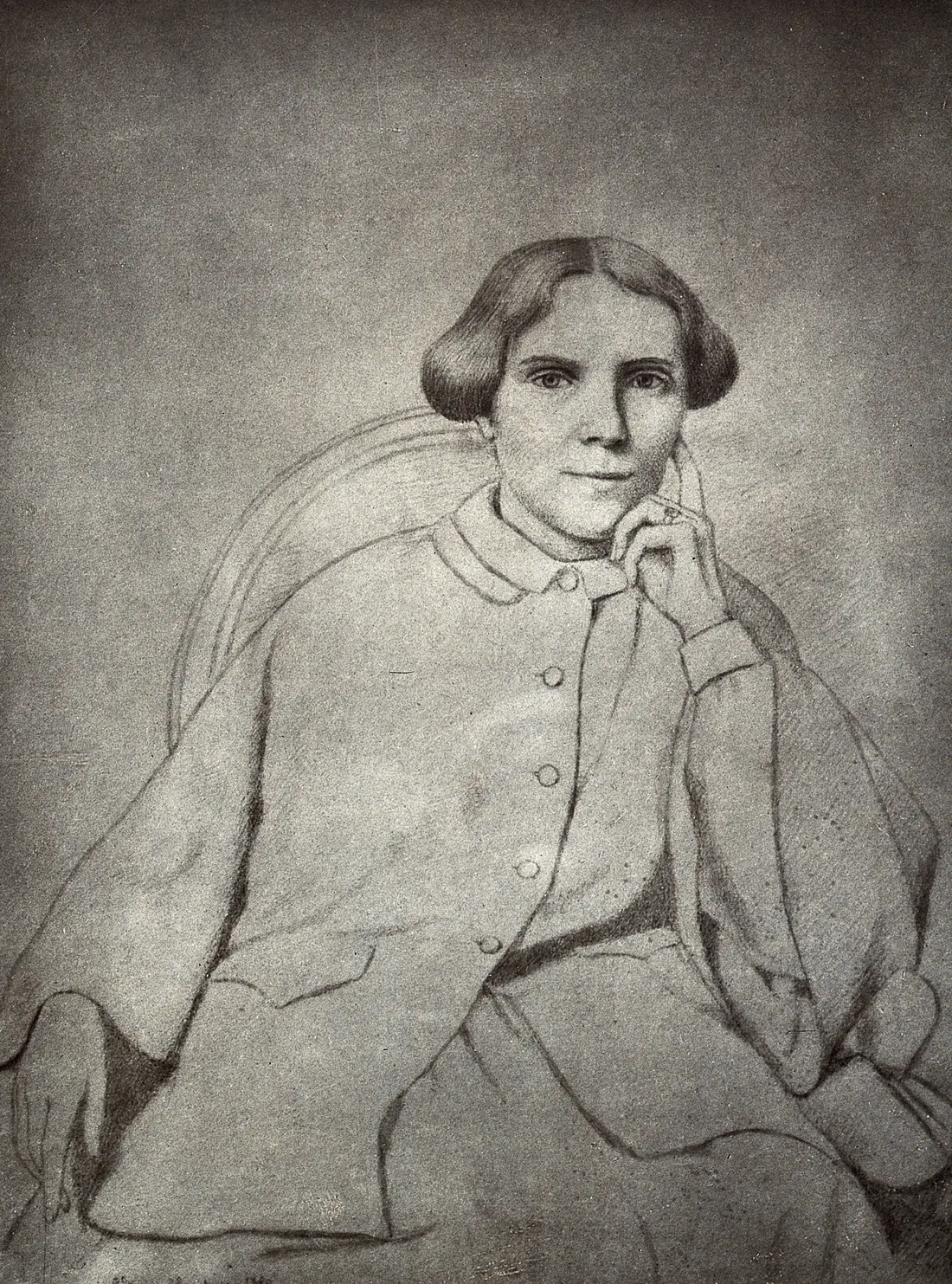
Pictures: Elizabeth Blackwell herself is in the daguerreotype of about 1841–1851, the profile portrait of about 1850–1860 and the head-and-shoulders portrait of about 1875–1885 (all at the Schlesinger Library, Harvard), Ernest Edwards’s photograph of about 1860, the undated drawn portrait printed by Swaine, and the National Library of Medicine’s photograph of her in later life. No photograph of her from 1847–49 exists, so the portraits are from the nearest years. Her sister Emily is in the 1893 engraving from A Woman of the Century. The Geneva Medical College photograph (19th century, date unrecorded) and the brochure engraving of about 1850 show the college, not the vote. The Star and Banner clipping of March 9, 1849, reports her diploma. La Maternité, the Paris hospital where she caught the infection, is shown in 1909. The Infirmary engraving shows its building at 128 Second Avenue in 1870 (it opened in 1857 at 64 Bleecker Street), and the Leslie’s engraving of 1870 shows the anatomy lecture room of its women’s medical college.
Photo credits
The archive photos in this story
The photographs and illustrations in this story are in the public domain or shared under open licenses; each one is credited below with its license. Tap one to enlarge it, or follow the link to its Wikimedia Commons page for the full record. The narration, captions and graphics in the Short are our own; its music and sound effects are credited below.
Music and sound effects
Music: Brahms, Symphony No. 1 in C minor, Op. 68: I. Un poco sostenuto - Allegro (Musopen Symphony Orchestra, CC0); Brahms, Symphony No. 2 in D major, Op. 73: IV. Allegro con spirito (Musopen Symphony Orchestra, CC0); Grieg, Peer Gynt Suite No. 1, Op. 46: II. Ase's Death (Musopen Symphony Orchestra, CC0); Grieg, Peer Gynt Suite No. 1, Op. 46: I. Morning Mood (Musopen Symphony Orchestra, public domain).
Sound effects: Freesound, CC0.