
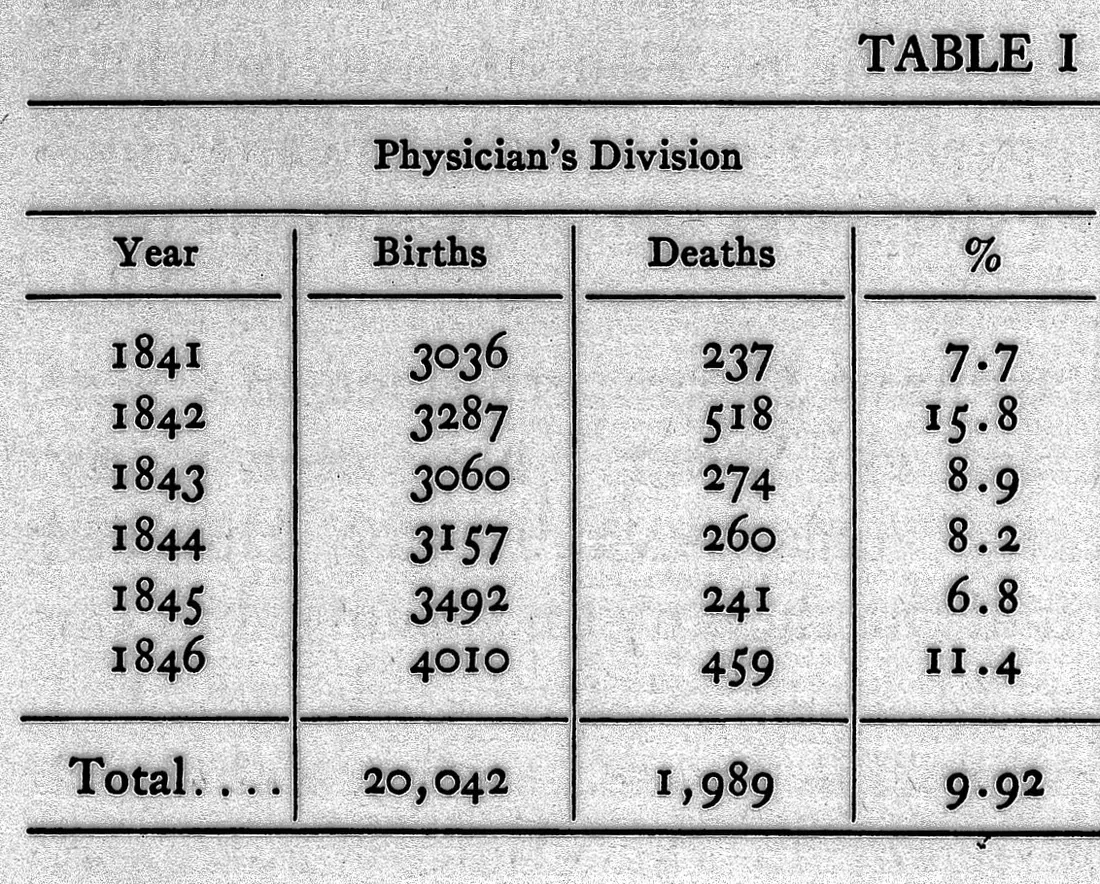
Ignaz Semmelweis was “a Hungarian medical doctor and scientist,” Wikipedia says, and on July 1, 1846, he “was appointed assistant to Professor Johann Klein in the First Obstetrical Clinic of the Vienna General Hospital.” “There were two maternity clinics at the Viennese hospital.” “One was staffed by all male doctors and medical students, and the other was staffed by female midwives,” NPR says. In Wikipedia’s words, “The First Clinic had an average maternal mortality rate of about 10% due to puerperal fever. The Second Clinic’s rate averaged less than 4%,” and the Science History Institute says “the physician-run ward had a mortality rate three times higher than that of the midwives’ ward.” His own Table I, for 1841–1846, counts 1,989 deaths in 20,042 births in the Physician’s Division (9.92%), and 691 in 17,791 in the Midwives’ Division (3.38%).
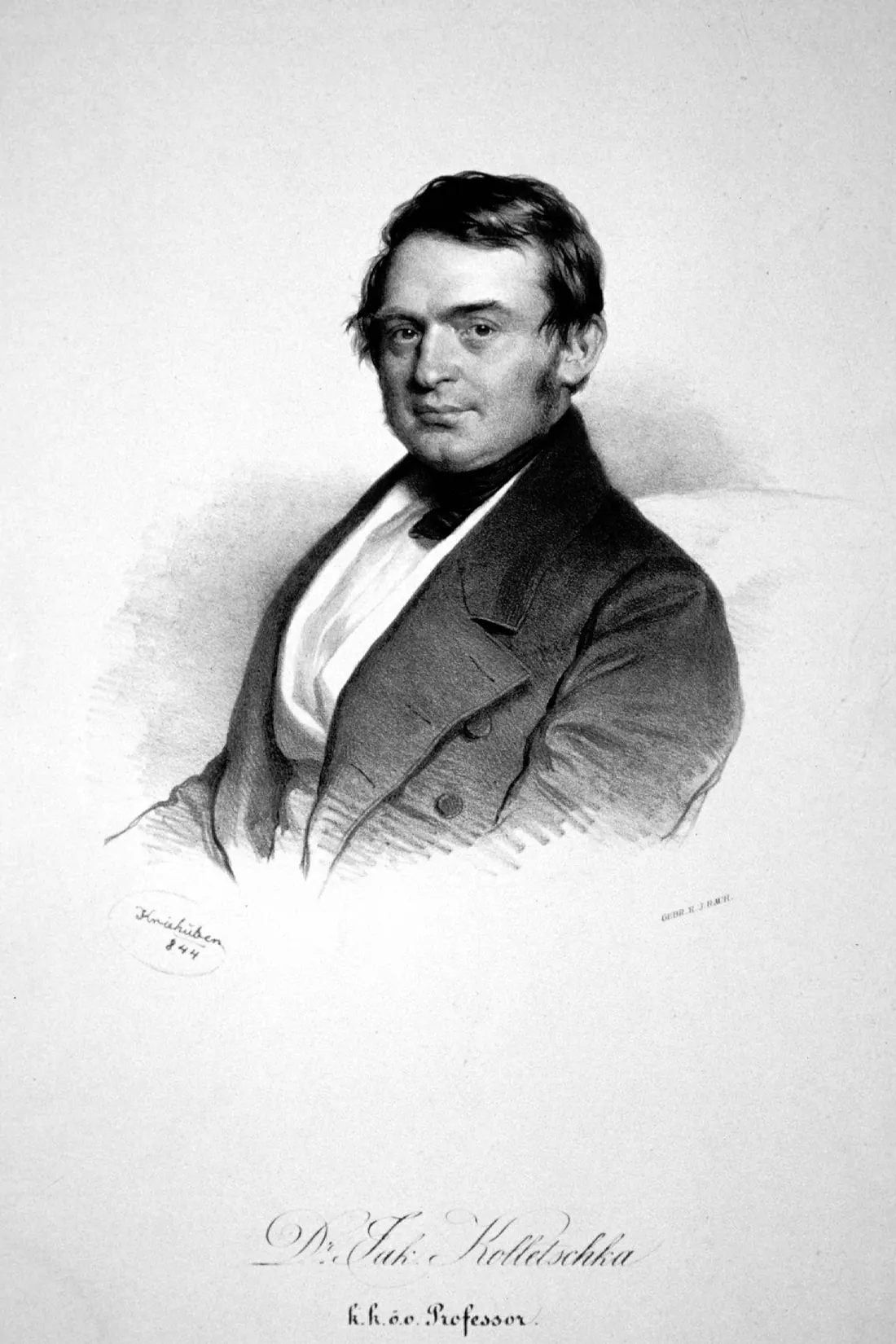
Then, the Science History Institute says, “His colleague, Jakob Kolletschka, died tragically … after his hand was cut with a scalpel during an autopsy,” and “These symptoms closely resembled those of childbed fever.” Wikipedia calls Kolletschka “his good friend,” “accidentally poked with a student’s scalpel while performing a post mortem examination,” and says his autopsy “showed a pathology similar to that of the women who were dying from puerperal fever.” Semmelweis “proposed that he and the medical students carried ‘cadaverous particles’ on their hands from the autopsy room to the patients they examined in the First Obstetrical Clinic.” As the medical historian Jacalyn Duffin told NPR, “The big difference between the doctors’ ward and the midwives’ ward is that the doctors were doing autopsies and the midwives weren’t.” So “He instituted a policy of using a solution of chlorinated lime (calcium hypochlorite) for washing hands between autopsy work and the examination of patients,” Wikipedia says, and “all doctors and medical students were required to disinfect their hands with chlorinated lime before examining pregnant women,” in the Science History Institute’s words.
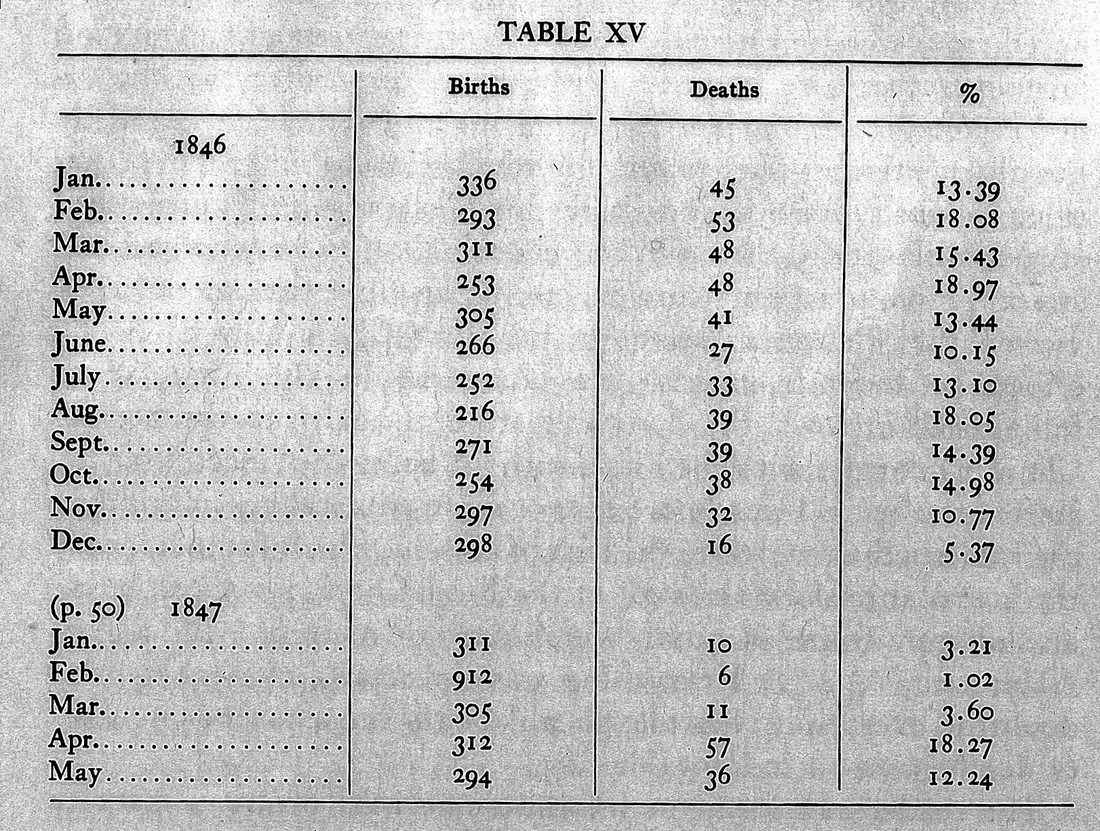
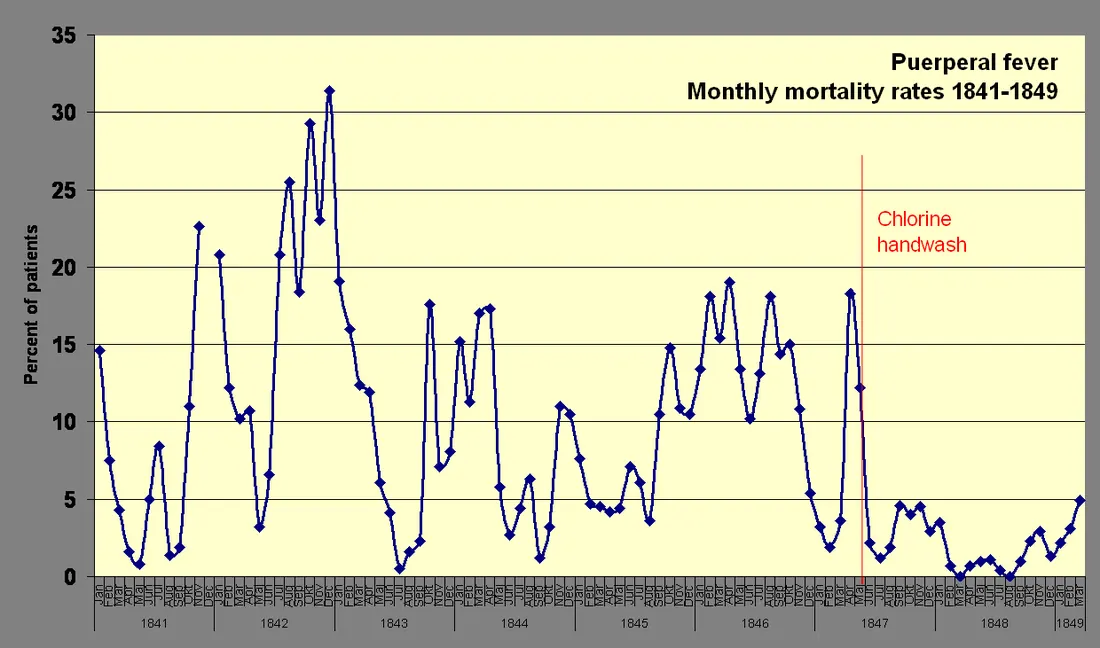
“The mortality rate in April 1847, before the new hand washing procedures were instituted, was 18.3%,” Wikipedia says; in his own Table XV, April 1847 reads 312 births, 57 deaths, 18.27%. “The new procedures started in mid-May leading to lower rates: June 2.2%, July 1.2%, and August 1.9%.” In 1848 his clinic counted 45 deaths in 3,556 births (1.3%), according to Wikipedia’s table of his figures, and the Science History Institute says “the mortality rate in Semmelweis’ ward decreased dramatically—from 18.27% to 1.27%—in 1848.” But “some doctors were offended by the suggestion that they should wash their hands, and mocked him for it,” Wikipedia says, “feeling that their social status as gentlemen was inconsistent with the idea that their hands could be unclean.” “On March 20, 1849, Klein dismissed Semmelweis from his position at the Vienna General Hospital,” the Science History Institute says; in NPR’s words, “Eventually the doctors gave up the chlorine hand-washing, and Semmelweis — he lost his job.”
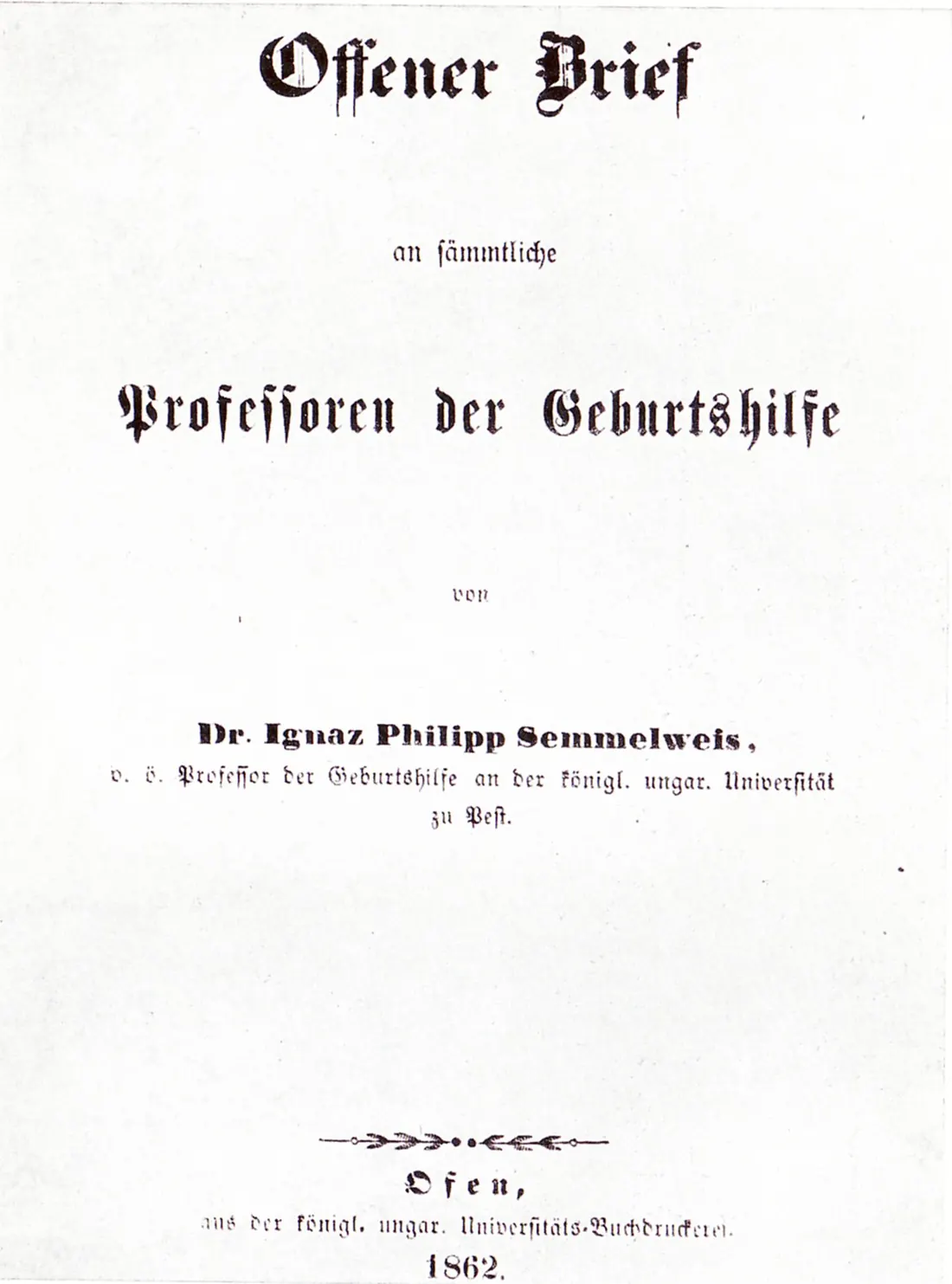
“In 1861, Semmelweis published his main work,” Wikipedia says, and he “lashed out against his critics in a series of open letters,” “at times denouncing his critics as irresponsible murderers or ignoramuses”; one was his 1862 Offener Brief an sämmtliche Professoren der Geburtshilfe (Open Letter to all professors of obstetrics). “His contemporaries, including his wife, presumed he was losing his mind,” and “In 1865, the increasingly outspoken Semmelweis purportedly suffered a nervous breakdown and was committed to an asylum by his colleagues.” On July 30, Wikipedia says, “Ferdinand Ritter von Hebra lured him, under the pretense of visiting one of Hebra’s ‘new Institutes’, to a Viennese insane asylum”; Hektoen International says it was done “under false pretenses.” What happened there is told with different certainty: Wikipedia says he “tried to leave” and “was severely beaten by several guards, secured in a straitjacket, and confined to a darkened cell”; Hektoen International says “he was restrained and beaten by attendants”; NPR says only that he “was probably beaten in the asylum.”
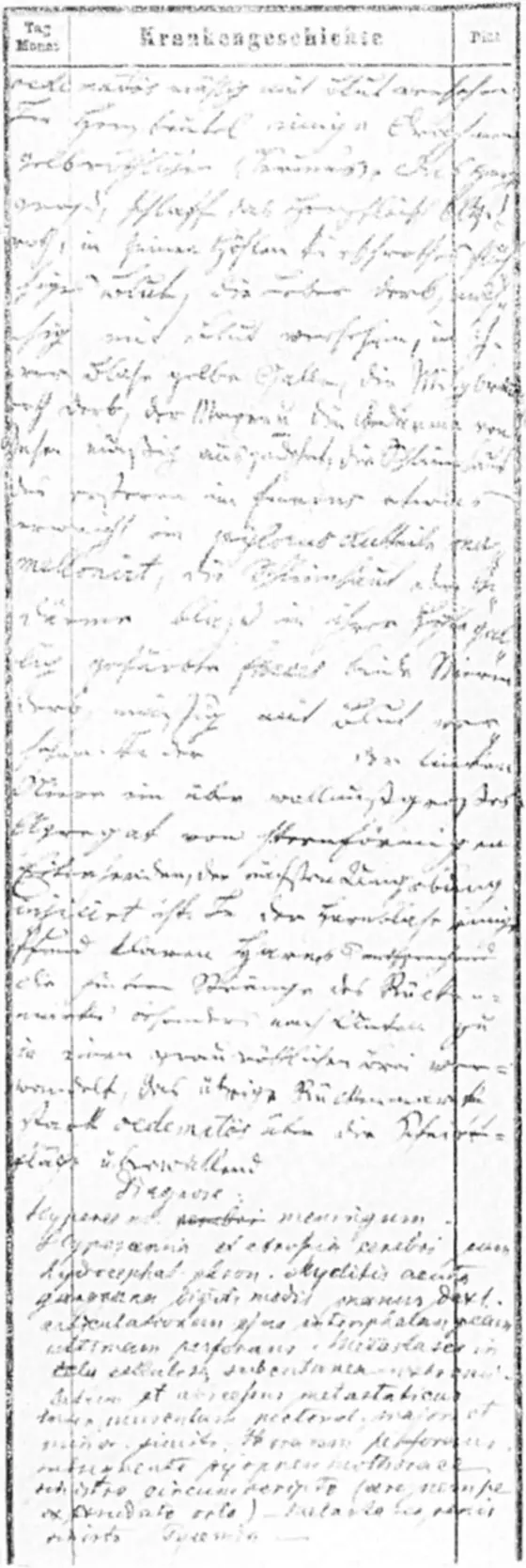
“He died after two weeks,” on August 13, 1865, Wikipedia says, “aged 47, from a gangrenous wound, due to an infection on his right hand which might have been caused by the struggle. The autopsy gave the cause of death as pyemia (blood poisoning).” NPR says he “eventually died of sepsis,” and “basically, it’s the same disease Semmelweis fought so hard to prevent in those women who died from childbed fever.” “Ironically, the pioneer of antiseptic technique himself died of sepsis,” Hektoen International says. His findings “only gained widespread acceptance years after his death, when Louis Pasteur confirmed the germ theory of disease, giving Semmelweis’s observations a scientific explanation, and Joseph Lister, acting on Pasteur’s research, pioneered antiseptic surgical methods with great success,” Wikipedia says. Later, the Science History Institute says, he became known as the “savior of mothers.”
Fact check
The facts and where they come from
- He begged doctors to wash their hands, but they locked him in an asylum. Wikipedia: “some doctors were offended by the suggestion that they should wash their hands, and mocked him for it. In 1865, the increasingly outspoken Semmelweis purportedly suffered a nervous breakdown and was committed to an asylum by his colleagues.” Hektoen International: “In 1865, concerned colleagues and family members arranged for his admission to an Austrian asylum under false pretenses.” 15
- His name was Ignaz Semmelweis, a doctor in Vienna. Wikipedia: “a Hungarian medical doctor and scientist”; “Semmelweis was appointed assistant to Professor Johann Klein in the First Obstetrical Clinic of the Vienna General Hospital on 1 July 1846.” 1
- In 1847, Vienna’s General Hospital had two maternity wards. Wikipedia: “There were two maternity clinics at the Viennese hospital.” Wikipedia’s table of his figures: “From 1841 only midwives worked in the second clinic.” NPR: “One was staffed by all male doctors and medical students, and the other was staffed by female midwives.” 124
- Far more mothers died in the doctors’ ward than in the midwives’. Wikipedia: “The First Clinic had an average maternal mortality rate of about 10% due to puerperal fever. The Second Clinic’s rate averaged less than 4%.” Science History Institute: “the physician-run ward had a mortality rate three times higher than that of the midwives’ ward.” His Table I, 1841–1846: 1,989 deaths in 20,042 births (9.92%) in the Physician’s Division, 691 in 17,791 (3.38%) in the Midwives’ Division. 136
- Then a friend died from an autopsy cut, with the same signs as the mothers. Wikipedia: “following the death of his good friend Jakob Kolletschka, who had been accidentally poked with a student’s scalpel while performing a post mortem examination. Kolletschka’s autopsy showed a pathology similar to that of the women who were dying from puerperal fever.” Science History Institute: “His colleague, Jakob Kolletschka, died tragically that year after his hand was cut with a scalpel during an autopsy.” … “These symptoms closely resembled those of childbed fever.” NPR: “Semmelweis studied the pathologist’s symptoms and realized the pathologist died from the same thing as the women he had autopsied.” 134
- Doctors came straight from corpses to the mothers. Wikipedia: “He proposed that he and the medical students carried ‘cadaverous particles’ on their hands from the autopsy room to the patients they examined in the First Obstetrical Clinic.” NPR, quoting the medical historian Jacalyn Duffin: “The big difference between the doctors’ ward and the midwives’ ward is that the doctors were doing autopsies and the midwives weren’t.” 14
- So Semmelweis made them wash their hands in chlorinated lime. Wikipedia: “He instituted a policy of using a solution of chlorinated lime (calcium hypochlorite) for washing hands between autopsy work and the examination of patients.” Science History Institute: “all doctors and medical students were required to disinfect their hands with chlorinated lime before examining pregnant women.” 13
- Before that, in April, nearly one mother in five had died. Wikipedia: “The mortality rate in April 1847, before the new hand washing procedures were instituted, was 18.3%.” His Table XV: “Apr. 312 57 18.27” (births, deaths, percent). Wikipedia’s table of his figures: April 1847, 312 births, 57 deaths. 172
- The next year, about one in a hundred. Science History Institute: “the mortality rate in Semmelweis’ ward decreased dramatically—from 18.27% to 1.27%—in 1848.” Wikipedia’s table of his figures: first clinic, 1848, 3,556 births, 45 deaths (1.3%). Wikipedia: “The new procedures started in mid-May leading to lower rates: June 2.2%, July 1.2%, and August 1.9%.” 321
- But doctors were offended, and mocked him. Wikipedia: “some doctors were offended by the suggestion that they should wash their hands, and mocked him for it”; “feeling that their social status as gentlemen was inconsistent with the idea that their hands could be unclean.” 1
- He lost his job, and called his critics murderers. Science History Institute: “On March 20, 1849, Klein dismissed Semmelweis from his position at the Vienna General Hospital.” NPR: “Eventually the doctors gave up the chlorine hand-washing, and Semmelweis — he lost his job.” Wikipedia: “Semmelweis lashed out against his critics in a series of open letters” … “at times denouncing his critics as irresponsible murderers or ignoramuses.” 341
- In 1865, colleagues tricked him into an asylum. Wikipedia: “On 30 July, Ferdinand Ritter von Hebra lured him, under the pretense of visiting one of Hebra’s ‘new Institutes’, to a Viennese insane asylum.” Hektoen International: “under false pretenses.” 15
- He tried to leave, and guards reportedly beat him. Wikipedia: “Semmelweis surmised what was happening and tried to leave. He was severely beaten by several guards, secured in a straitjacket, and confined to a darkened cell.” NPR: “Semmelweis was probably beaten in the asylum.” Hektoen International: “There, he was restrained and beaten by attendants.” 145
- Within two weeks, he was dead from an infected wound. Wikipedia: “He died after two weeks, on 13 August 1865, aged 47, from a gangrenous wound, due to an infection on his right hand which might have been caused by the struggle. The autopsy gave the cause of death as pyemia (blood poisoning).” 1
- It was the same kind of infection that killed those mothers. NPR: he “eventually died of sepsis, a potentially fatal complication of an infection in the bloodstream — basically, it’s the same disease Semmelweis fought so hard to prevent in those women who died from childbed fever.” Hektoen International: “Ironically, the pioneer of antiseptic technique himself died of sepsis.” 45
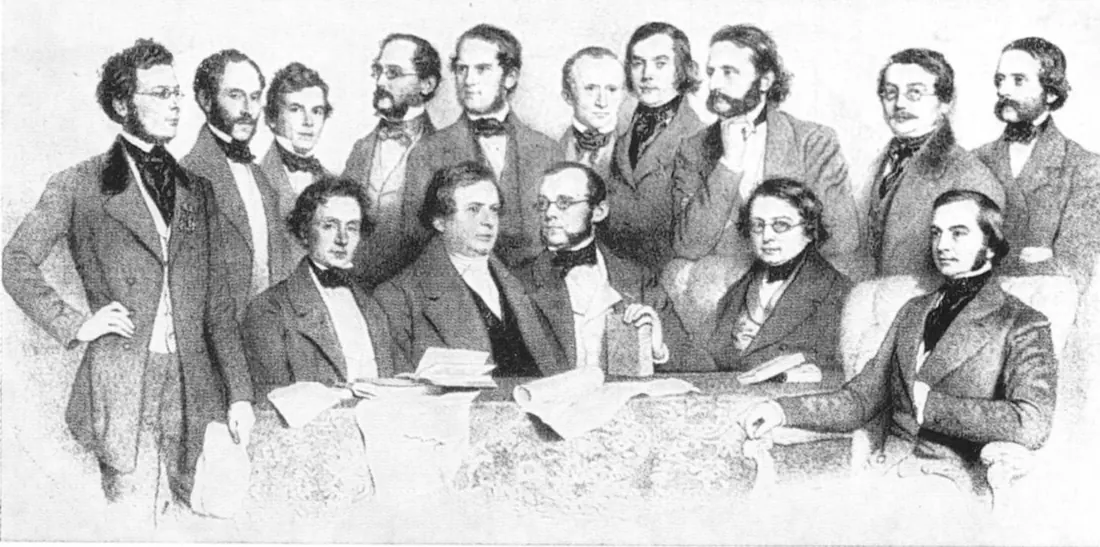
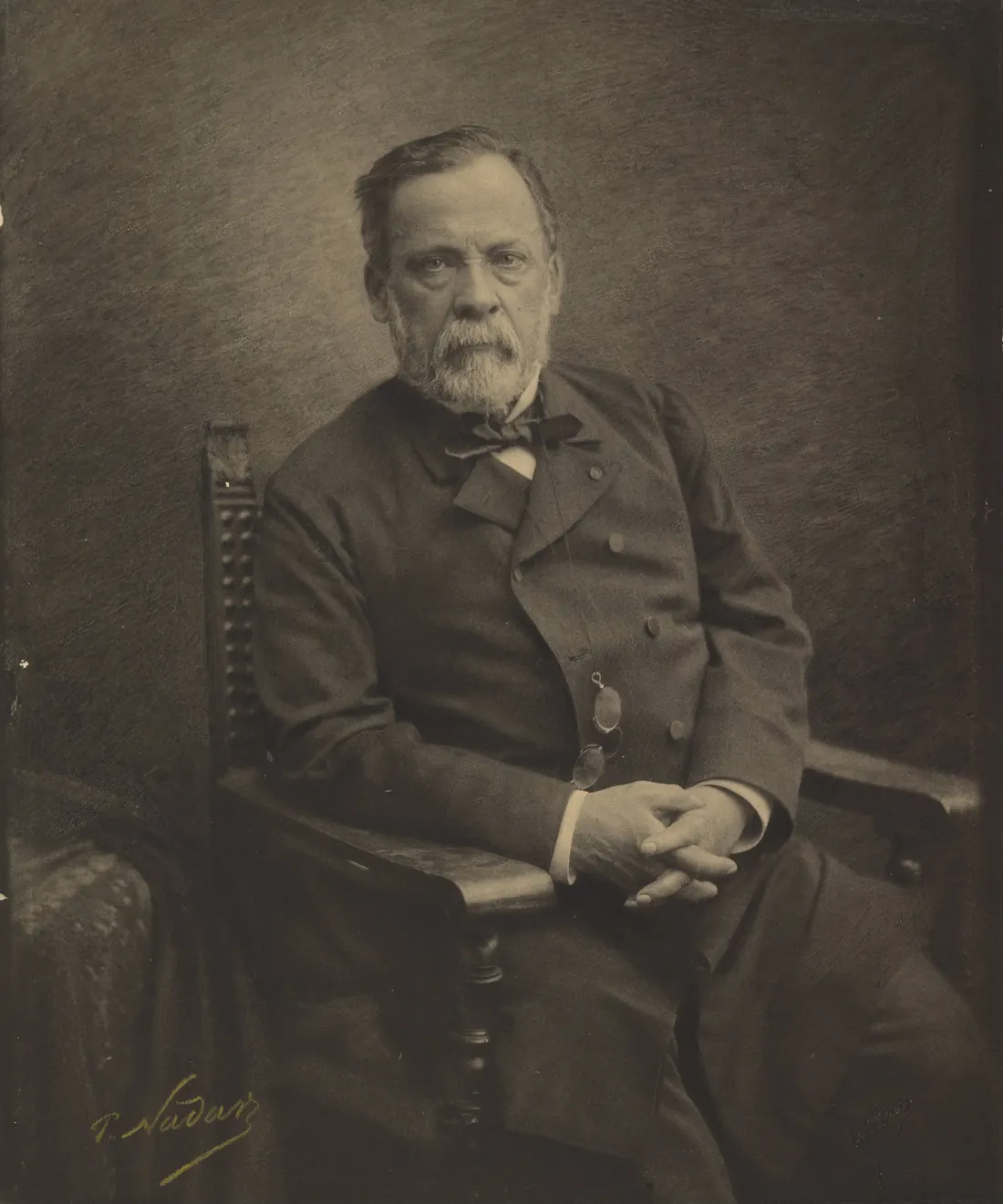
- Later, Pasteur and Lister proved him right. Wikipedia: “Semmelweis’s findings only gained widespread acceptance years after his death, when Louis Pasteur confirmed the germ theory of disease, giving Semmelweis’s observations a scientific explanation, and Joseph Lister, acting on Pasteur’s research, pioneered antiseptic surgical methods with great success.” 1
- Today, he’s called the savior of mothers. Science History Institute: he became known as the “savior of mothers.” Wikipedia: the “saviour of mothers.” 31
Sources
- Ignaz Semmelweis Wikipedia
- Historical mortality rates of puerperal fever (tables from Semmelweis’s 1861 book) Wikipedia
- Ignaz Semmelweis Science History Institute
- The Doctor Who Championed Hand-Washing And Briefly Saved Lives (January 12, 2015) NPR
- Ignaz Semmelweis: the original hand hygiene pioneer (February 9, 2026) Hektoen International
- Semmelweis’s Table I, in English translation (Medical Classics; Wellcome Collection L0004951) Wikimedia Commons
- Semmelweis’s Table XV, in English translation (Wellcome Collection L0004952) Wikimedia Commons
Notes
How much worse the doctors’ ward was: “three times higher” on average (the Science History Institute; Wikipedia’s lead says “thrice”); about four times in 1846 alone, 11.4% against 2.8% (Wikipedia’s table of his figures); “nearly five times higher” (NPR). The Short gives no multiplier (“far more”), and the page shows his own six-year totals, 9.92% against 3.38%.
The numbers: April 1847 is 18.3% (Wikipedia) or 18.27% (the Science History Institute and his Table XV); 1848 is 1.27% (the Science History Institute) or 1.3% (Wikipedia’s table of his figures). The Short says “nearly one mother in five” and “about one in a hundred,” which fits both.
Kolletschka “just like them”: Wikipedia says his autopsy showed “a pathology similar to that of the women,” the Science History Institute that his symptoms “closely resembled those of childbed fever.”
“Lost his job”: strictly, his assistant post was not renewed when it ran out on March 20, 1849 (Wikipedia); the Science History Institute calls it a dismissal, and NPR says he lost his job.
The beating: Wikipedia says he “was severely beaten by several guards” and Hektoen International that he was “beaten by attendants,” but NPR says he “was probably beaten,” so the Short says “reportedly,” and so do we. Whether the infected wound on his right hand came from the struggle or from an earlier cut is uncertain (Wikipedia: it “might have been caused by the struggle”), so we don’t link the two.
Which asylum: the Lower Austrian asylum in the Lazarettgasse, Vienna (Wikipedia, after Carter), or the Döbling asylum (German Wikipedia; the Science History Institute says Oberdöbling). We say only “an asylum in Vienna,” and show no picture of it.
His illness and the hook: what was wrong with him is unknown (Wikipedia quotes Carter: Alzheimer’s disease, late syphilis or exhaustion are all possible). The Short’s twist, that the man who told doctors to wash was locked up, is how NPR and Hektoen International tell it, but he was committed when his behavior had become erratic (“His contemporaries, including his wife, presumed he was losing his mind,” Wikipedia). Left out for length: women begging on their knees to avoid the doctors’ ward (Wikipedia).
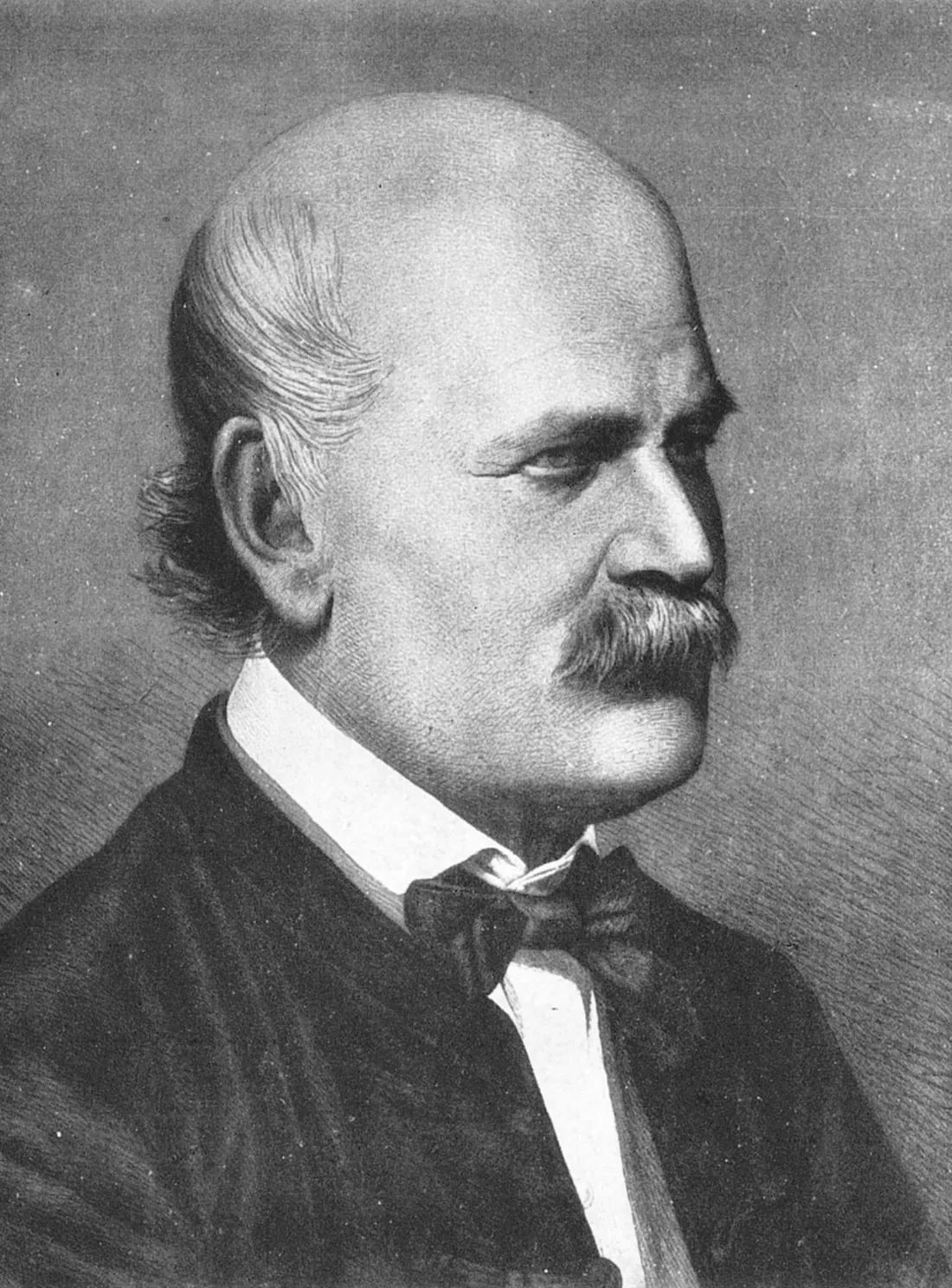
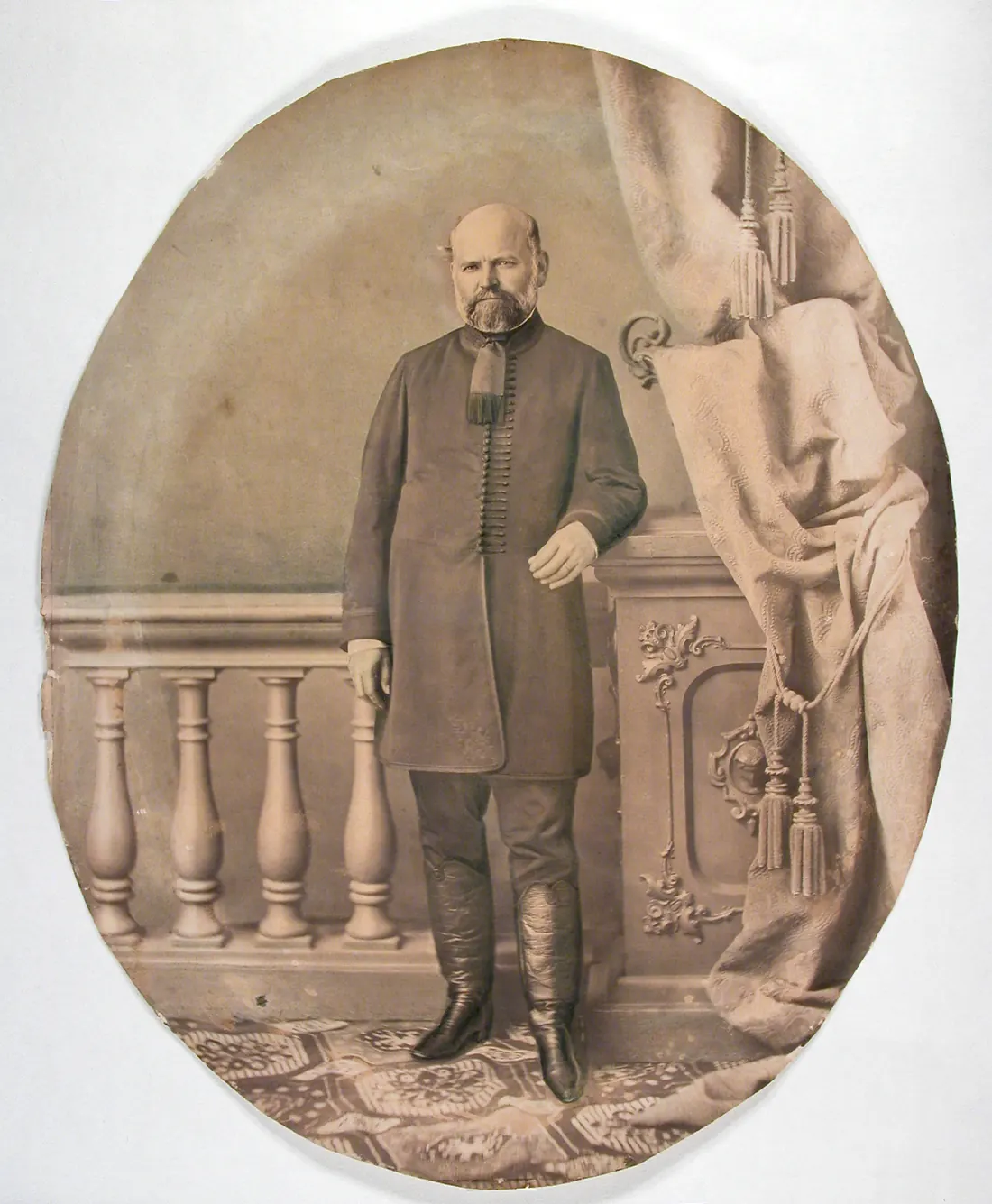
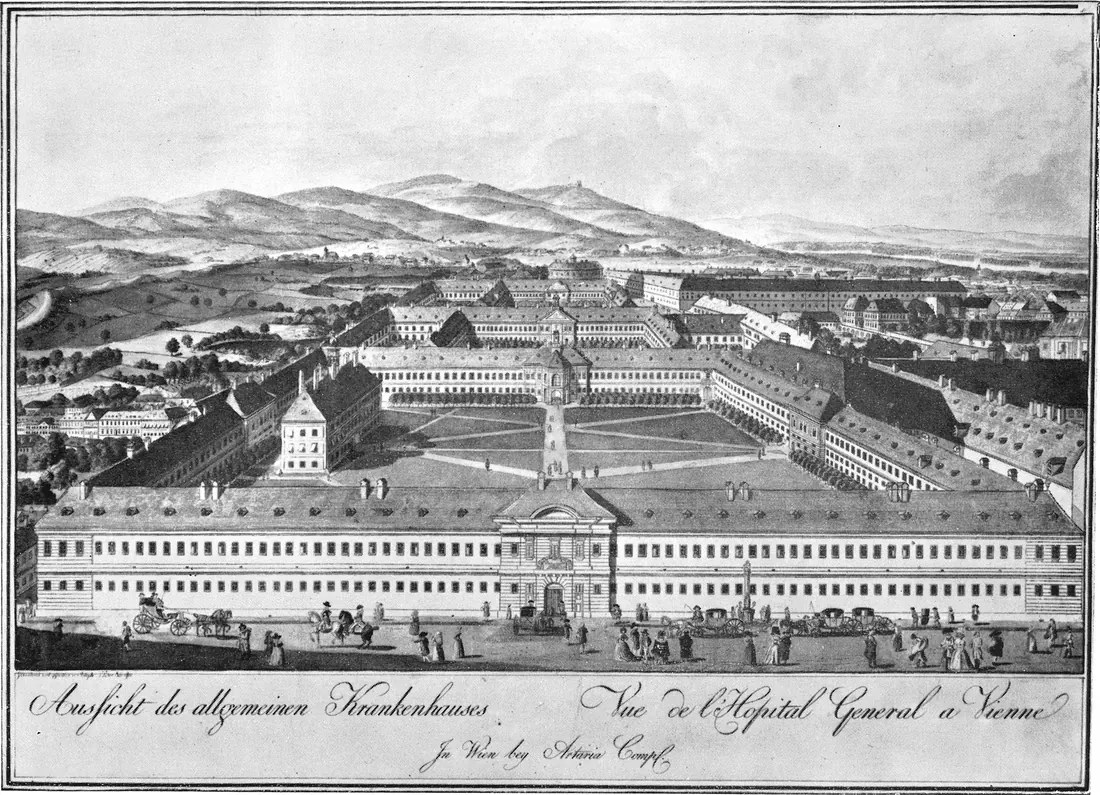
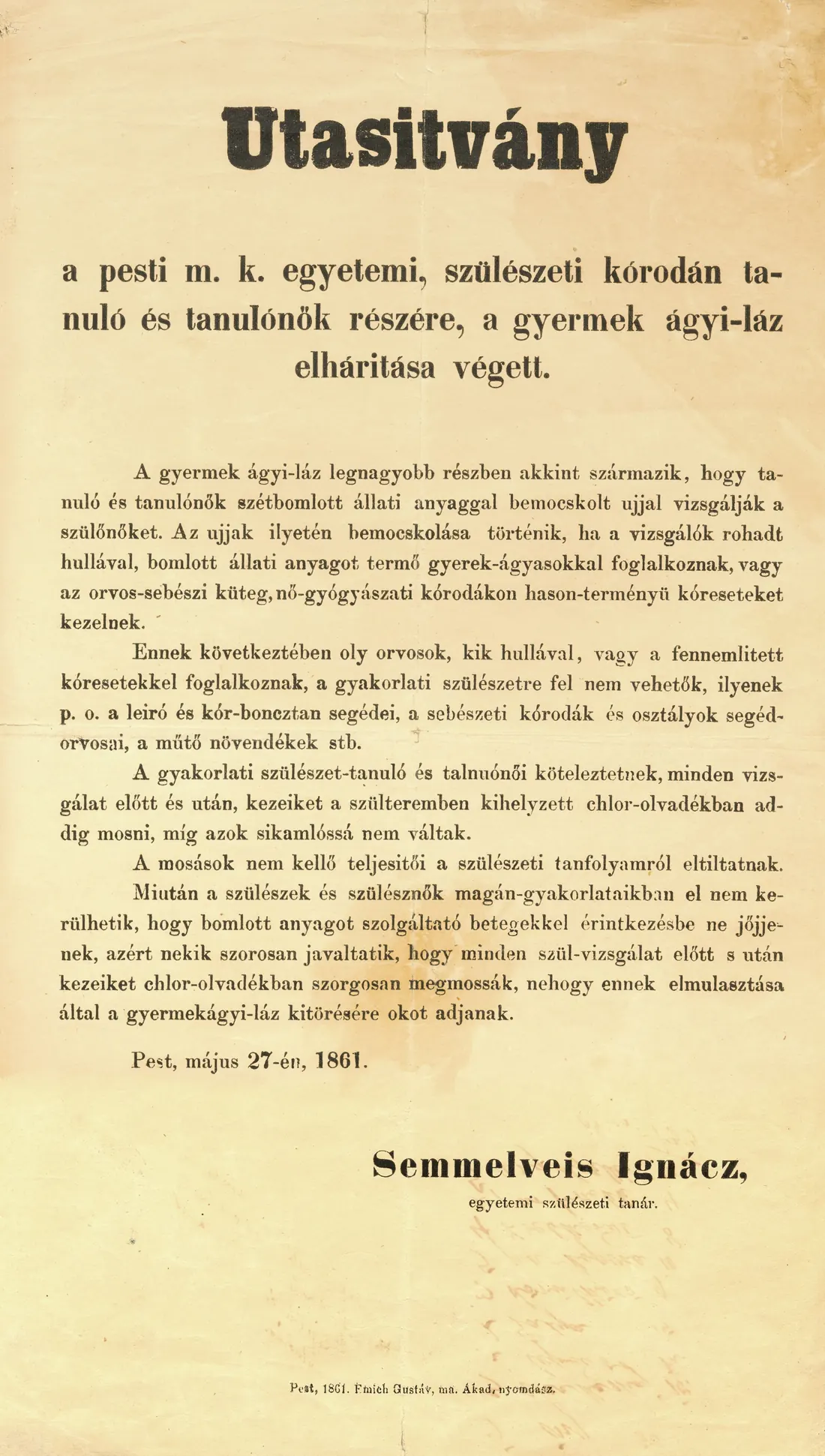
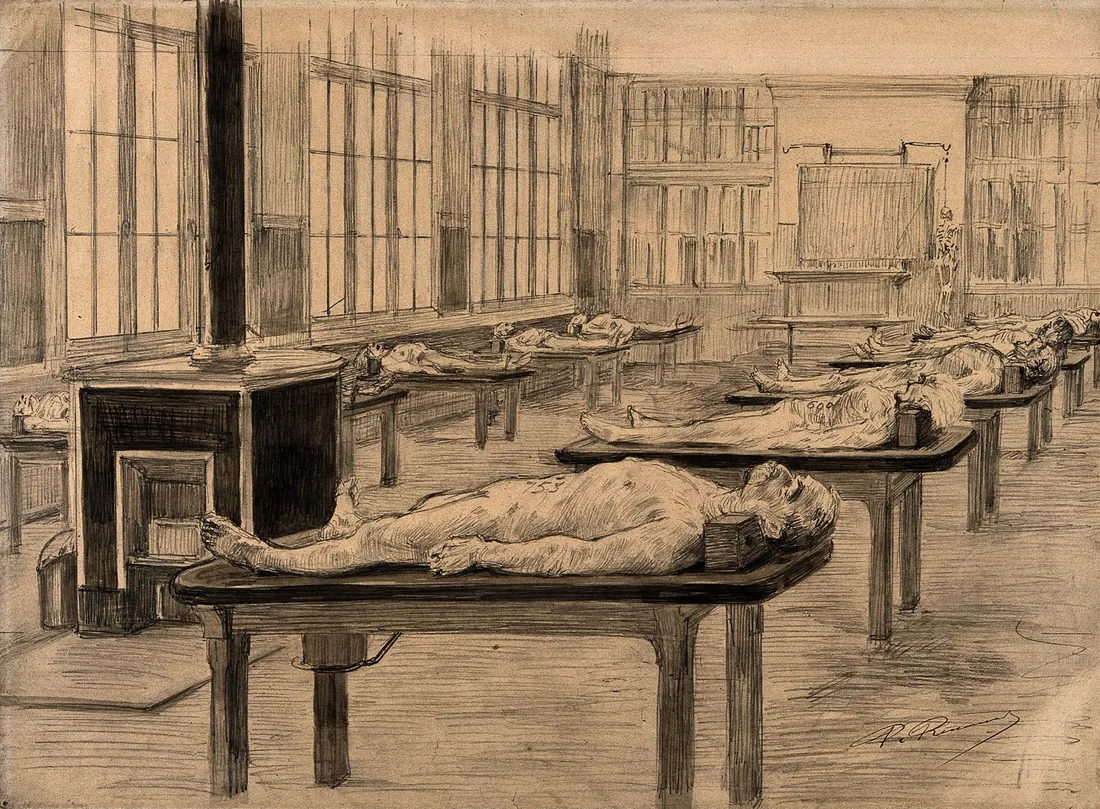
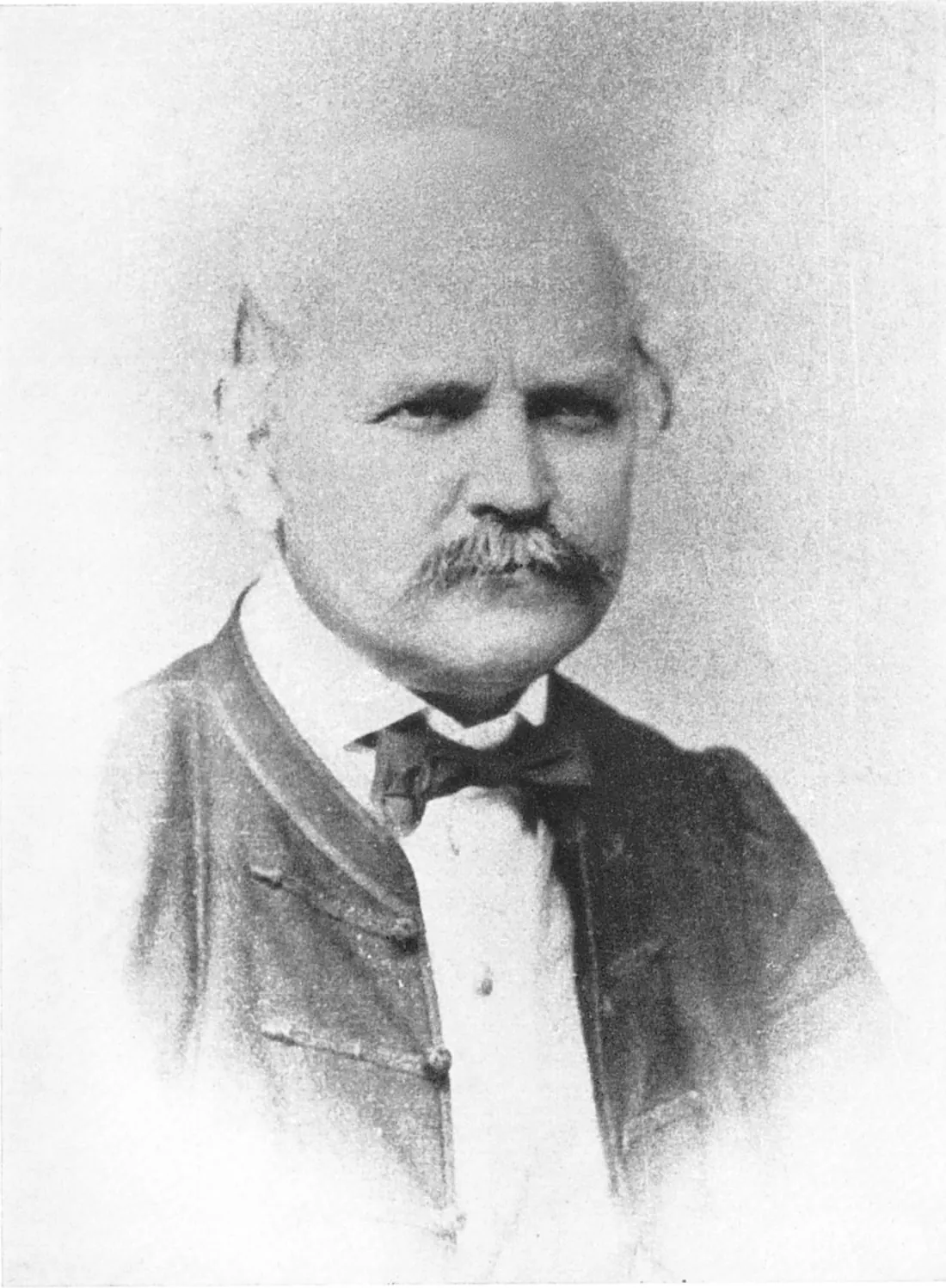
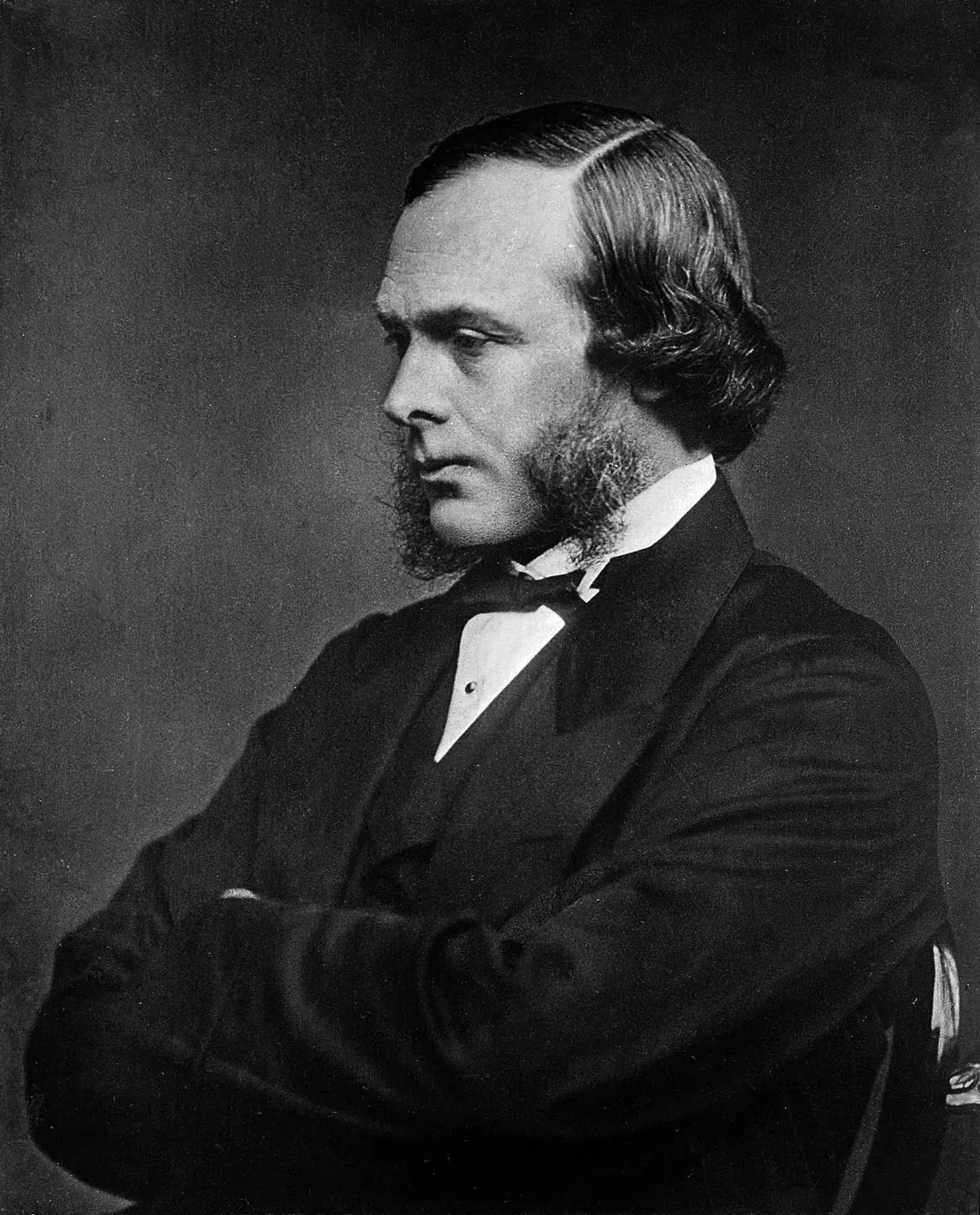
Pictures: Semmelweis himself is in Jenő Doby’s engraving after an 1860 photograph, the 1861 photograph by Borsos & Doctor in Pest, and his last photograph, taken by Ludwig Angerer in Vienna in 1864. His friend Jakob Kolletschka is in Josef Kriehuber’s lithograph of 1844. The Vienna General Hospital is shown in Josef and Peter Schaffer’s engraving of 1784, long before 1847; there is no picture of the 1847 wards. His Table I (1841–1846, cropped into its two halves, the Physician’s and the Midwives’ Divisions) and Table XV (month by month, 1846–May 1847) are from an English translation (Medical Classics, 1941) at the Wellcome Collection, and the chart of his monthly figures for 1841–1849 was drawn by the Wikimedia Commons user Power.corrupts. The dissecting room is Paul Renouard’s drawing of 1906, not Vienna; the hand-washing notice is the one he printed for students in Pest on May 27, 1861, not the 1847 Vienna order; August Prinzhofer’s lithograph of 1853 shows the Vienna medical faculty, not identified as his opponents. The title page is his Open Letter of 1862, and the 1865 case record (headed Krankengeschichte, case history, though its Commons description calls it an “obduction report”) is a plate in István Benedek’s book of 1983. Louis Pasteur was photographed by Paul Nadar in 1886, and Joseph Lister in about 1867.
Photo credits
The archive photos in this story
The photographs and illustrations in this story are in the public domain or shared under open licenses; each one is credited below with its license. Tap one to enlarge it, or follow the link to its Wikimedia Commons page for the full record. The narration, captions and graphics in the Short are our own; its music and sound effects are credited below.
Music and sound effects
Music: Brahms, Symphony No. 1 in C minor, Op. 68: I. Un poco sostenuto - Allegro (Musopen Symphony Orchestra, CC0); Brahms, Symphony No. 2 in D major, Op. 73: IV. Allegro con spirito (Musopen Symphony Orchestra, CC0); Tchaikovsky, Symphony No. 6 'Pathetique', Op. 74: IV. Finale: Adagio lamentoso (Musopen Symphony Orchestra, CC0); Brahms, Symphony No. 1 in C minor, Op. 68: IV. Adagio - Piu andante - Allegro non troppo, ma con brio (Musopen Symphony Orchestra, CC0).
Sound effects: Freesound, CC0.













































































_-_Google_Art_Project.jpg)


