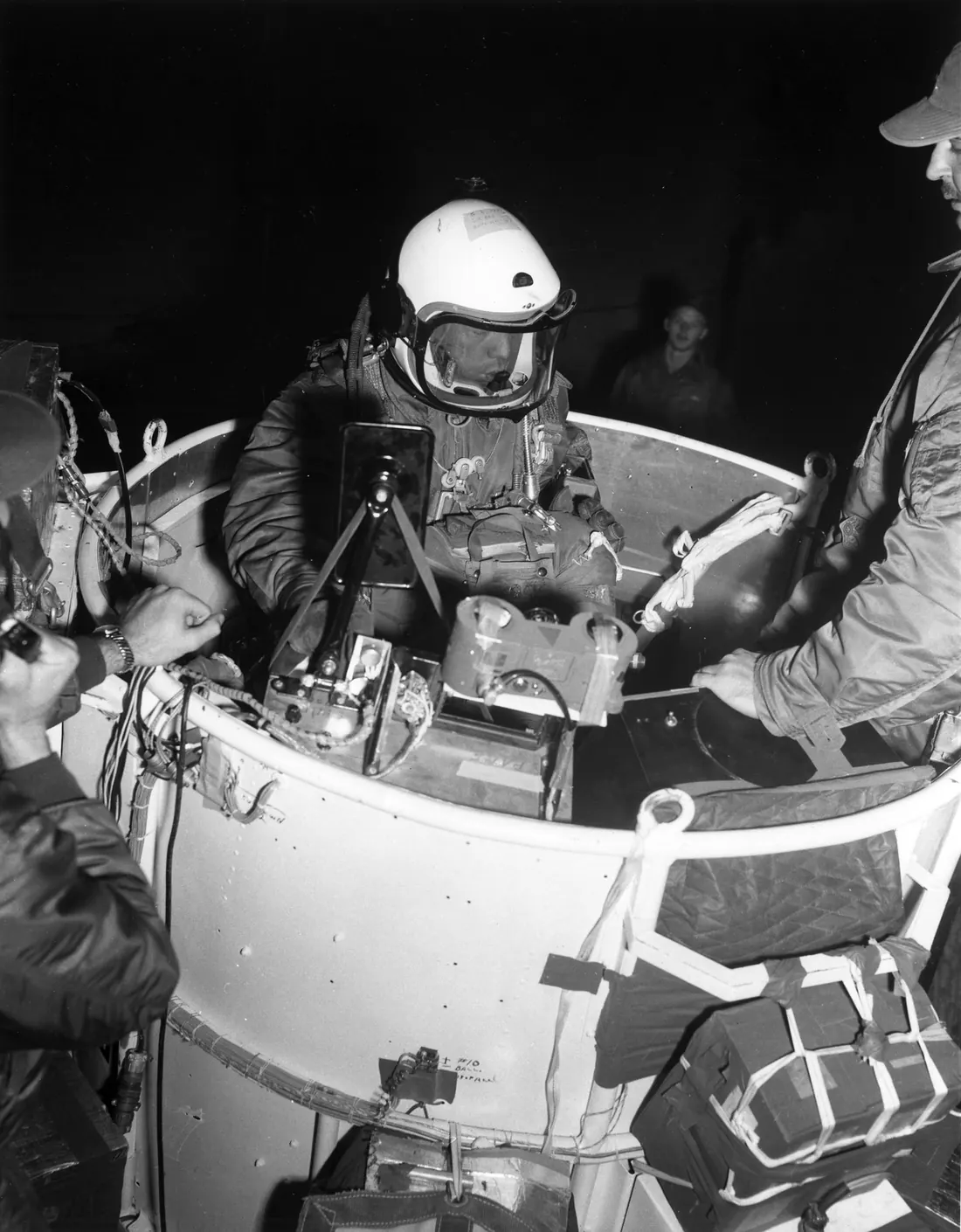
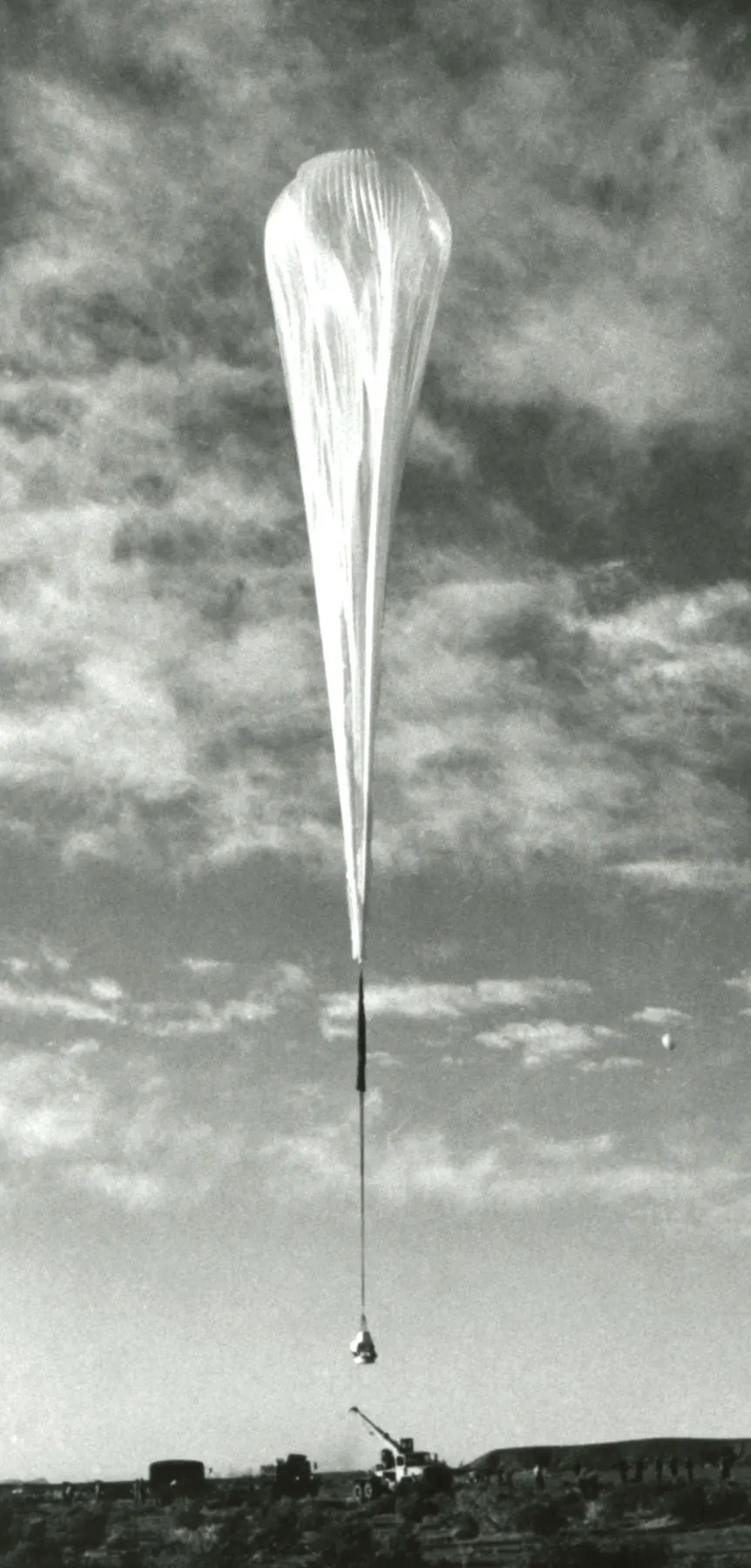
“Before Yuri Gagarin, Alan Shepard, John Glenn—before any human had rocketed away from Earth—Kittinger had reached the frontier of space,” the National Air and Space Museum says. Project Excelsior was testing “the Beaupre multi-stage parachute system intended to be used by pilots ejecting from high altitude,” with a “200 ft (61 m) high helium balloon … that could lift an open gondola and test pilot into the stratosphere.” “Captain Joseph Kittinger, who was test director for the project, made three ascents and test jumps.”
“He almost didn’t survive the first test,” in November 1959. “Kittinger’s drogue chute deployed too soon and failed to unfurl, causing suspension lines to wrap around his neck. He went into a flat spin of 90 rpm and lost consciousness.” But “Beaupre had anticipated this possibility and included an automatic reserve chute, which deployed at 10,000 feet. Beaupre’s backup plan saved Kittinger’s life.”
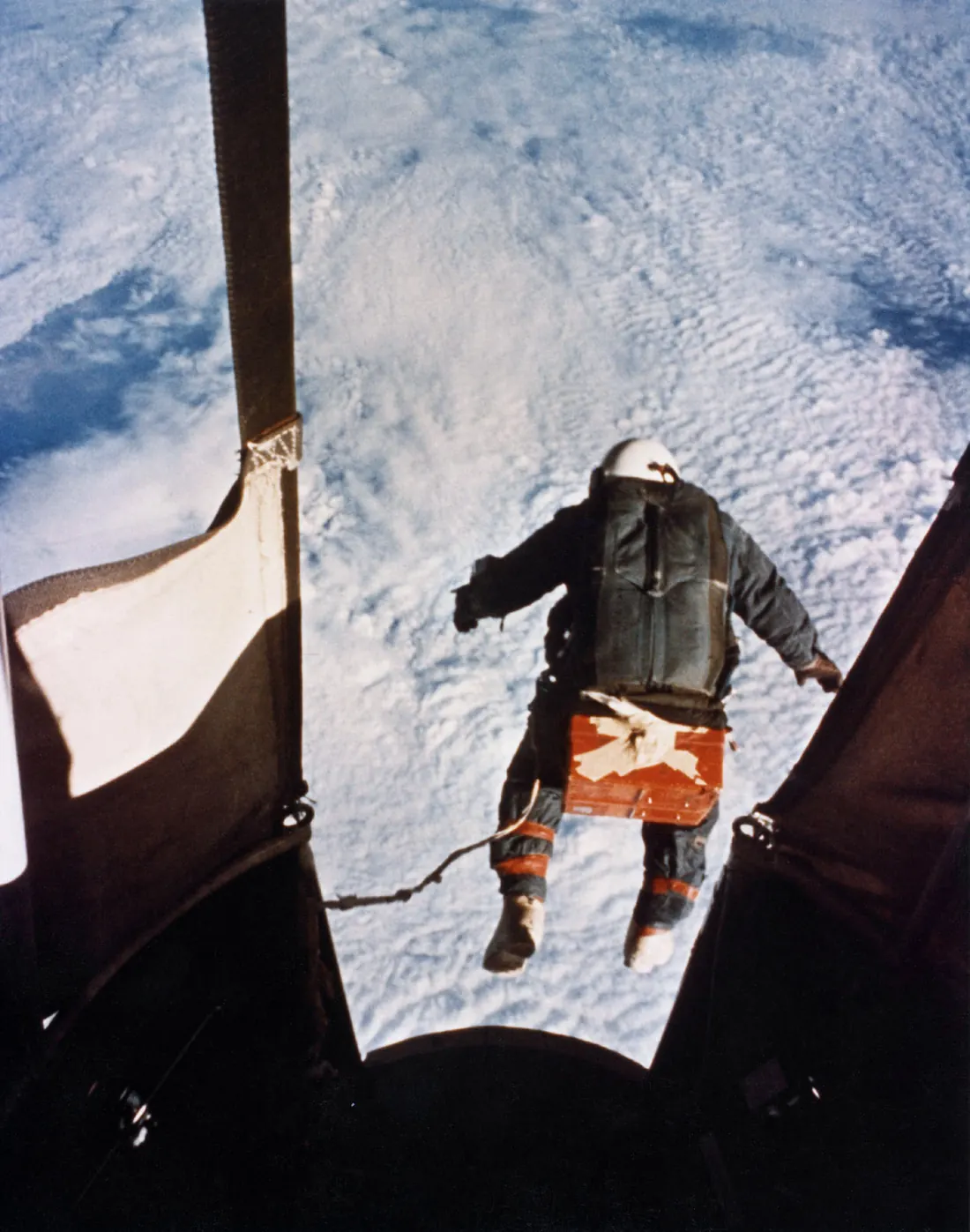
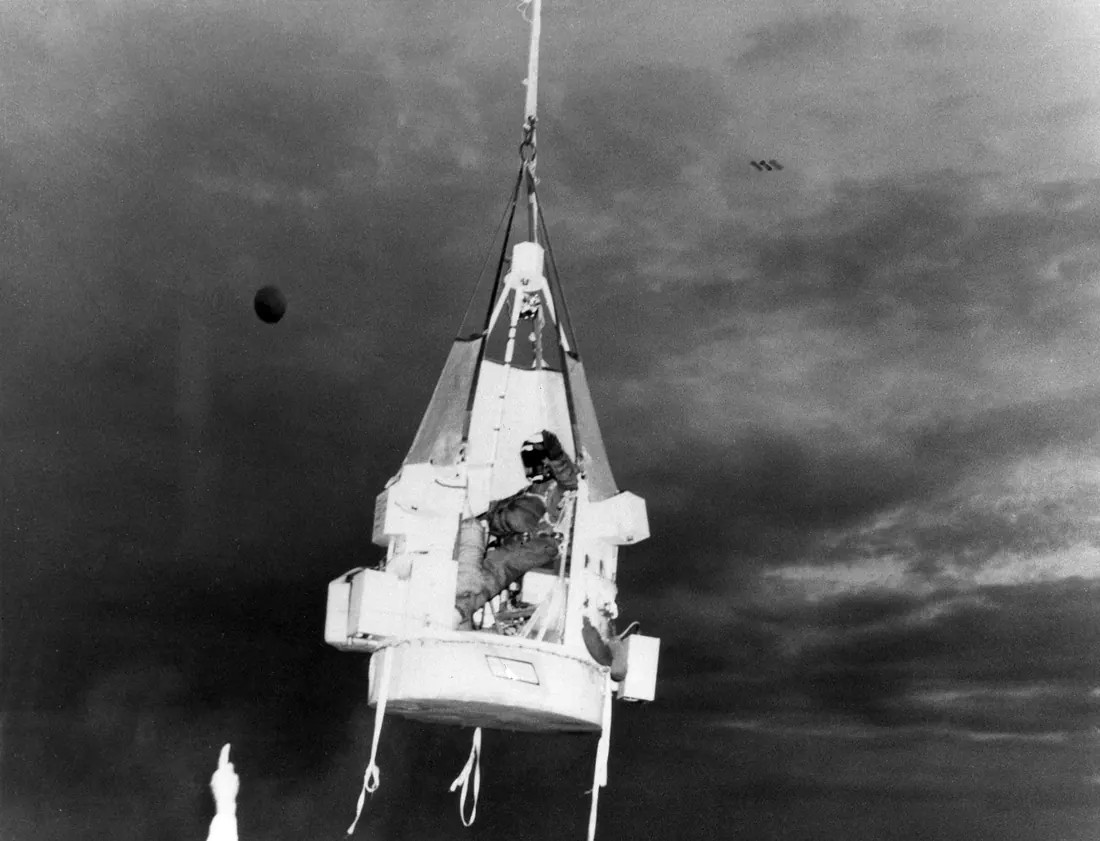
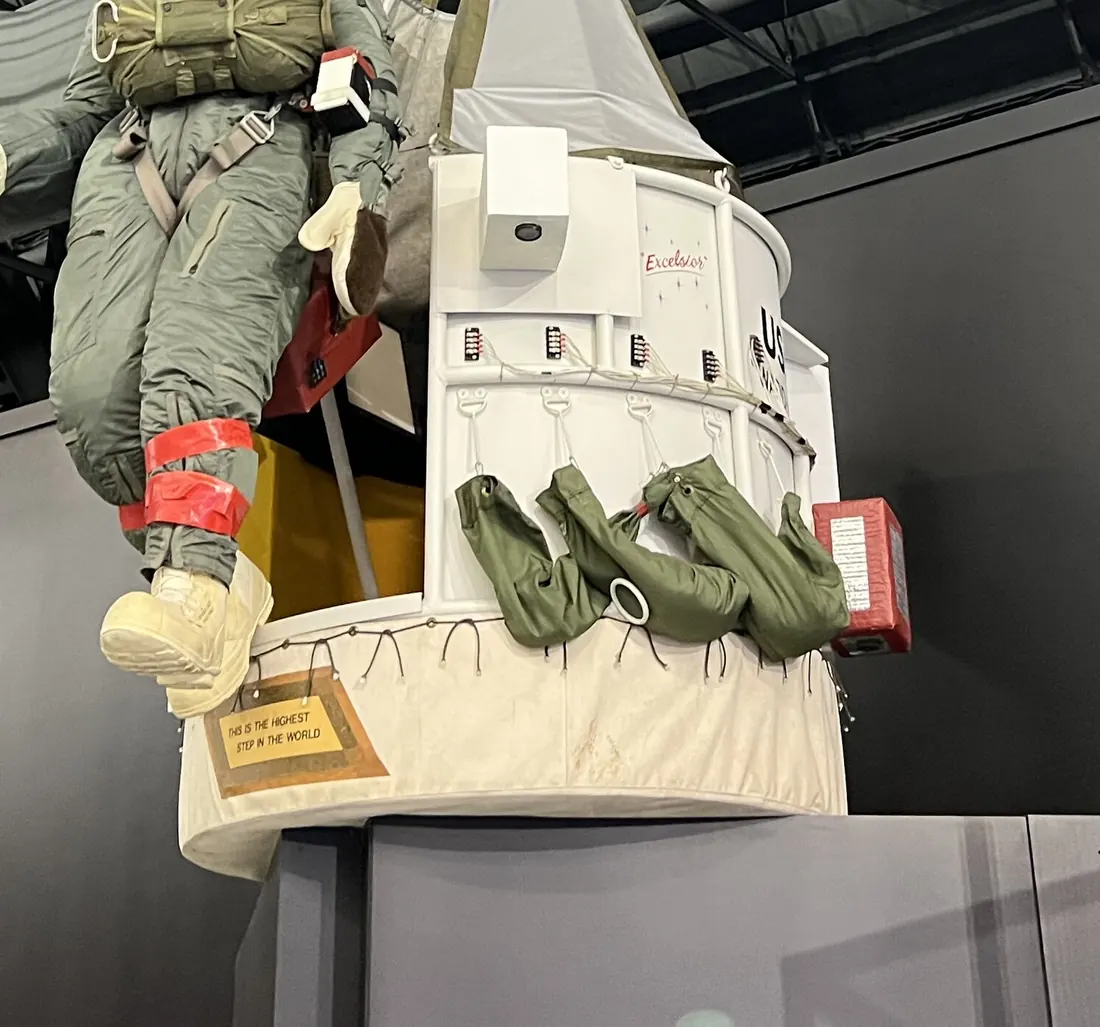
On August 16, 1960, “his open-air gondola ascended through the stratosphere” over the New Mexico desert. “During the ascent, one of his protective gloves had failed to pressurize,” and his right hand “had swollen to twice its normal size and was very painful.” “Kittinger did not let the ground crew know about his predicament until the last minute for fear of a mission abort.” At 102,800 feet, he “stood up and moved to the edge of the gondola, below which was posted a sign: ‘This is the highest step in the world.’” “He said a short prayer—‘Lord, take care of me now’—and then made the long lonely leap into history.”
“In freefall for 4.5 minutes at speeds up to 614 mph and temperatures as low as -94 degrees Fahrenheit, he opened his parachute at 18,000 feet.” “He looked at his hand and saw it was still swollen. Three hours later, it would return to normal.” The seven Mercury astronauts sent a cable: “Good show, Joe, the news of your continued penetrations of the space environment are most encouraging.”
His records for the highest parachute jump and the fastest velocity “stood for 52 years, until they were broken in 2012 by Felix Baumgartner.” Kittinger was “Baumgartner’s mentor and capsule communicator at mission control,” and as the final checks were made he said, “OK, we’re getting serious now, Felix.” Kittinger died on December 9, 2022, aged 94. “He is buried at Arlington National Cemetery.”
Fact check
The facts and where they come from
- He jumped from 19 miles above the Earth, but his glove had already failed. The National Air and Space Museum: “then Capt. Kittinger stepped from a balloon-supported gondola at the altitude of 102,800 feet (31,300 meters)”; “During the ascent, one of his protective gloves had failed to pressurize.” Wikipedia: “Altitude: 19.47 mi (31.33 km).” 12
- His name was Joe Kittinger, an Air Force test pilot. The museum: “The celebrated fighter pilot, test pilot, aeronaut, and adventurer.” Wikipedia: “Captain Joseph Kittinger, who was test director for the project, made three ascents and test jumps.” 12
- No human had been to space yet. The museum: “Before Yuri Gagarin, Alan Shepard, John Glenn—before any human had rocketed away from Earth—Kittinger had reached the frontier of space.” 1
- On his first test jump, in November 1959, he spun so fast he blacked out. The museum: “He almost didn’t survive the first test. Kittinger’s drogue chute deployed too soon and failed to unfurl, causing suspension lines to wrap around his neck. He went into a flat spin of 90 rpm and lost consciousness.” 12
- A backup parachute saved him. The museum: “Beaupre had anticipated this possibility and included an automatic reserve chute, which deployed at 10,000 feet. Beaupre’s backup plan saved Kittinger’s life.” 1
- On August 16, 1960, a giant balloon lifted his open gondola. Wikipedia: a “200 ft (61 m) high helium balloon … that could lift an open gondola and test pilot into the stratosphere.” The museum: “his open-air gondola ascended through the stratosphere.” 21
- On the way up, his right glove failed. The museum: “Kittinger’s right glove failed to pressurize prior to his last jump due to a broken seal.” Wikipedia: “the pressurization for his right glove malfunctioned during the ascent.” 13
- His hand swelled to twice its size. The museum: “his right hand, which had swollen to twice its normal size and was very painful.” Wikipedia: “his right hand swelled to twice its normal size.” 13
- He didn’t tell the ground crew until the last minute, afraid they’d call it off. The museum: “Kittinger did not let the ground crew know about his predicament until the last minute for fear of a mission abort.” 1
- At the edge, a sign read, “This is the highest step in the world.” The museum: “Kittinger stood up and moved to the edge of the gondola, below which was posted a sign: ‘This is the highest step in the world.’” 1
- He said, “Lord, take care of me now.” The museum: “He said a short prayer—‘Lord, take care of me now’—and then made the long lonely leap into history.” 13
- Then he stepped off: he “made the long lonely leap into history.” 1
- He fell for four and a half minutes, reaching 614 miles an hour. The museum: “In freefall for 4.5 minutes at speeds up to 614 mph.” Wikipedia: “Kittinger fell for 4 minutes and 36 seconds”; “he reached a top speed of 614 miles per hour (988 km/h).” 12
- His record stood for 52 years. Wikipedia: “His records for highest parachute jump and fastest velocity stood for 52 years, until they were broken in 2012 by Felix Baumgartner.” 32
- When another man broke it, the voice on his radio was Joe’s. Wikipedia: Baumgartner broke “the record for the highest-altitude jump, set in 1960 by USAF Colonel Joseph Kittinger, who was Baumgartner’s mentor and capsule communicator at mission control”; “As the final checks were being undertaken, Kittinger said to Baumgartner, ‘OK, we’re getting serious now, Felix.’” The museum: “Kittinger mentored Baumgartner and handled communications with his balloon capsule.” 41
Sources
- Space Jumper (Air & Space Quarterly, Summer 2023) Smithsonian National Air and Space Museum
- Project Excelsior Wikipedia
- Joseph Kittinger Wikipedia
- Red Bull Stratos Wikipedia
Notes
Free-fall time: 4 minutes 36 seconds (Wikipedia’s Excelsior article), “4.5 minutes” (the museum’s caption) or 4 minutes 38 seconds (the museum’s text and the citation quoted on Wikipedia), so the page says “about four and a half minutes.”
The spin on the first jump was 90 rpm (the museum) or 120 rpm (Wikipedia), and the main parachute opened at 18,000 feet (the museum and Wikipedia’s Kittinger article) or 17,500 feet (the Excelsior article).
The ground crew: the museum says he kept the glove from them “until the last minute”; Wikipedia’s Excelsior article says he decided not to tell them. The page follows the museum.
In 1960 he was a captain and the project’s test director; the museum and Wikipedia call him a test pilot. 102,800 feet is 19.47 miles, rounded down to 19. The page never claims he went to space; Gagarin flew in April 1961.
“His record” means the jump: the balloon altitude record fell in 1961, while his records for the highest parachute jump and the fastest velocity stood for 52 years.
Left out: his later military career and his other balloon flights. Felix Baumgartner is named only as Wikipedia’s accounts of the 2012 jump name him.
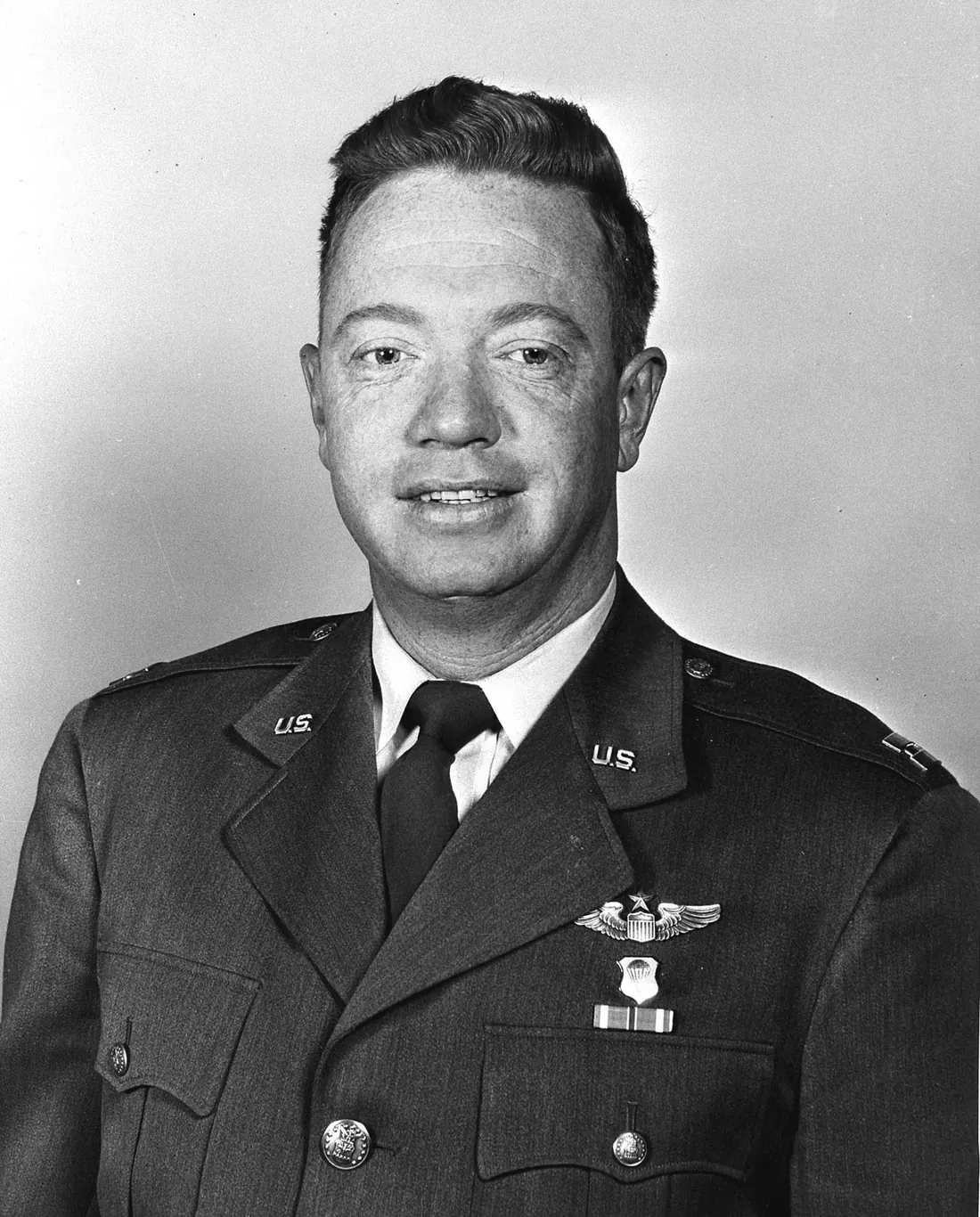
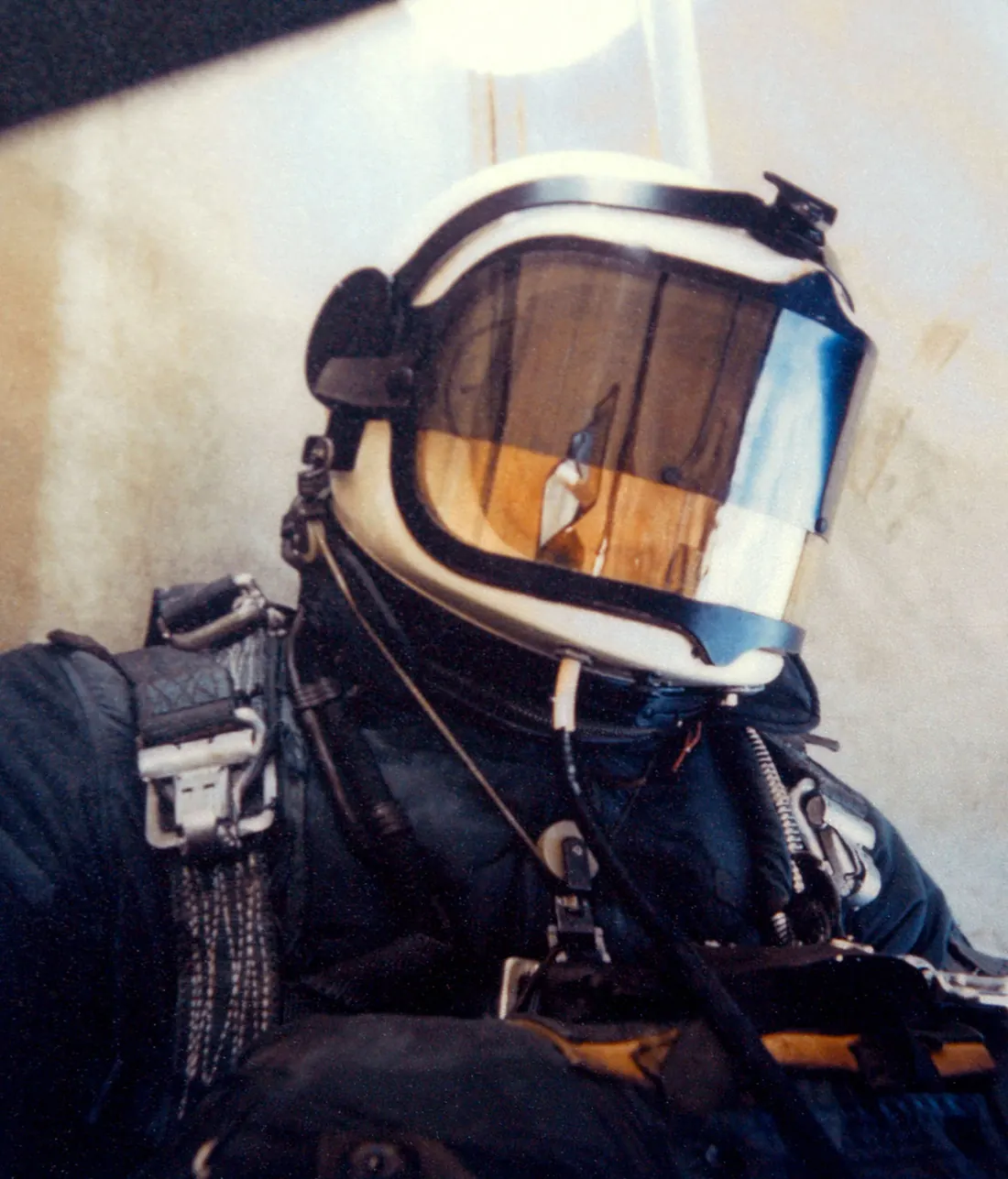
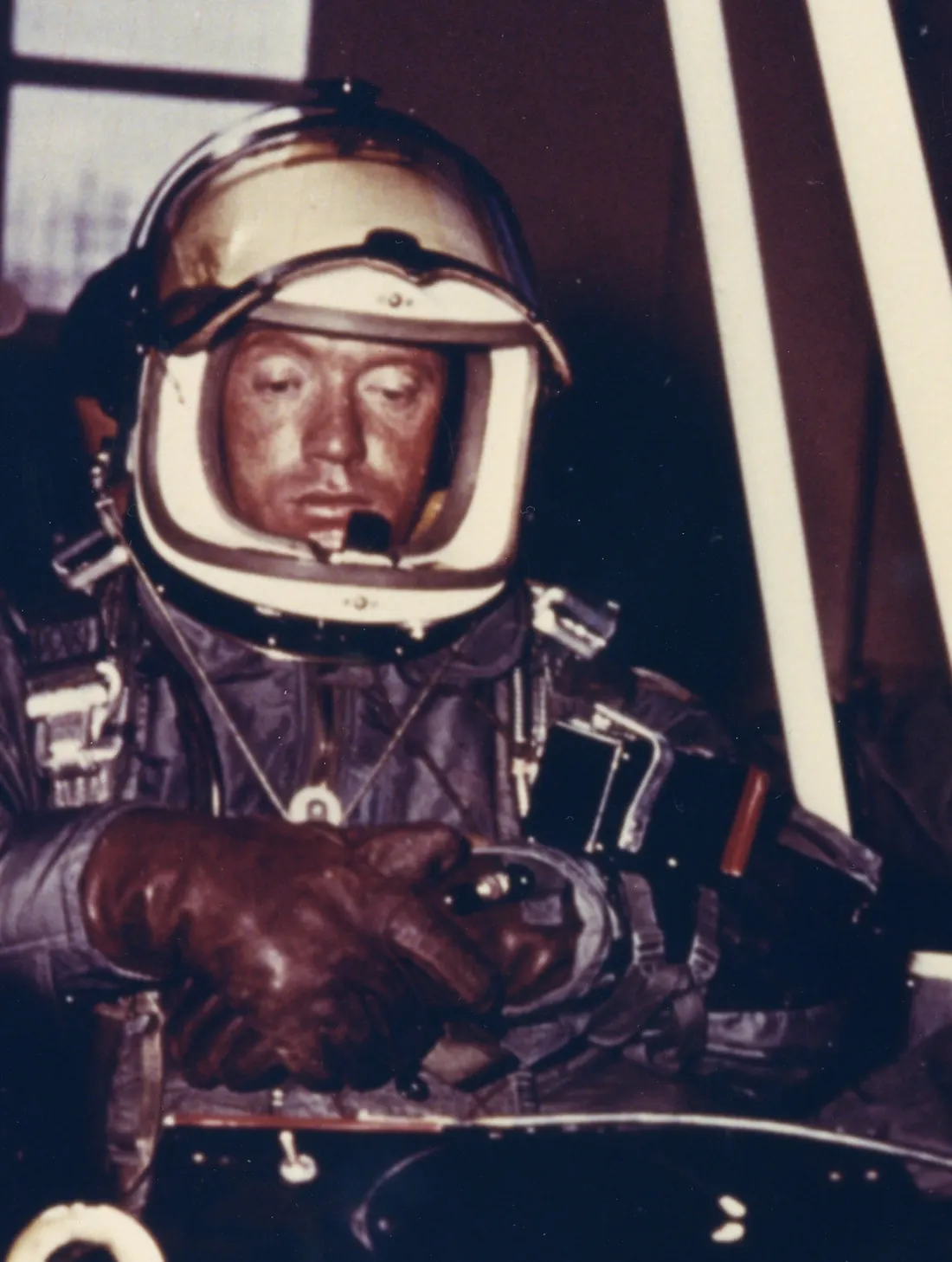
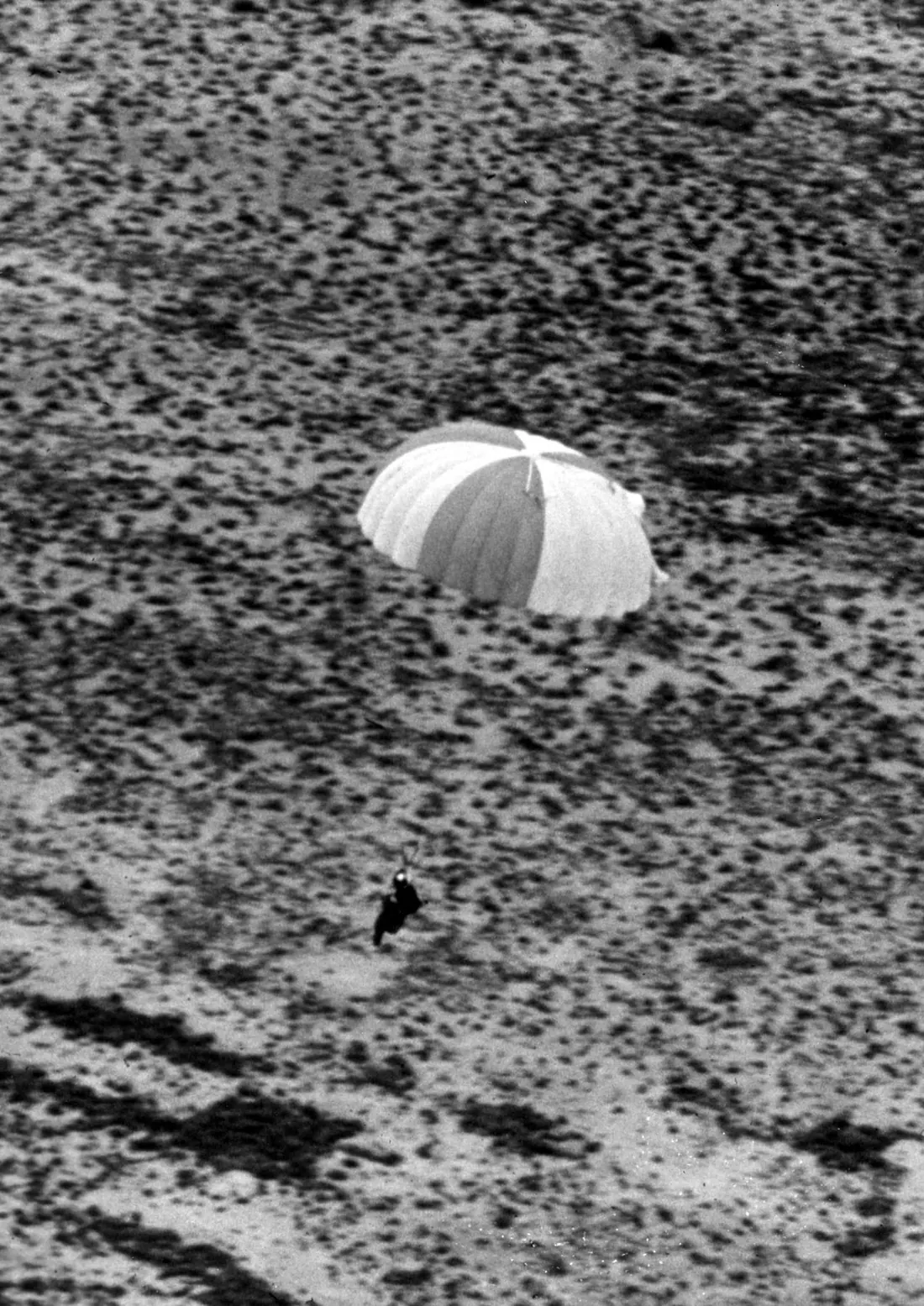
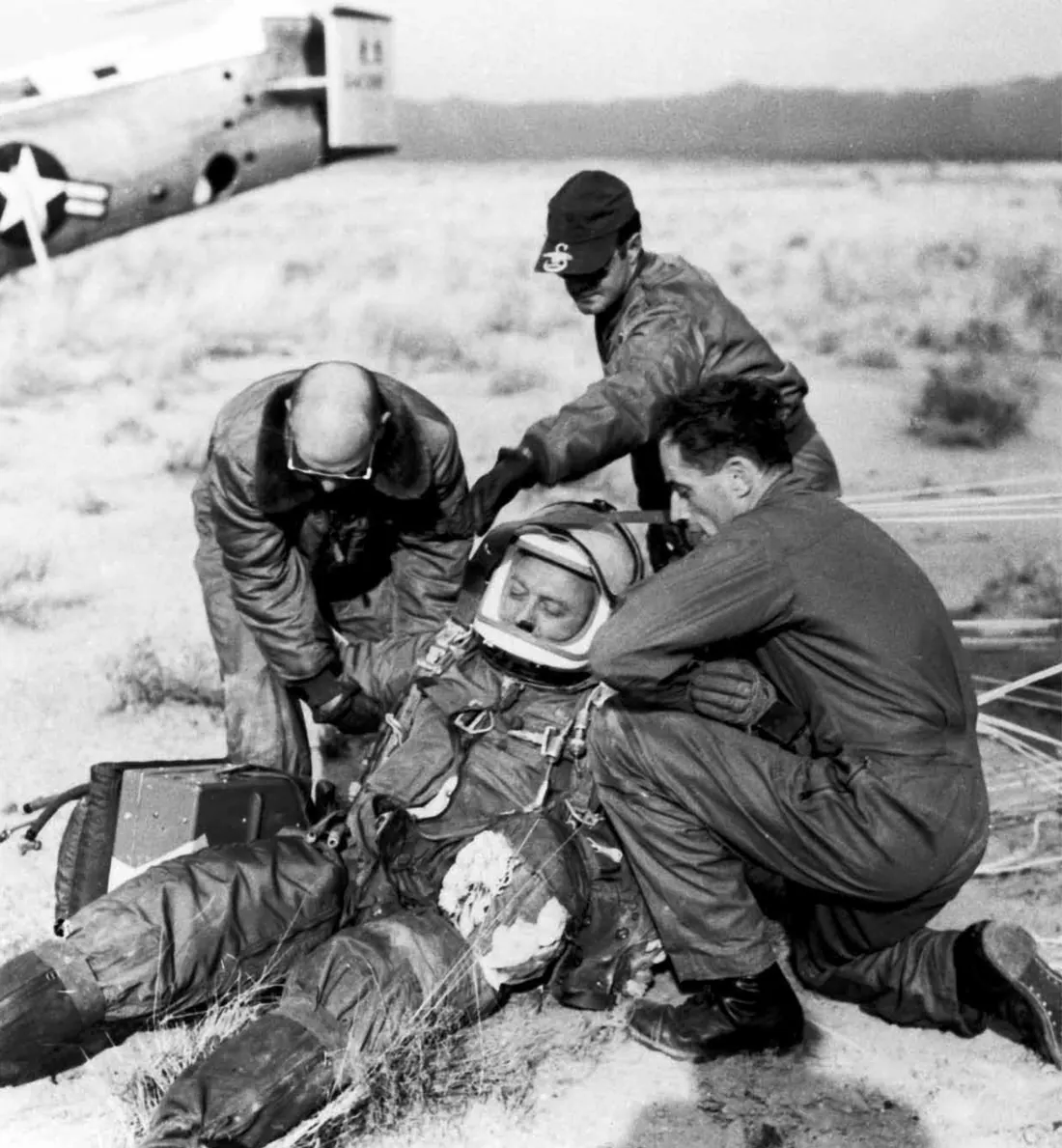
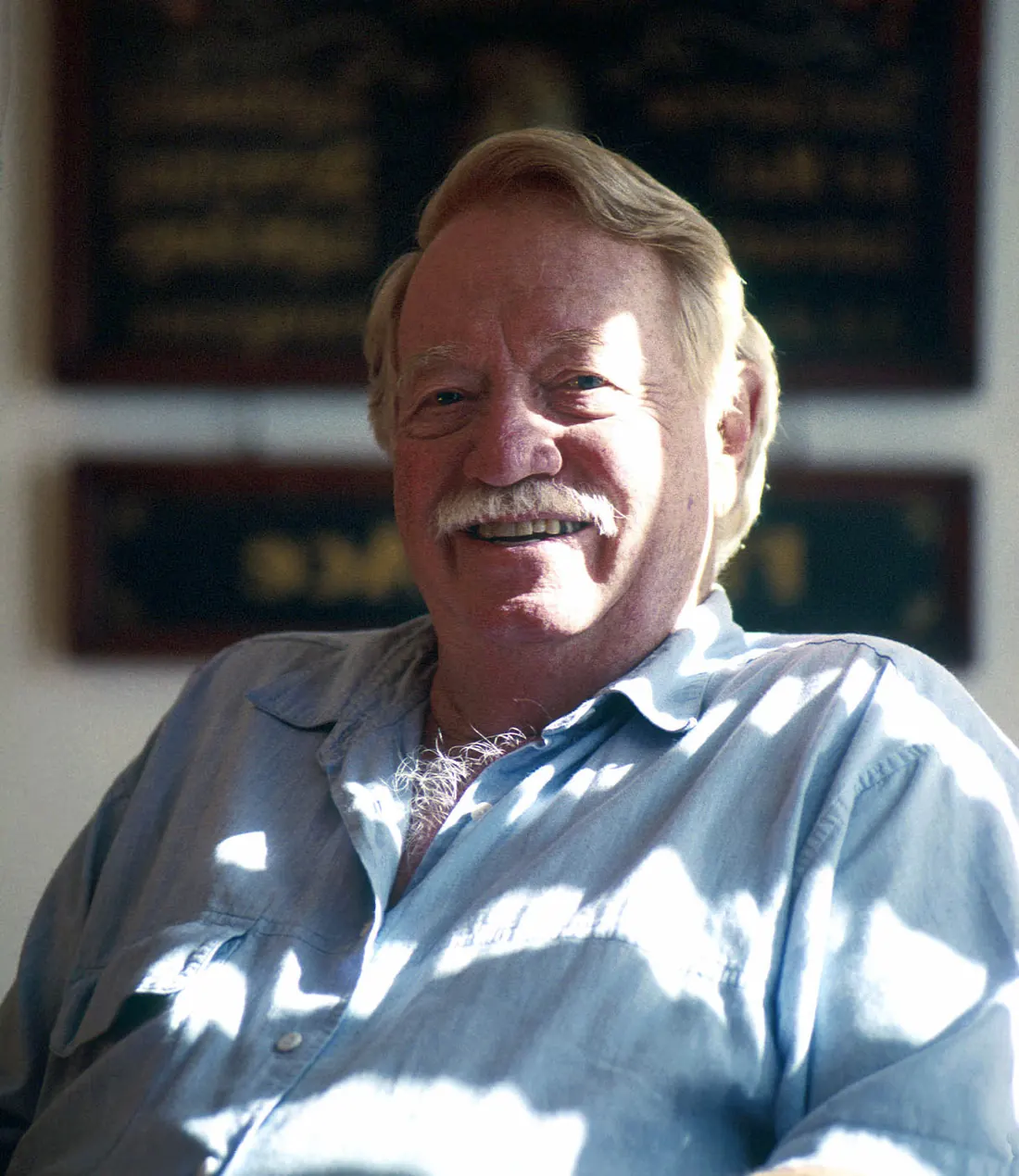
Pictures: all are US Air Force photos in the public domain, except the replica. The step photo, taken by an automatic camera on the gondola at 102,800 feet on August 16, 1960, is published by the National Museum of the US Air Force and the Smithsonian as a US Air Force photo. The ascent photos and the ground crew helping him out of his gear are from the same day. The photos of him in the gondola, before a flight and coming down under his parachute are from the Excelsior test flights of November 1959 or August 1960; which one isn’t known. No photo of his swollen hand exists. The sign is shown on a replica of the Excelsior III gondola at the National Museum of the US Air Force, photographed in 2023, not the real gondola. The last photo shows him as a retired colonel in December 1999. No free photo of Kittinger with Baumgartner exists.
Photo credits
The archive photos in this story
The photographs and illustrations in this story are in the public domain or shared under open licenses; each one is credited below with its license. Tap one to enlarge it, or follow the link to its Wikimedia Commons page for the full record. The narration, captions and graphics in the Short are our own; its music and sound effects are credited below.
Music and sound effects
Music: Schumann, Kinderszenen, Op. 15: No. 1 'Of Foreign Lands and Peoples (Musopen, public domain); Mussorgsky, Pictures at an Exhibition: IV. Bydlo (piano) (Musopen, public domain); Dvorak, Symphony No. 9 'From the New World': II. Largo (Musopen, public domain).
Sound effects: Freesound, CC0.