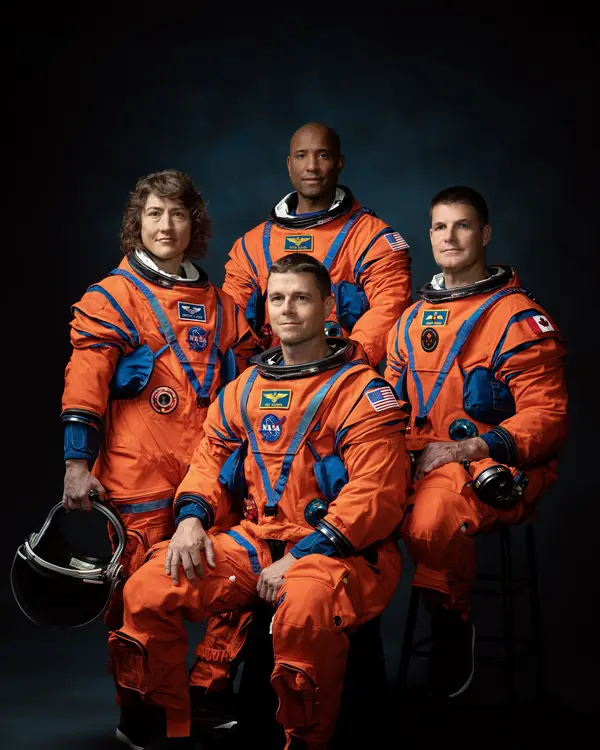
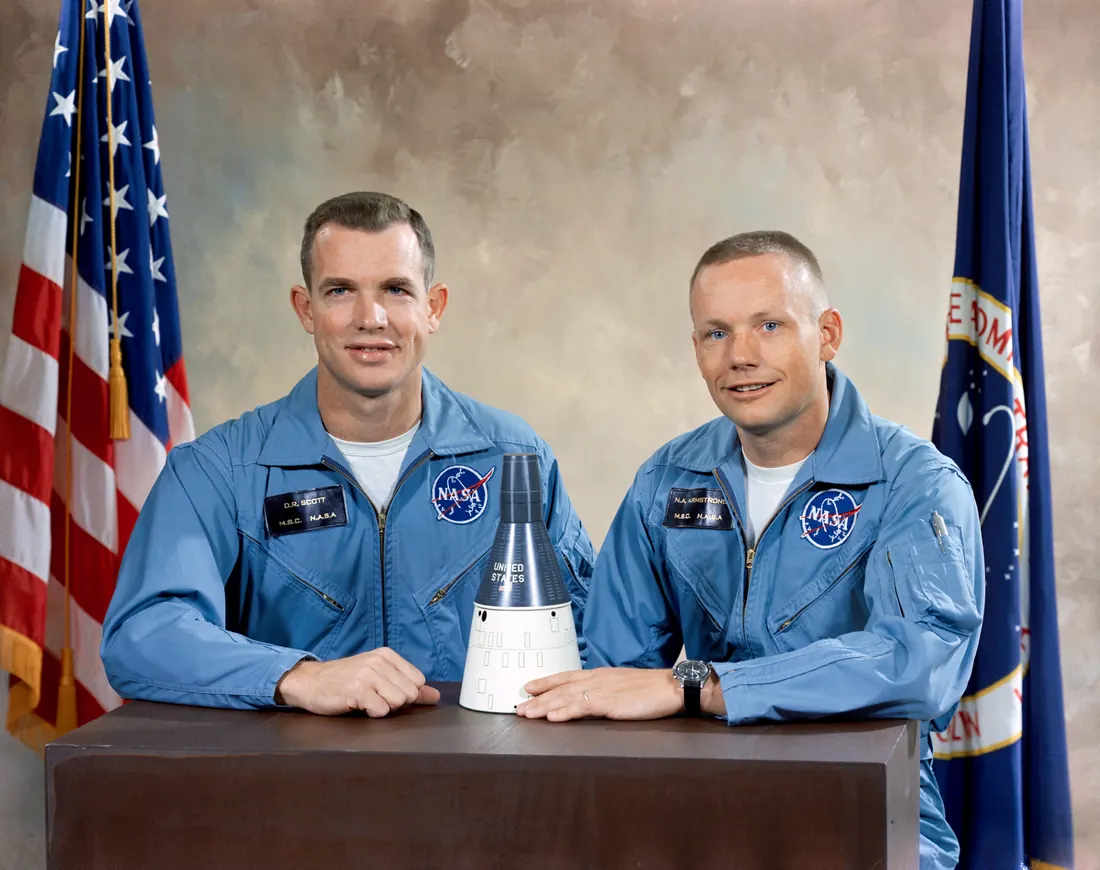
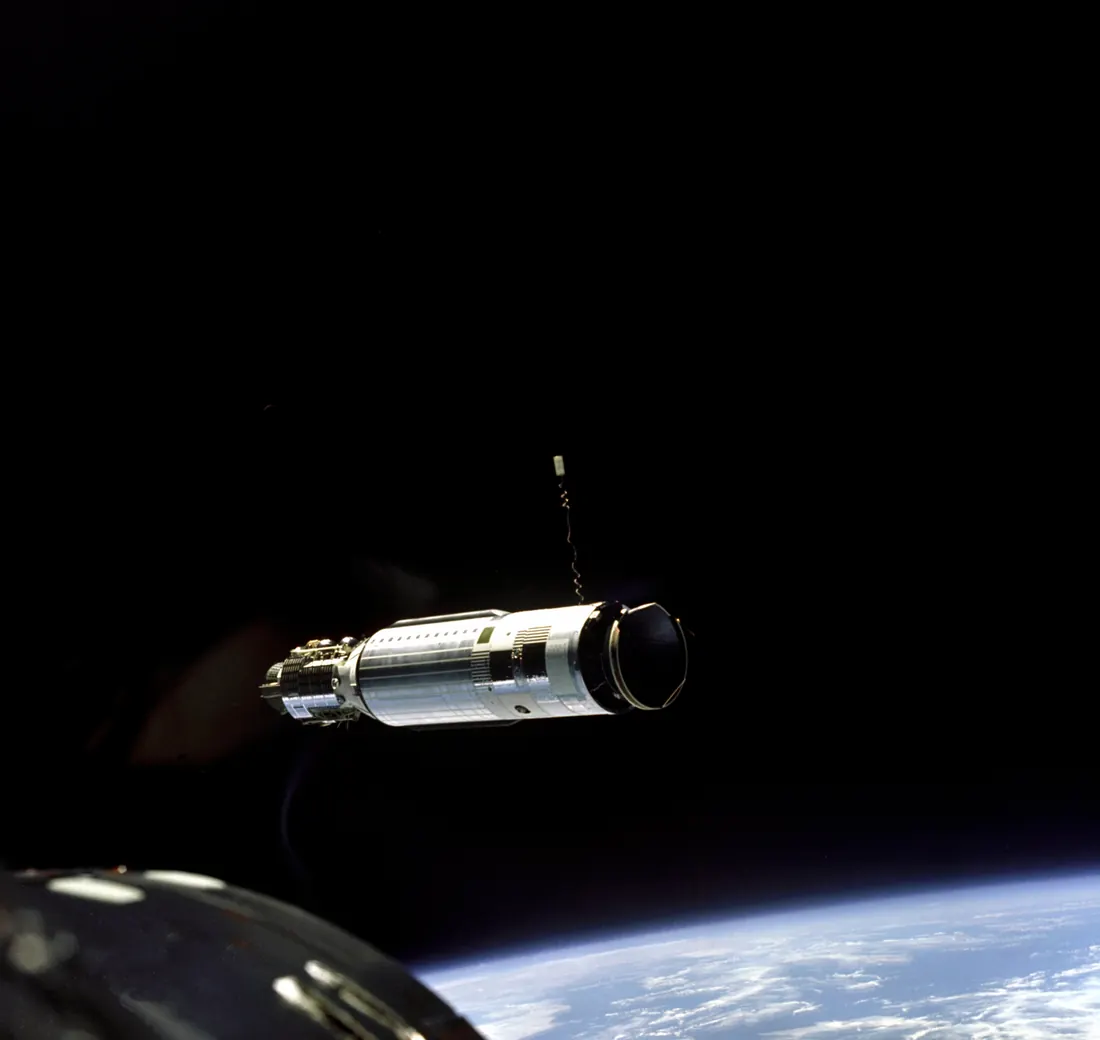
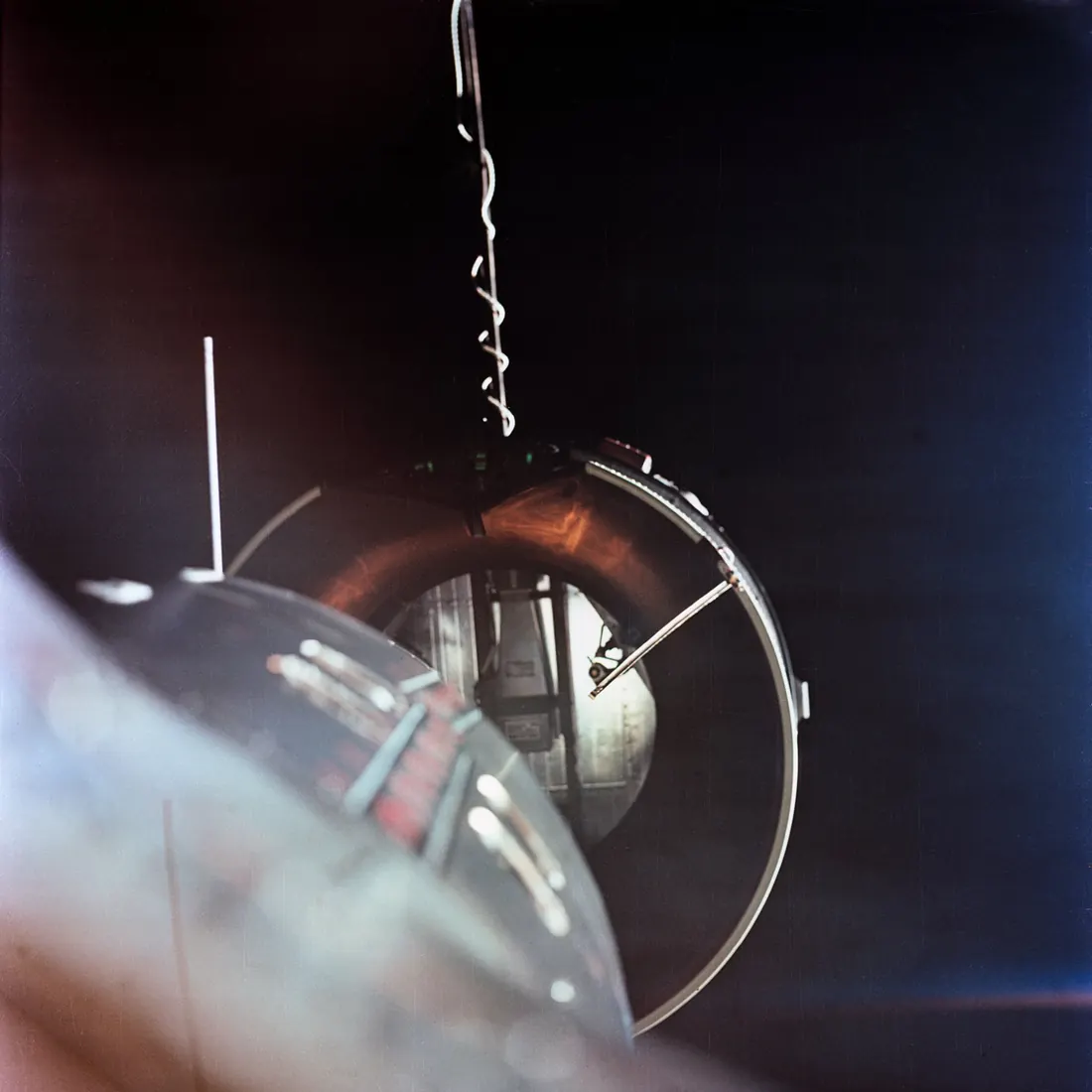
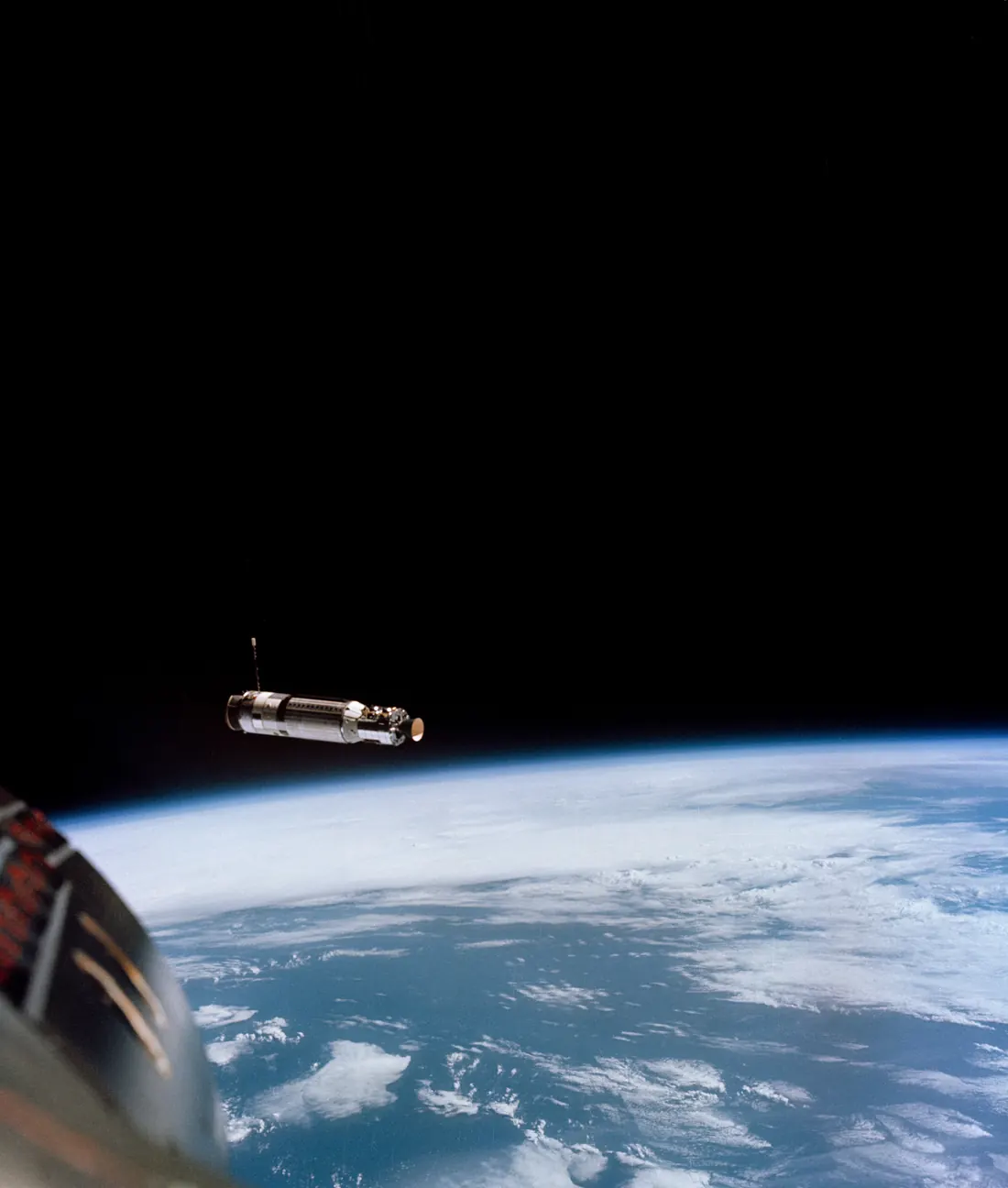
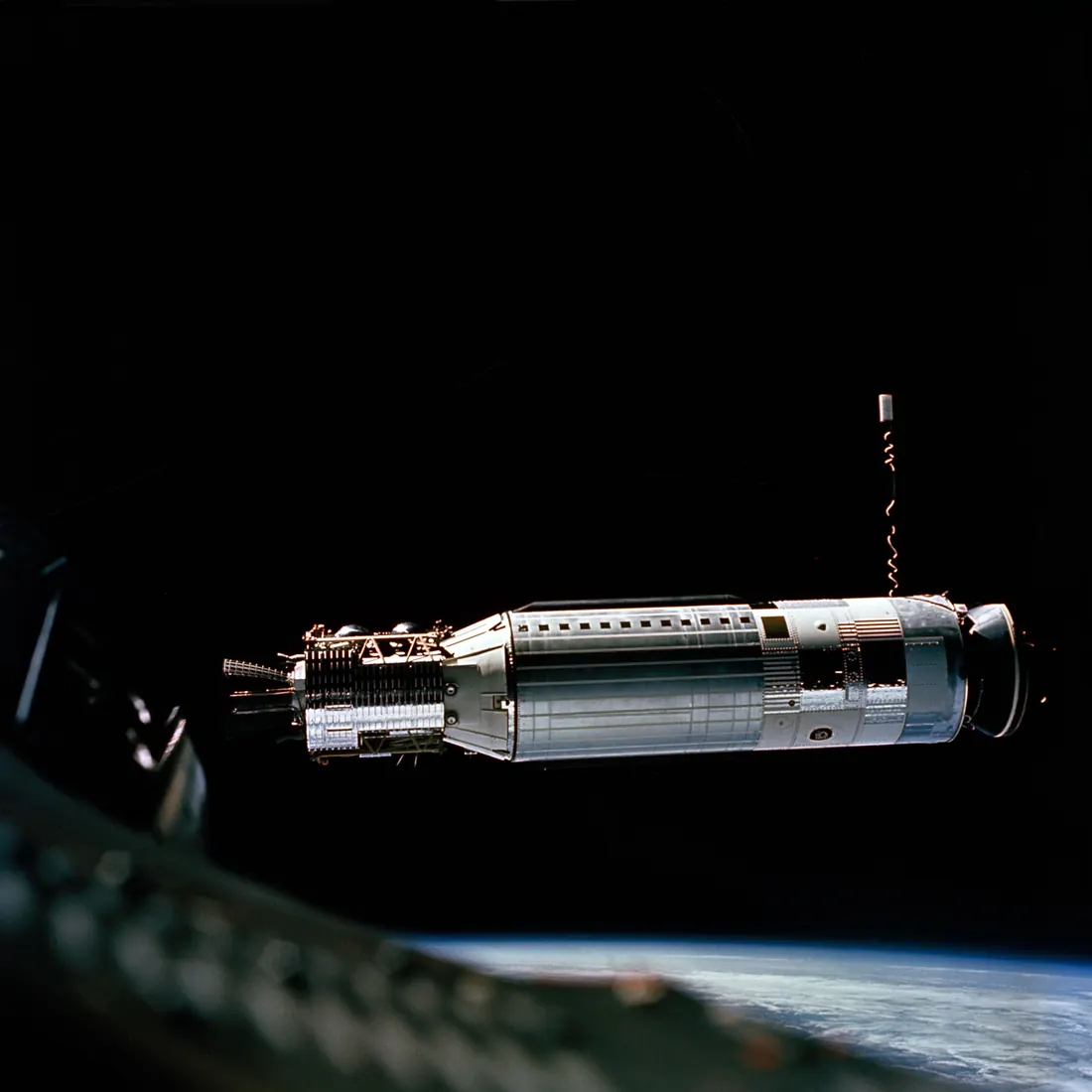
Gemini 8 lifted off from Cape Kennedy on March 16, 1966, with Neil Armstrong as command pilot and David Scott as pilot. “On the fourth revolution of the three-day flight, they were to rendezvous” with an Agena target vehicle, NASA History says, and “Scott also was scheduled to perform a spacewalk of more than two hours.” The Agena “was based on Lockheed Aircraft’s Agena-D upper stage rocket, fitted with a docking target.” Gemini 8 “docked with the GATV on the fifth revolution at 5:14 p.m., the first docking ever to take place in space.”
“About 27 minutes after docking at 5:41 p.m. the combined vehicle began to go into a violent yaw and tumble,” NASA’s mission page says. “Neil, we’re in a bank,” Scott said. “Armstrong used the Gemini’s orbital attitude and maneuvering system, or OAMS, thrusters to stop the tumbling. However, the roll immediately began again.” And “Gemini VIII was out of range of ground communications.” “Not knowing, the crew’s first reaction was to blame the Agena. So Scott pushed the undock button, and Armstrong backed Gemini away from the Agena. Without the added mass of the Agena, the Gemini’s rate of spin began to quickly accelerate.”
“Soon after, Gemini VIII came in range of the tracking ship USNS Coastal Sentry Quebec, stationed southwest of Japan. ‘We have serious problems here,’ Scott said.” Armstrong’s words were, “We’re rolling up and we can’t turn anything off.” “As the spin rate approached one revolution per second, the astronauts’ vision became blurred.” The Smithsonian’s National Air and Space Museum says “Gemini’s rotation accelerated to the point where the crew could black out and die.”
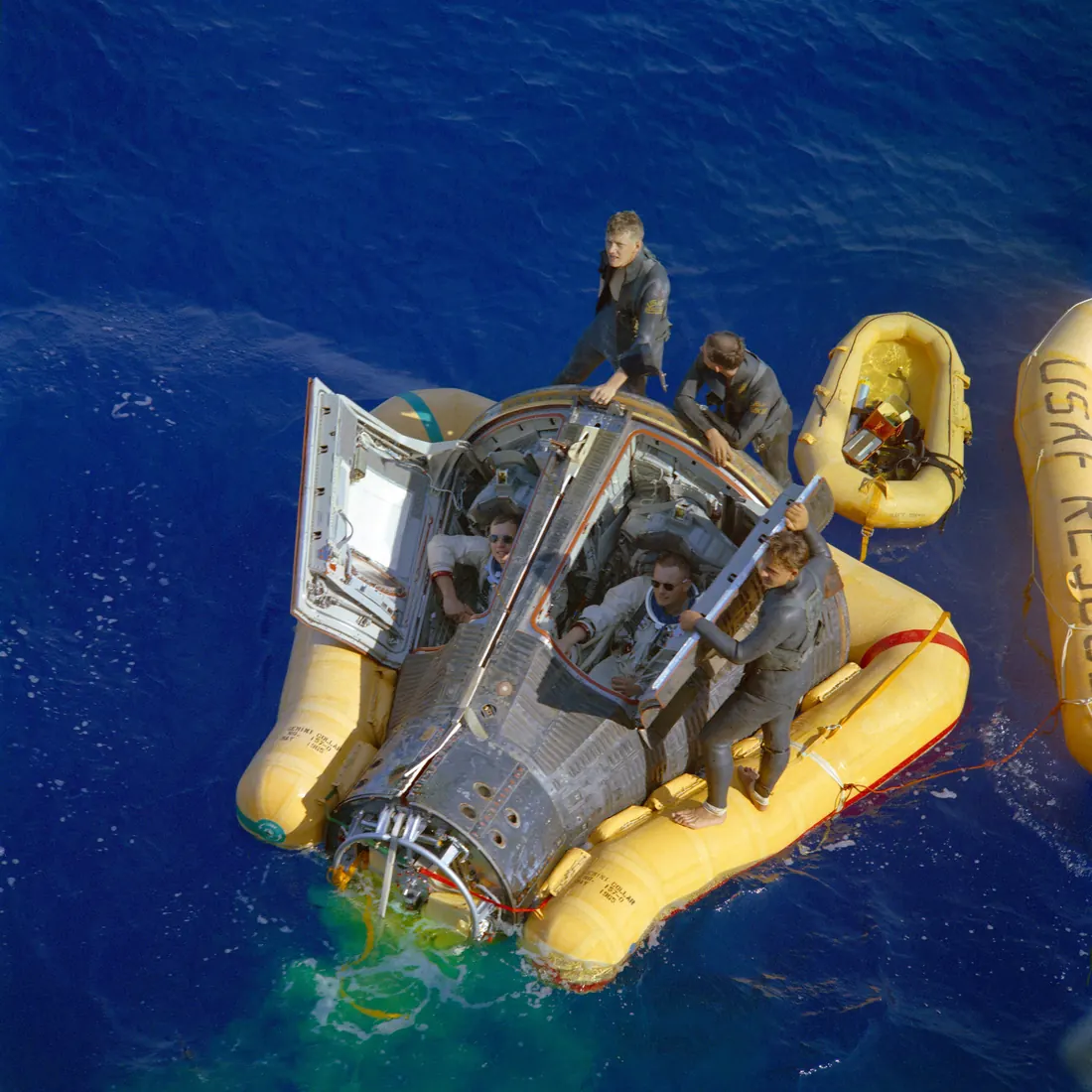
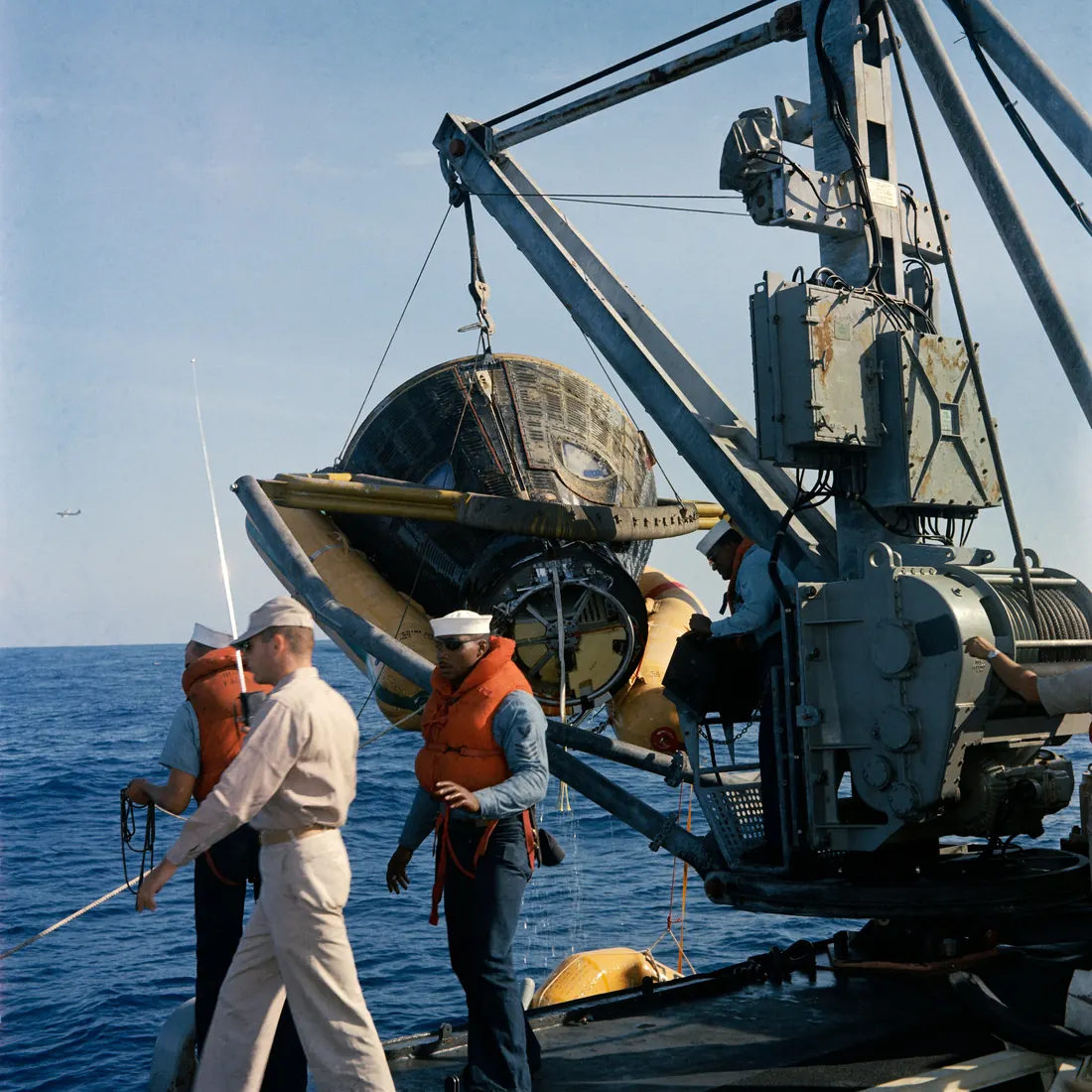
“Armstrong’s quick thinking led him to turn off the entire OAMS system and then use the re-entry control system, or RCS, thrusters on the nose of the spacecraft.” “After using three-quarters of their RCS propellants, he stopped the spin.” Then “the crew tested each OAMS thruster in turn and found that Number 8 had stuck on,” Wikipedia says. But they had to “follow the mission rules that dictated once the RCS was activated, the crew must be brought home,” and “the planned EVA and other activities were cancelled.” “Splashdown occurred within two miles of the predicted impact point 10 hours, 41 minutes after liftoff,” “in the western Pacific Ocean about 800 km west of Okinawa,” and “The crew was picked up by the recovery ship U.S.S. Mason 3 hours later.”
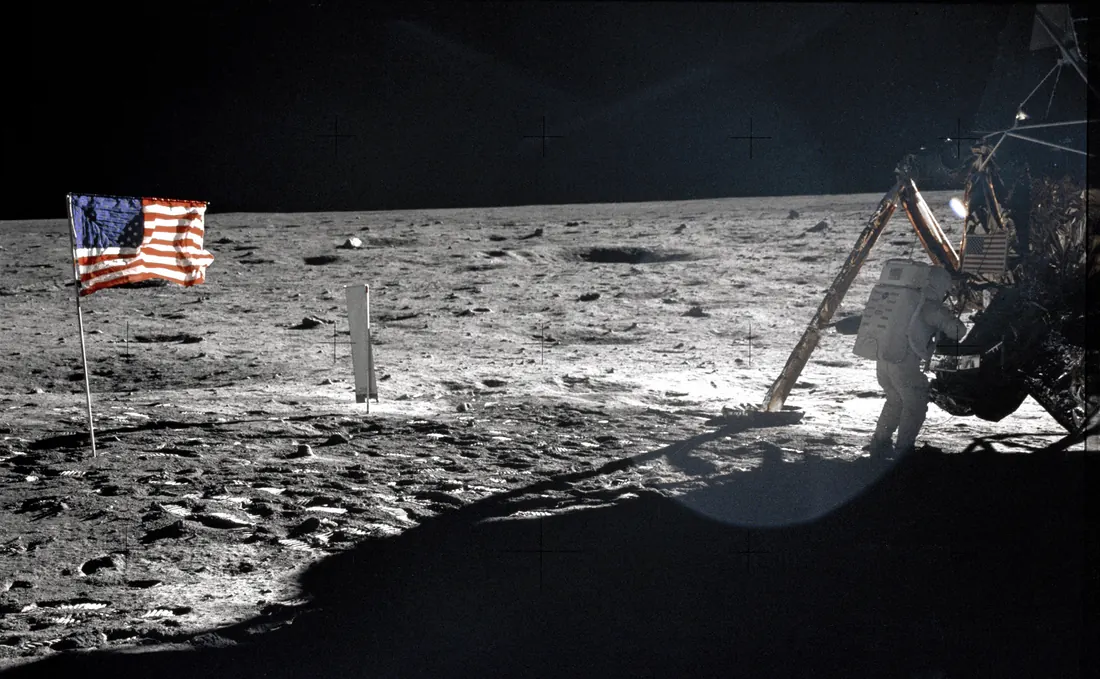
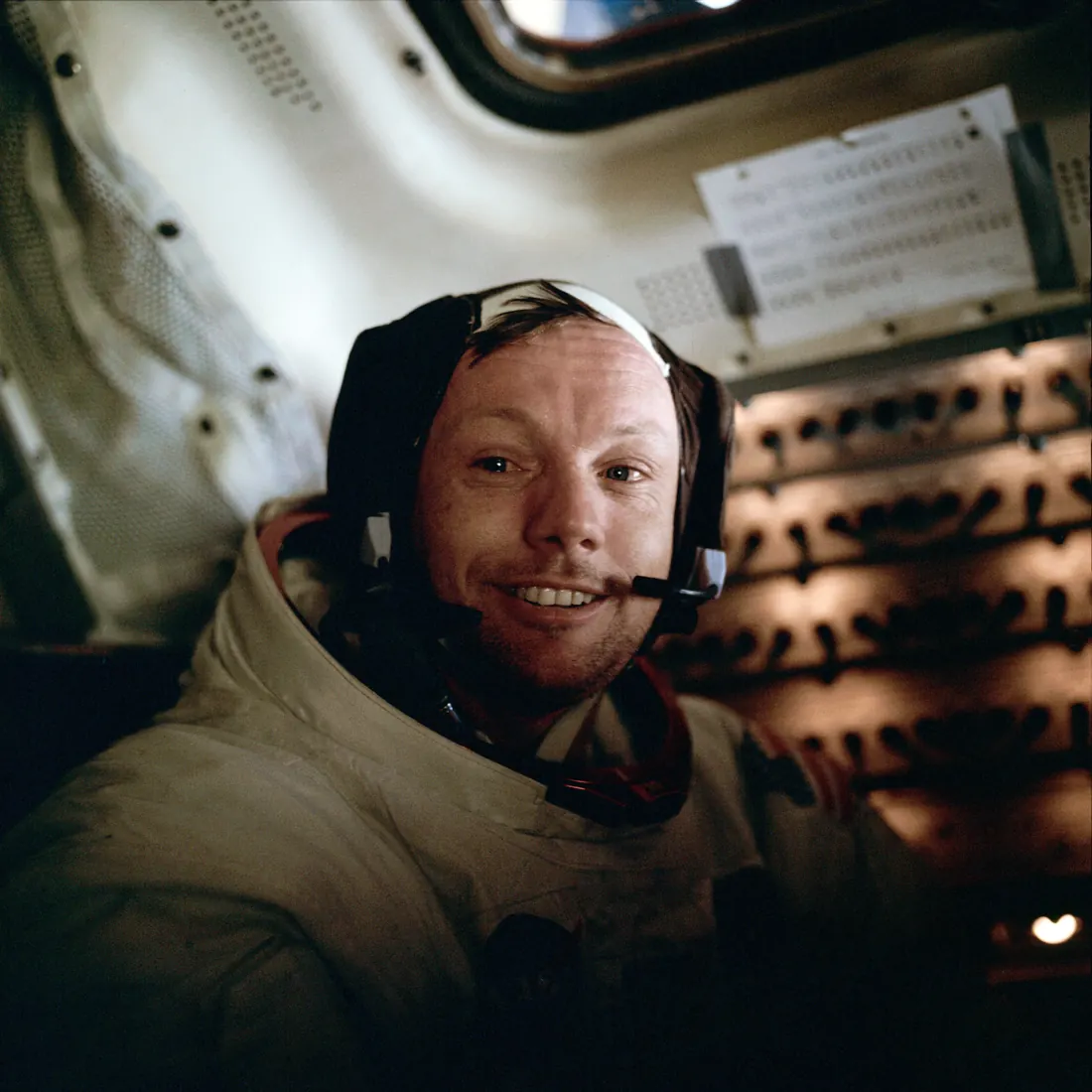
“The guy was brilliant,” Scott said later. “He knew the system so well. He found the solution, he activated the solution, under extreme circumstances … it was my lucky day to be flying with him.” “Forty months later, he would become the first human to set foot on the Moon as commander of Apollo 11.” Scott went on to be “the command module pilot of Apollo 9 and the commander of Apollo 15, the first lunar landing to carry a roving vehicle.”
Fact check
The facts and where they come from
- Their spaceship was spinning almost once a second, and they couldn’t turn anything off. NASA History: “As the spin rate approached one revolution per second, the astronauts’ vision became blurred.” NASA’s mission page: “approaching and possibly exceeding a rate of one revolution per second.” Wikipedia gives the peak as “296 degrees per second.” Armstrong: “We’re rolling up and we can’t turn anything off.” 125
- His name was Neil Armstrong, the command pilot. Guinness World Records: “the Gemini VIII capsule, piloted by Neil Armstrong and David Scott (both USA).” 54
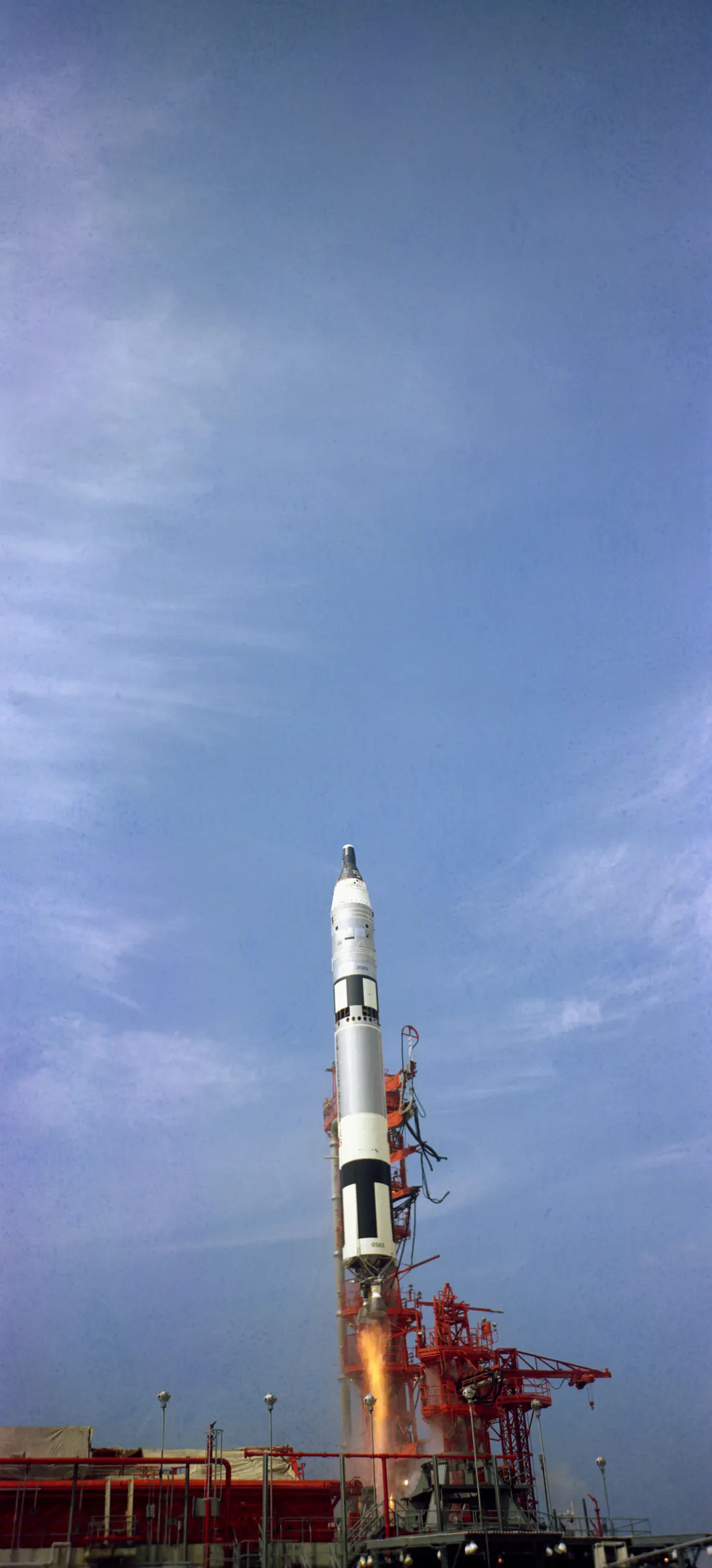
- In March 1966, he and David Scott launched. NASA’s photo caption: “successfully launched by the National Aeronautics and Space Administration’s (NASA) John F. Kennedy Space Center (KSC) at 11:41 a.m. (EST), March 16, 1966.” 752
- They made the first docking in space, with a target rocket. Guinness World Records: “The first docking between two spacecraft occurred … on 16 March 1966, when the Gemini VIII capsule, piloted by Neil Armstrong and David Scott (both USA) docked with an unmanned spacecraft called the Agena Target Vehicle.” NASA: “the first docking ever to take place in space.” Wikipedia: “The spacecraft was based on Lockheed Aircraft’s Agena-D upper stage rocket, fitted with a docking target.” 426
- Then they started to roll. NASA History: “‘Neil, we’re in a bank,’ Scott said”; “Armstrong used the Gemini’s orbital attitude and maneuvering system, or OAMS, thrusters to stop the tumbling. However, the roll immediately began again.” 1
- Nobody on the ground could hear them. NASA History: “Gemini VIII was out of range of ground communications.” The Smithsonian: “Out of touch with Houston controllers on the far side of the world, far from any tracking stations.” 13
- They let go of the rocket, but spun even faster. NASA History: “Not knowing, the crew’s first reaction was to blame the Agena. So Scott pushed the undock button, and Armstrong backed Gemini away from the Agena. Without the added mass of the Agena, the Gemini’s rate of spin began to quickly accelerate.” 1
- When a tracking ship heard them, Scott said, “We have serious problems here.” NASA History: “Soon after, Gemini VIII came in range of the tracking ship USNS Coastal Sentry Quebec, stationed southwest of Japan. ‘We have serious problems here,’ Scott said.” 1
- Their vision blurred, and they could black out and die. NASA History: “the astronauts’ vision became blurred.” The Smithsonian: “Gemini’s rotation accelerated to the point where the crew could black out and die”; “in danger of losing consciousness from the ever-accelerating rotation.” 13
- A thruster on their own ship was stuck on. Wikipedia: “After steadying the spacecraft, the crew tested each OAMS thruster in turn and found that Number 8 had stuck on.” The Smithsonian: “a stuck thruster in the Orbital Attitude and Maneuvering System (OAMS) on the white adapter module of the Armstrong and Scott’s spacecraft.” 53
- So Armstrong shut those thrusters off and fired the ones meant for coming home. NASA History: “Armstrong’s quick thinking led him to turn off the entire OAMS system and then use the re-entry control system, or RCS, thrusters on the nose of the spacecraft.” The Smithsonian: “Armstrong turned off the OAMS and activated the Reentry Control System (RCS)”; “The RCS thrusters were needed after the retrorockets were fired and the adapter separated.” 13
- The spin stopped, but the rules said they had to land. The Smithsonian: “After using three-quarters of their RCS propellants, he stopped the spin.” NASA History: “follow the mission rules that dictated once the RCS was activated, the crew must be brought home.” NASA’s mission page: “an immediate landing was required by Gemini safety rules, so the planned EVA and other activities were cancelled.” 312
- Their three-day mission lasted under 11 hours. NASA History: “On the fourth revolution of the three-day flight, they were to rendezvous”; “Splashdown occurred within two miles of the predicted impact point 10 hours, 41 minutes after liftoff.” NASA’s mission page: “Total mission elapsed time was 10 hours, 41 minutes, and 26 seconds.” 12
- Scott later said it was his lucky day to be flying with Armstrong. The Smithsonian: “The guy was brilliant. He knew the system so well. He found the solution, he activated the solution, under extreme circumstances … it was my lucky day to be flying with him.” 3
- Forty months later, Armstrong was the first man on the Moon. The Smithsonian: “Forty months later, he would become the first human to set foot on the Moon as commander of Apollo 11.” 3
Sources
- Gemini’s First Docking Turns to Wild Ride in Orbit (Granath, 2016) NASA
- Gemini VIII (mission page) NASA
- Spinning Out of Control: Gemini VIII (Neufeld, 2021) Smithsonian National Air and Space Museum
- First docking between two spacecraft Guinness World Records
- Gemini 8 Wikipedia
- Agena target vehicle Wikipedia
- Liftoff of Gemini-Titan 8 (NASA photo S66-24465 and its caption) Wikimedia Commons
Notes
The spin: NASA History says it “approached one revolution per second,” NASA’s mission page says “approaching and possibly exceeding a rate of one revolution per second,” and Wikipedia gives a peak of “296 degrees per second,” about 0.8 of a turn, so the page says “almost once a second.”
NASA History credits Armstrong with the radio call that they had docked, and Wikipedia credits Scott, so the page leaves it out. The docking time is 22:14 UTC (Guinness World Records) or 23:14 UTC (Wikipedia), and the launch time 11:41 a.m. EST (NASA) or 10:41 a.m. EST (Wikipedia).
“The first docking in space” means the first docking of any two spacecraft (Guinness World Records); the first Soviet docking came in October 1967. Wikipedia’s lead calls it the first US docking, which is also true.
Why the thruster stuck on is not known: NASA History says it was “later believed to be due to a short circuit in the wiring,” but “In the post-flight investigation, no conclusive reason for thruster malfunction was found.”
The Short’s “three years later” rounds the Smithsonian’s “Forty months later” (March 1966 to July 1969). Scott’s canceled spacewalk was to last “more than two hours.”
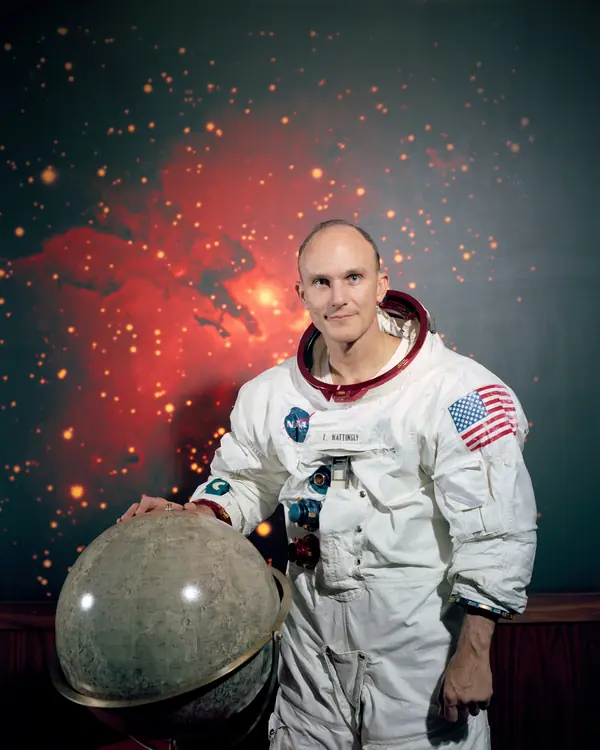
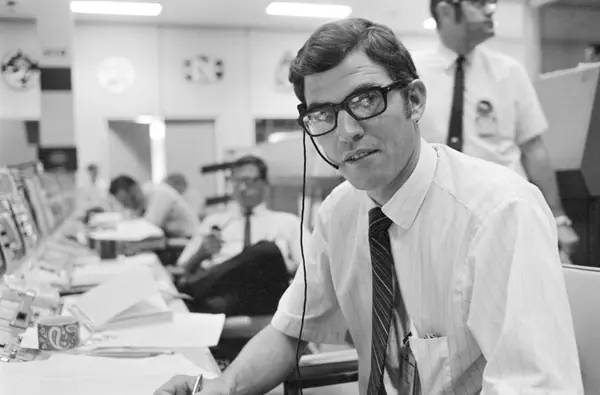
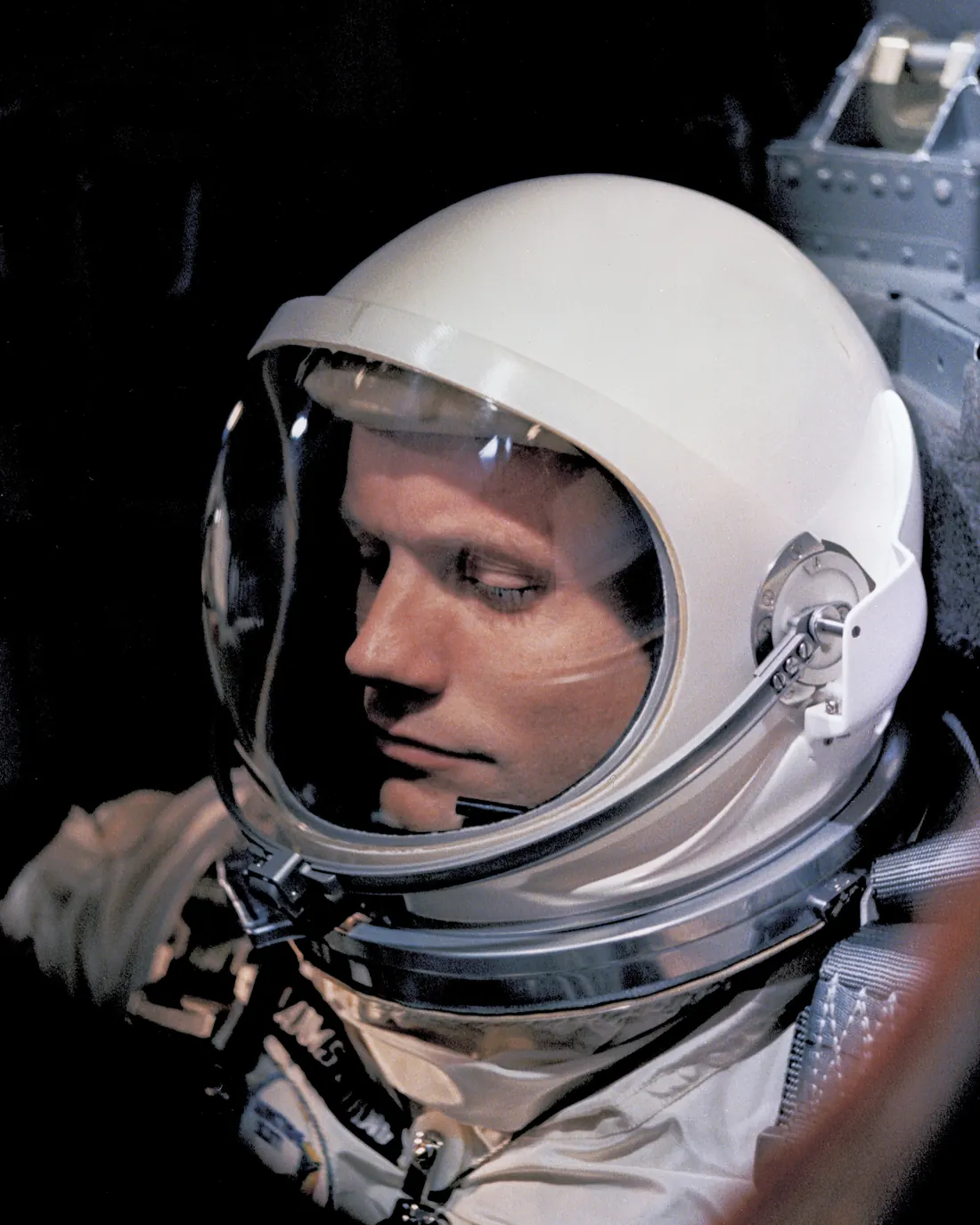
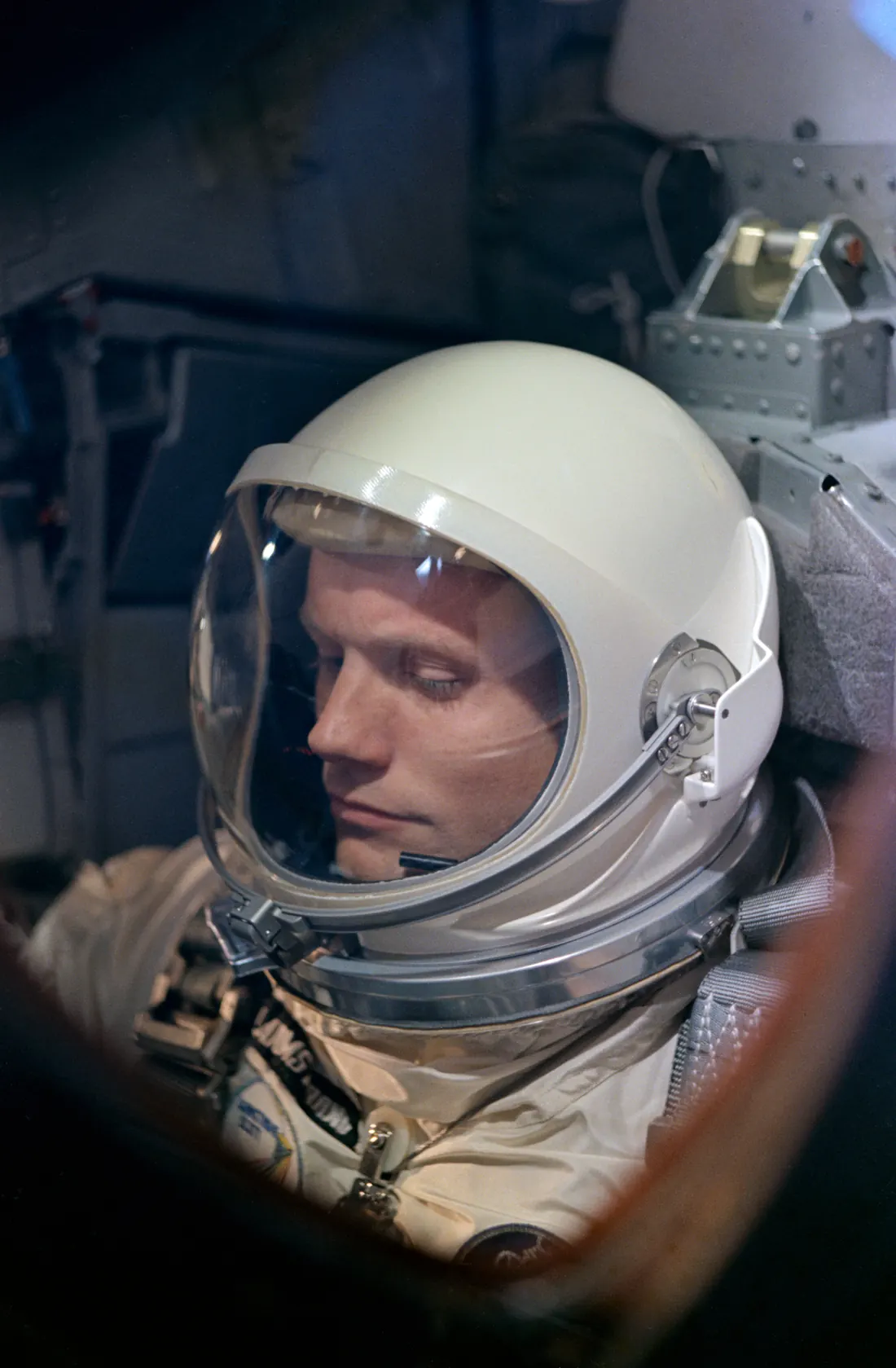
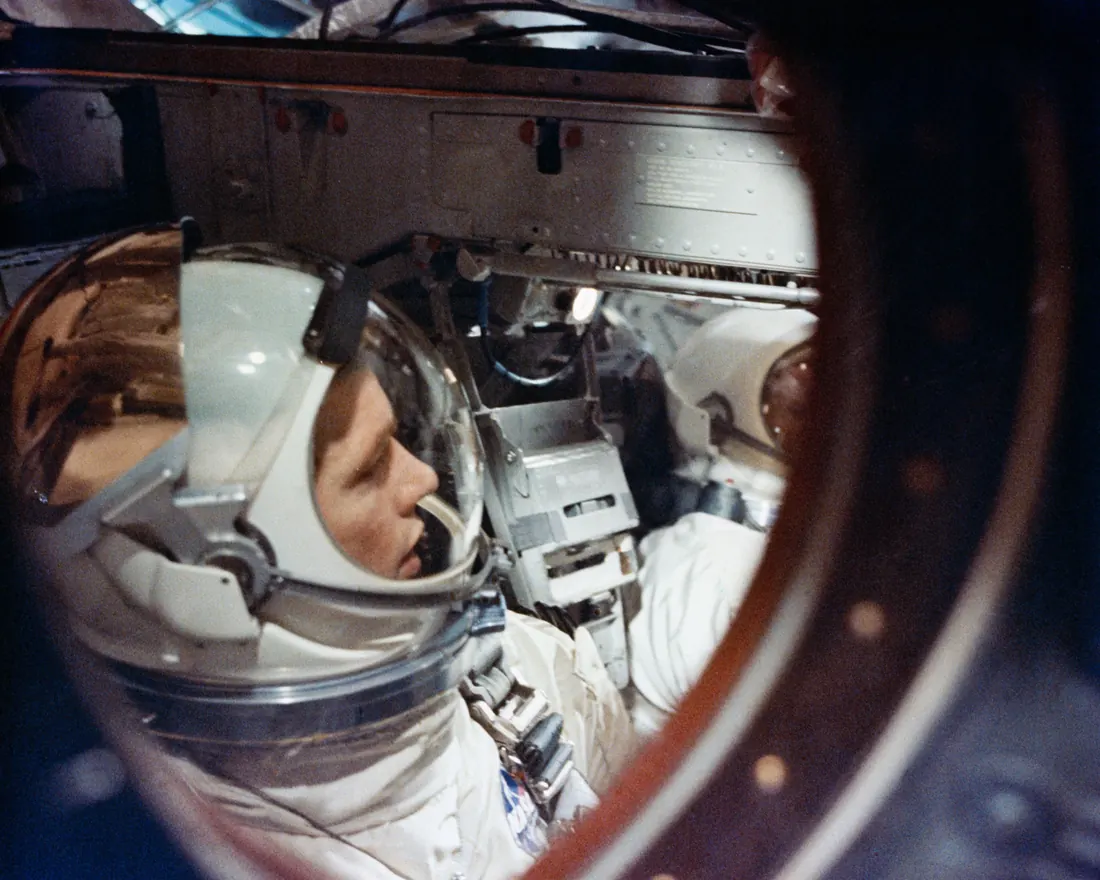
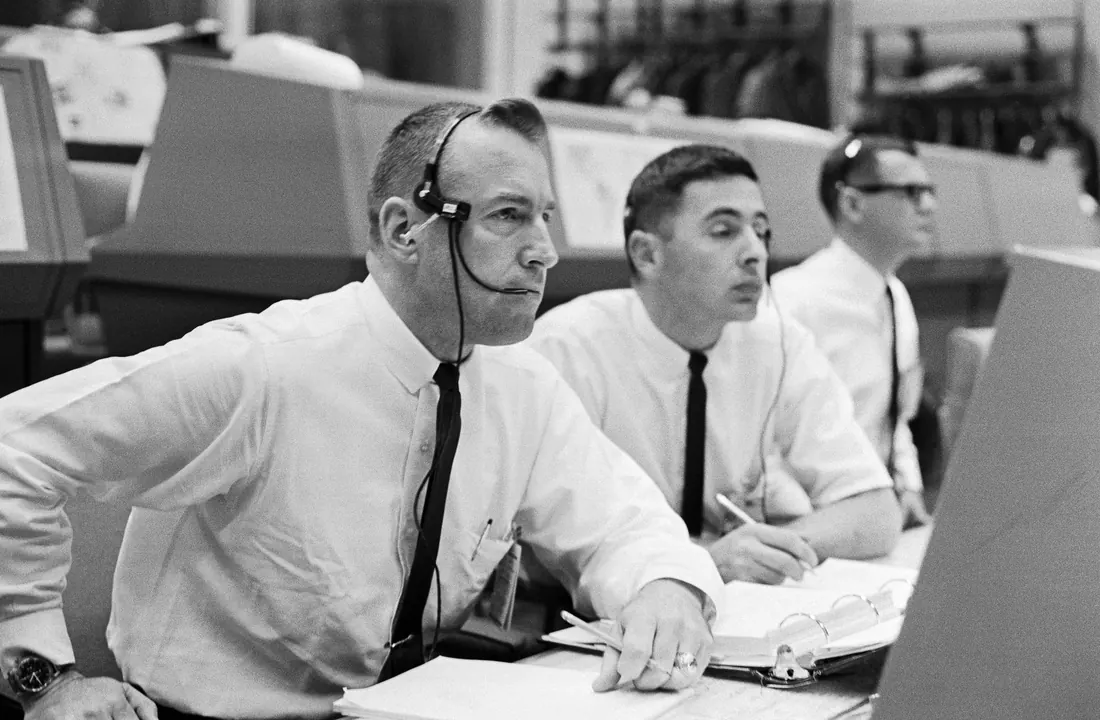
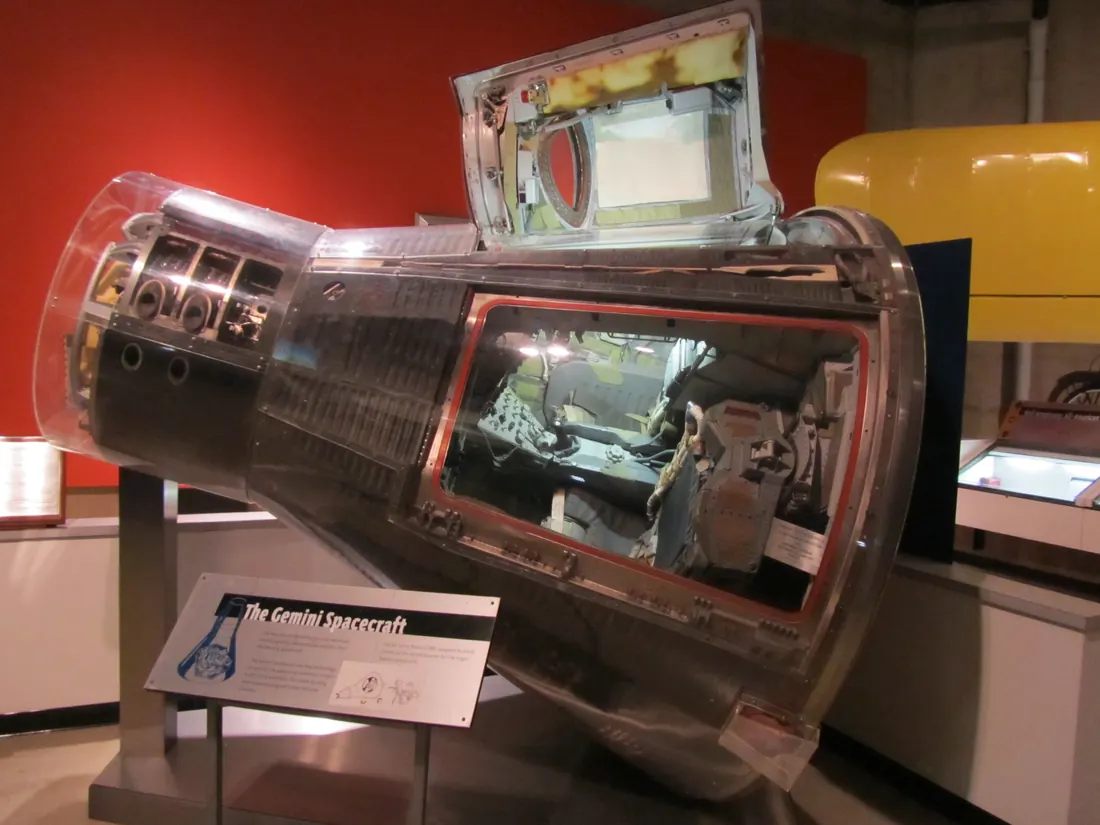
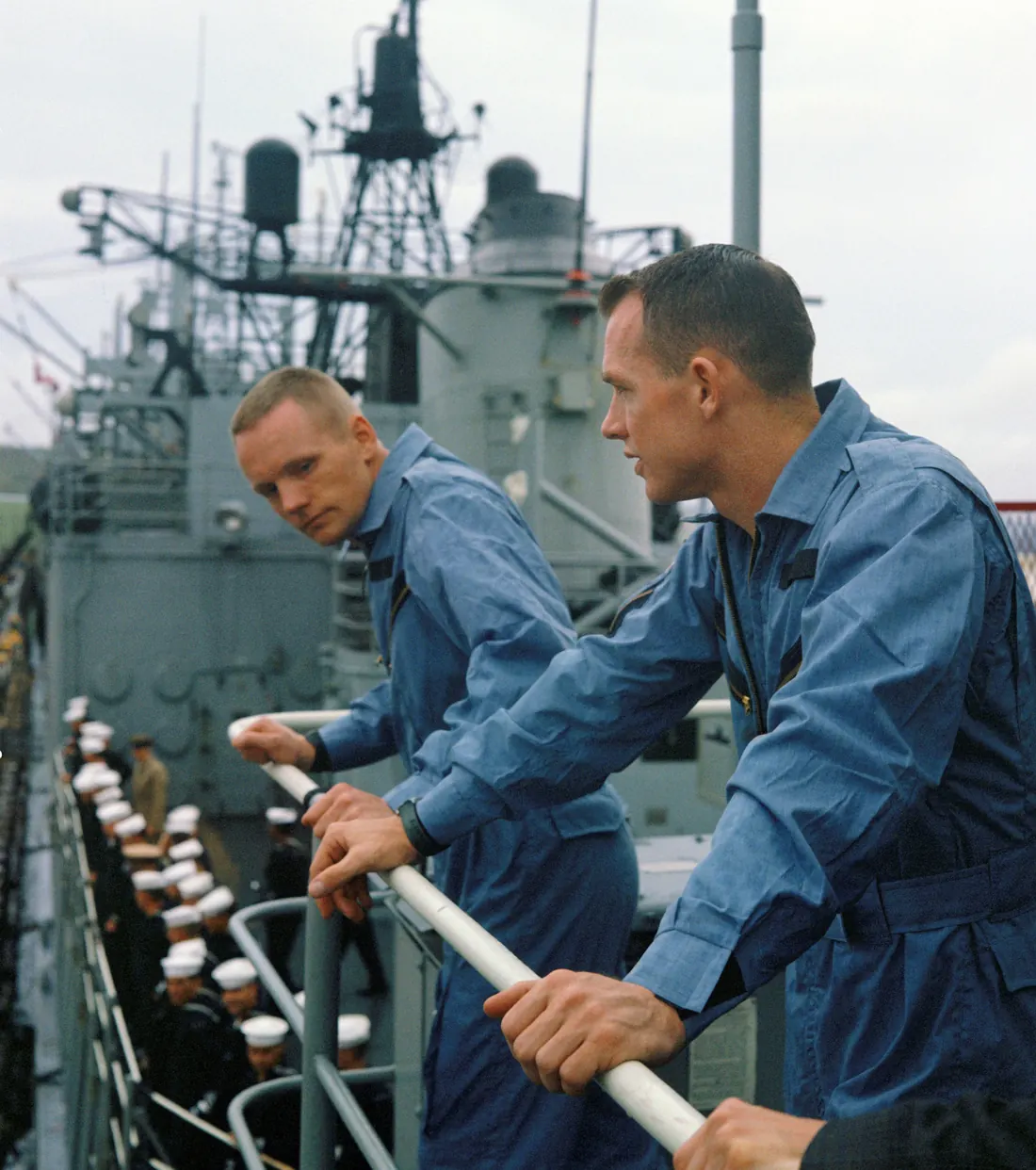
Pictures: all are NASA photos in the public domain except the capsule. Armstrong seen through the hatch window and the close-ups of Armstrong and Scott in the cabin were taken before liftoff on March 16, 1966, not during the spin; no photo of the spin itself exists. The crew portrait is from November 4, 1965. The four photos of the Agena were taken from Gemini 8 during the rendezvous on March 16, 1966, before the docking. The Mission Control photo was taken during the launch, not while the ground couldn’t hear them. The capsule is the real Gemini 8 spacecraft at the Armstrong Air and Space Museum in Wapakoneta, Ohio, photographed by HrAtsuo in 2010; the stuck thruster was on the adapter module, which is not part of it. After splashdown, the crew sat with their hatches open beside US Air Force pararescuemen, and the capsule, with the crew still aboard, was hoisted aboard USS Leonard F. Mason; Scott and Armstrong are on its deck arriving at Naha, Okinawa, on March 17, 1966. The last two photos are from Apollo 11, not Gemini 8: Armstrong at the lunar module Eagle on July 20, 1969, photographed by Buzz Aldrin, and Armstrong inside the lunar module after the moonwalk.
Photo credits
The archive photos in this story
All the photographs and illustrations in this story are in the public domain. Tap one to enlarge it, or follow the link to its Wikimedia Commons page for the full record. The narration, captions and graphics in the Short are our own; its music and sound effects are credited below.
Music and sound effects
Music: Schumann, Kinderszenen, Op. 15: No. 1 'Of Foreign Lands and Peoples (Musopen, public domain); Mussorgsky, Pictures at an Exhibition: IV. Bydlo (piano) (Musopen, public domain); Dvorak, Symphony No. 9 'From the New World': II. Largo (Musopen, public domain).
Sound effects: Freesound, CC0.