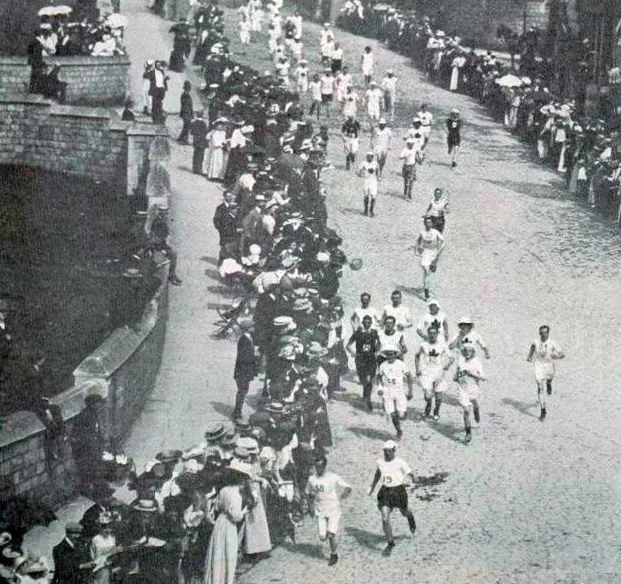
The 1908 Olympic marathon was run on July 24, 1908, and “The race started by the East Terrace of Windsor Castle,” Olympedia says; “It was a very warm day for long-distance running, the temperature eventually reaching 78° F (26° C).” Among the runners was Dorando Pietri of Italy. “Pietri was 5ft 2in, a pastry chef by trade, and looked younger than his 22 years,” The Guardian says, and Arthur Conan Doyle, there to write about the race for the Daily Mail, saw “a little man, with red running-drawers, a tiny boy-like creature.”
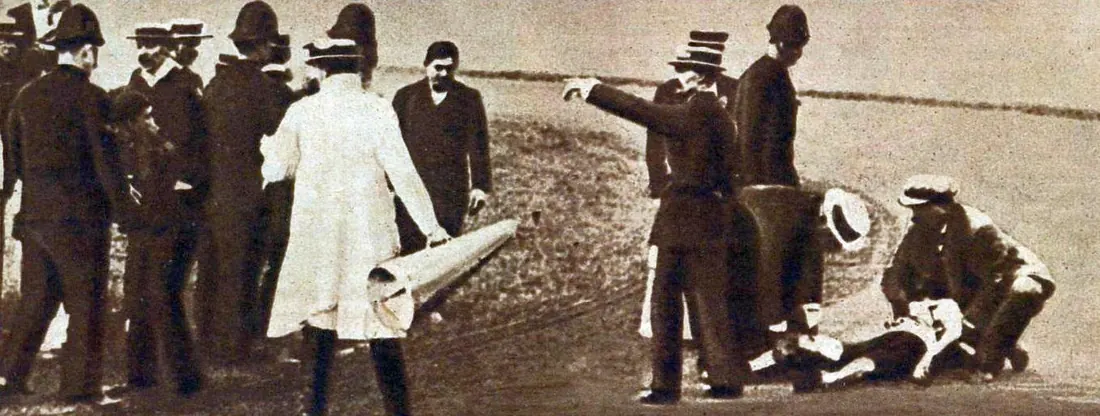
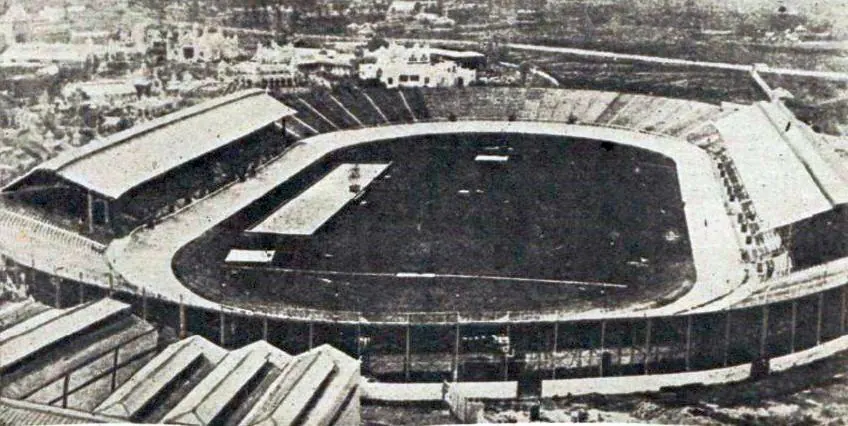
“Hefferon had control of the race from 15 through 25 miles, leading Pietri by over 3 minutes at 20 miles.” Then “A little more than one mile from the finish, Pietri moved into the lead, passing Hefferon,” Olympedia says. “However, the effort cost him dearly.” “Dorando’s premature effort had so exhausted him that he could scarcely reach the entrance of the Stadium,” the Official Report says, “where nearly a hundred thousand spectators were awaiting his arrival.” “Dorando was almost unconscious when he reached the cinder path, and turned to his right instead of his left.” “He collapsed upon the track,” and “the doctors and attendants rushed to his assistance.”
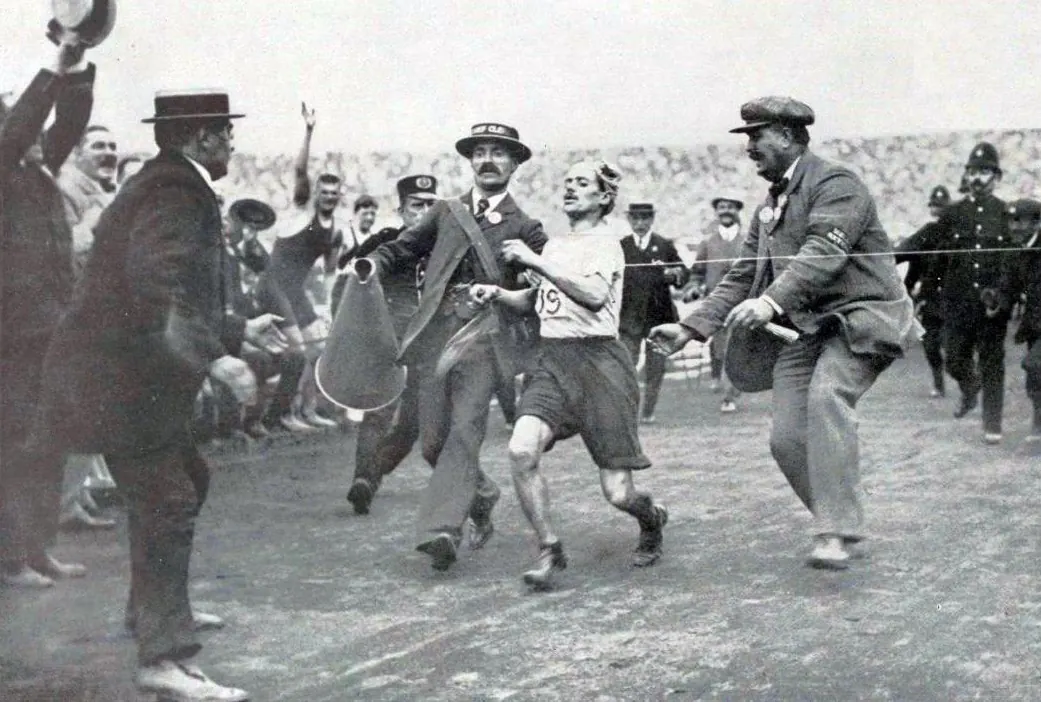
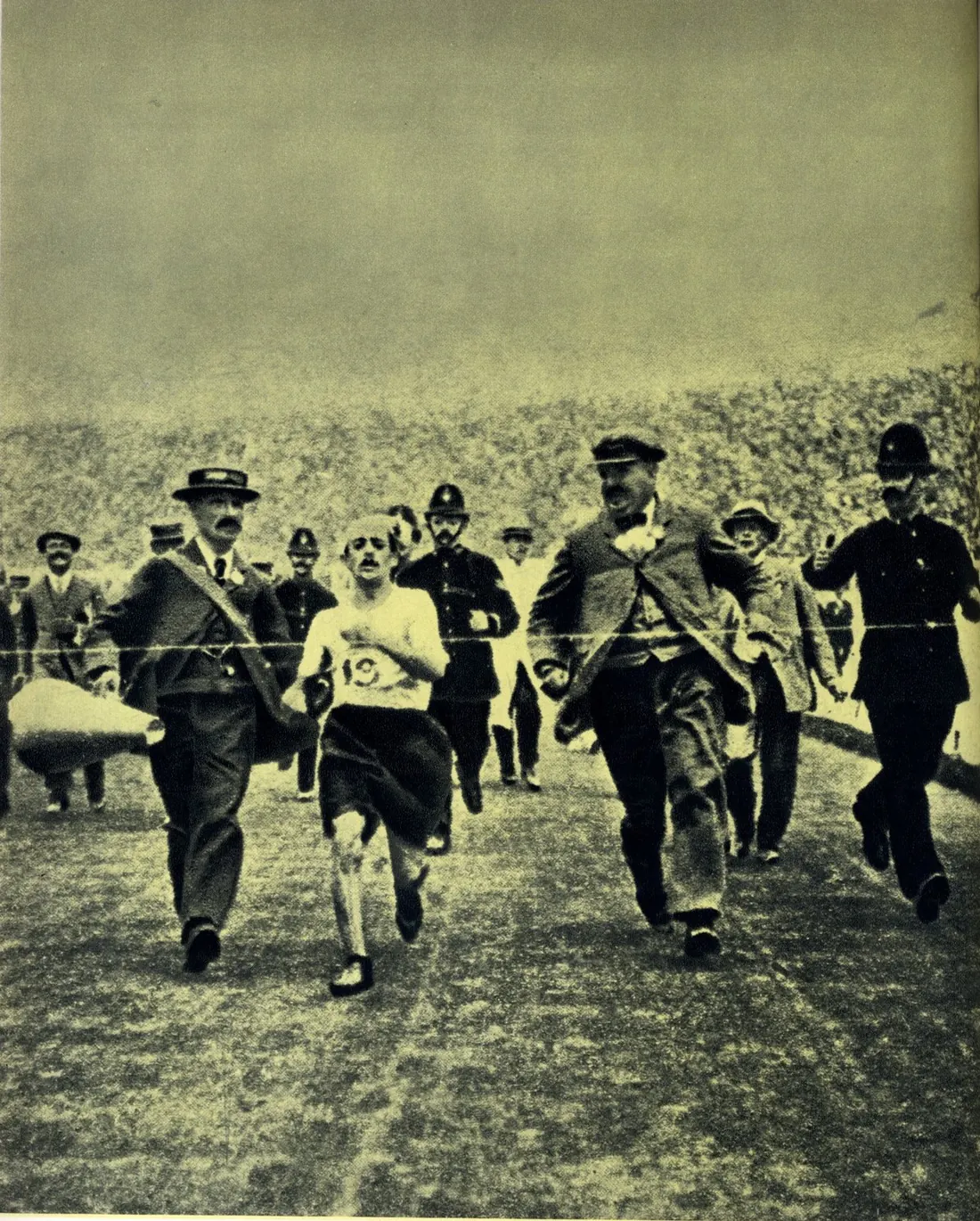
“He then fell four more times over the final lap, each time being helped by his handlers,” Olympedia says, and “He eventually staggered across the finish line, while surrounded by officials, doctors, and attendants.” He had crossed it first, but “The objection to Dorando lodged by the American officials was upheld, and the race was finally given to Hayes,” the Official Report says; Johnny Hayes of the United States “was rightly declared the Olympic champion,” in Olympedia’s words. Conan Doyle wrote: “Of course the prize went to the American, as his rival had been helped.” “Meanwhile, Dorando lay between life and death for two hours and a half.”
“Pietri quickly recovered from his ordeal and returned to the Stadium the next day to receive a special award from the Queen,” Olympedia says: “Queen Alexandra presented him with a large gold cup which was an exact replica of the one awarded to the Olympic champion.” And Conan Doyle, in his memoir, wrote: “I started a subscription for him in the ‘Daily Mail,’ which realized over £300 — a fortune in his Italian village — so that he was able to start a baker’s shop, which he could not have done on an Olympic medal.”
“Irving Berlin wrote the popular song ‘Dorando’ in his honor,” Olympedia says, and “To this day, Dorando Pietri is better remembered than the Olympic champion, Johnny Hayes.” “In defeat, Pietri’s fame far exceeded that of the winner.”
Fact check
The facts and where they come from
- He finished the Olympic marathon in first place, but they took it away from him. The Official Report: “until Dorando had staggered past the tape”; “The objection to Dorando lodged by the American officials was upheld, and the race was finally given to Hayes.” Wikipedia: “Johnny Hayes won after Dorando Pietri was disqualified for having received assistance before the finish line.” 17
- His name was Dorando Pietri, a tiny pastry chef from Italy. The Guardian: “Pietri was 5ft 2in, a pastry chef by trade, and looked younger than his 22 years.” Wikipedia: “Here he worked as a shop-boy at a confectionery shop.” Conan Doyle: “a little man, with red running-drawers, a tiny boy-like creature.” 465
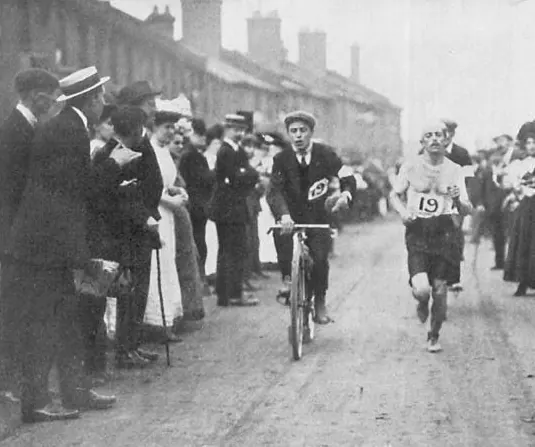
- In London in 1908, he spent hours chasing the leader. Olympedia: “Date 24 July 1908”; “The race started by the East Terrace of Windsor Castle”; “Hefferon had control of the race from 15 through 25 miles, leading Pietri by over 3 minutes at 20 miles.” Wikipedia gives his total time as 2 hours, 54 minutes and 46 seconds. 26
- Near the end, he passed him. Olympedia: “A little more than one mile from the finish, Pietri moved into the lead, passing Hefferon.” The Official Report: “Dorando made the fatal spurt which took him past Hefferon before they reached Wormwood Scrubs.” 21
- But it used up everything he had. The Official Report: “Dorando’s premature effort had so exhausted him that he could scarcely reach the entrance of the Stadium.” Olympedia: “However, the effort cost him dearly, and Pietri entered the White City Stadium in an advanced state of exhaustion.” 12
- In the packed stadium, he turned the wrong way. The Official Report: “where nearly a hundred thousand spectators were awaiting his arrival”; “Dorando was almost unconscious when he reached the cinder path, and turned to his right instead of his left.” Wikipedia: “When he entered the stadium, he took the wrong path.” 16
- Then he collapsed. The Official Report: “He collapsed upon the track.” 1
- Doctors lifted him up, but he fell again, five times in all. The Official Report: “the doctors and attendants rushed to his assistance.” Olympedia: “He stumbled and fell, but doctors and attendants revived him, administering stimulants, and helping him to his feet. He then fell four more times over the final lap, each time being helped by his handlers”; he “collapsed five times and had to be helped across the finishing line.” 123
- Officials helped him stagger across the line. Olympedia: “He eventually staggered across the finish line, while surrounded by officials, doctors, and attendants”; he “had to be helped across the finishing line.” 23
- The Americans protested. The Official Report: “The objection to Dorando lodged by the American officials was upheld.” Conan Doyle: “Of course the prize went to the American, as his rival had been helped.” 15
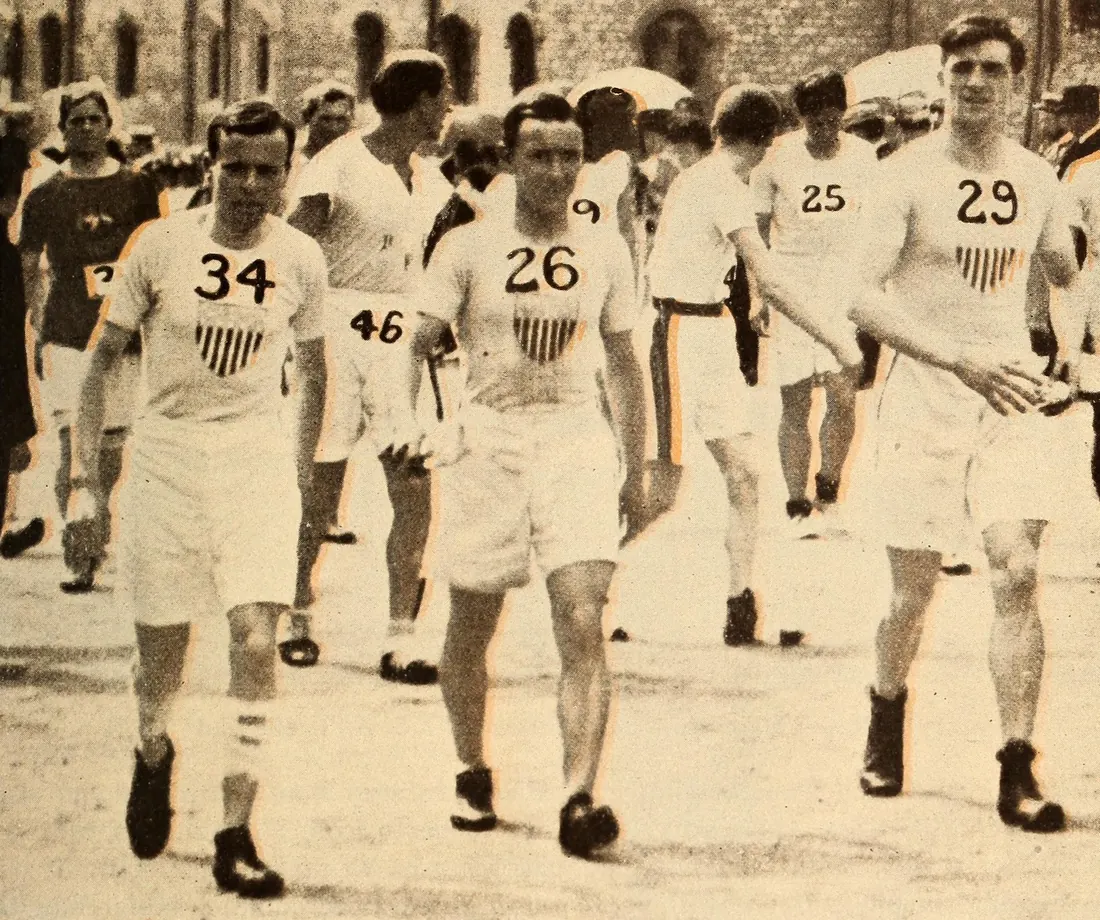
- He was disqualified, and Johnny Hayes of America got the gold. Olympedia: “after Pietri had been disqualified for receiving assistance, the American was rightly declared the Olympic champion.” The Official Report: “the race was finally given to Hayes.” Physical Culture (1908): “The winner, J. J. Hayes, is No. 26, in center of photo.” 219
- Dorando lay between life and death for two and a half hours. The Official Report: “Meanwhile, Dorando lay between life and death for two hours and a half.” 1
- The next day, Queen Alexandra gave him a special cup. The Official Report, plate caption: “QUEEN ALEXANDRA PRESENTS DORANDO WITH A GOLD CUP, JULY 25, 1908.” Olympedia: “Pietri quickly recovered from his ordeal and returned to the Stadium the next day to receive a special award from the Queen”; “Queen Alexandra presented him with a large gold cup which was an exact replica of the one awarded to the Olympic champion.” Wikipedia: “Queen Alexandra gave him a gilded silver cup.” 1236
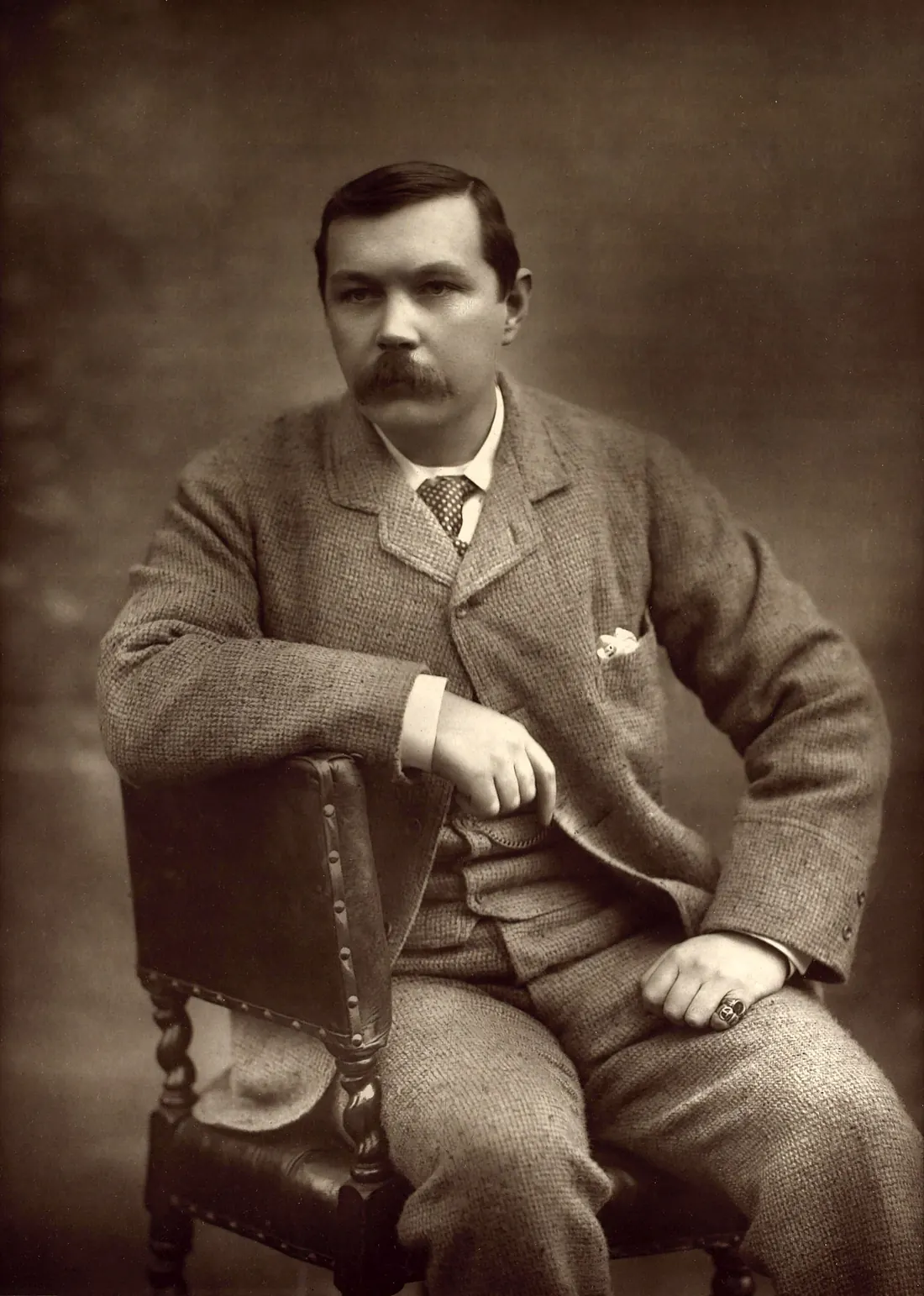
- Sherlock Holmes author Arthur Conan Doyle raised money so he could open a bakery. Conan Doyle, Memories and Adventures: “I started a subscription for him in the ‘Daily Mail,’ which realized over £300 — a fortune in his Italian village — so that he was able to start a baker’s shop, which he could not have done on an Olympic medal.” Wikipedia: “Conan Doyle proposed the Daily Mail to start a subscription to raise money and help Pietri to open a bakery in his native town.” Wikipedia (Conan Doyle): “He is best known for his four novels and fifty-six short stories about the fictional consulting detective Sherlock Holmes.” 568
- He lost the gold, but the world remembers him far more than the winner. Olympedia: “To this day, Dorando Pietri is better remembered than the Olympic champion, Johnny Hayes”; “in defeat, Pietri’s fame far exceeded that of the winner.” 23
Sources
- The Fourth Olympiad, being the Official Report of the Olympic Games of 1908 (Theodore Andrea Cook, British Olympic Association, 1908), pp. 77–79 and plates Internet Archive
- Marathon, Men, 1908 Summer Olympics Olympedia
- Dorando Pietri Olympedia
- 50 stunning Olympic moments No16: Dorando Pietri’s marathon, 1908 (Simon Burnton, February 29, 2012) The Guardian
- Dorando Pietri (quoting Conan Doyle’s memoir Memories and Adventures, 1924) The Arthur Conan Doyle Encyclopedia
- Dorando Pietri Wikipedia
- Athletics at the 1908 Summer Olympics – Men’s marathon Wikipedia
- Arthur Conan Doyle Wikipedia
- American athletes at the 1908 Olympic Games, from Physical Culture (1908), with its caption Wikimedia Commons
Notes
The cup: the Official Report and Olympedia say a gold cup (Olympedia: a replica of the champion’s), Wikipedia “a gilded silver cup,” and The Guardian a small silver cup given at the closing ceremony on July 25, the date the Official Report gives. The Short says “a special cup” and “the next day.”
The falls: Olympedia says five (one, then four more), as does Wikipedia, and Pietri himself later wrote, “They tell me that I fell another five or six times” (The Guardian). Where he took the lead: Olympedia says “a little more than one mile from the finish,” The Guardian “with two miles to go,” Wikipedia “the 39 km mark”; the Short says “near the end.” The crowd: Conan Doyle says some 50,000, Wikipedia 75,000, and the Official Report and The Guardian about 100,000; the Short says “packed.”
The bakery: Conan Doyle says the fund let him “start a baker’s shop,” and Wikipedia that it was to “help Pietri to open a bakery”; the Short says he raised money “so he could open a bakery,” not that the bakery opened.
Who is who at the finish: the man beside Dorando with the megaphone is Jack Andrew, clerk of the course, and the man on the right is Dr. Michael Bulger, often mistaken for Conan Doyle (The Arthur Conan Doyle Encyclopedia); no race photo here shows Conan Doyle.
Left out: a figure for how long his last few hundred meters took (found only in Wikipedia and a Guardian picture gallery, not in the Official Report or Olympedia), a popular story about where the race started (Olympedia shows it is false), a medical claim in the Official Report that is doubtful, the race’s length, and his later races against Hayes in New York.
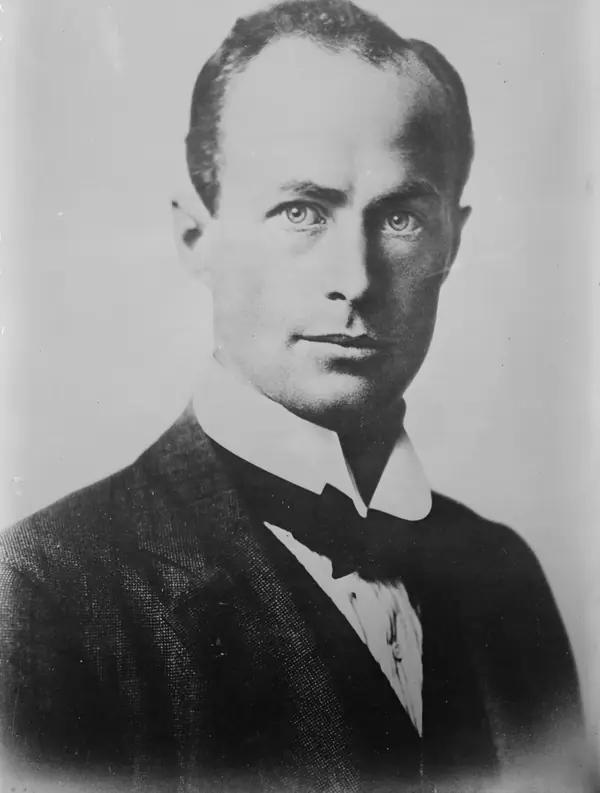
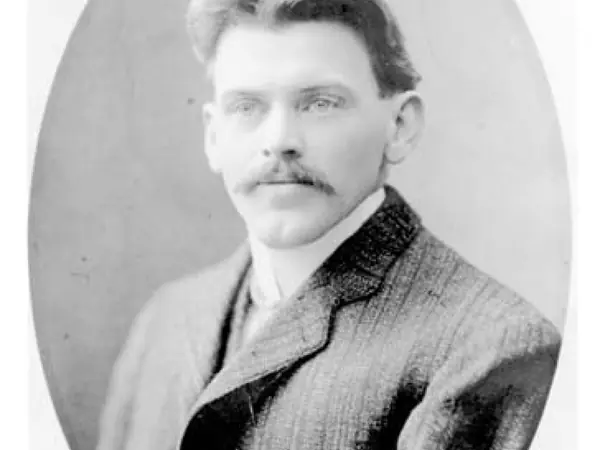
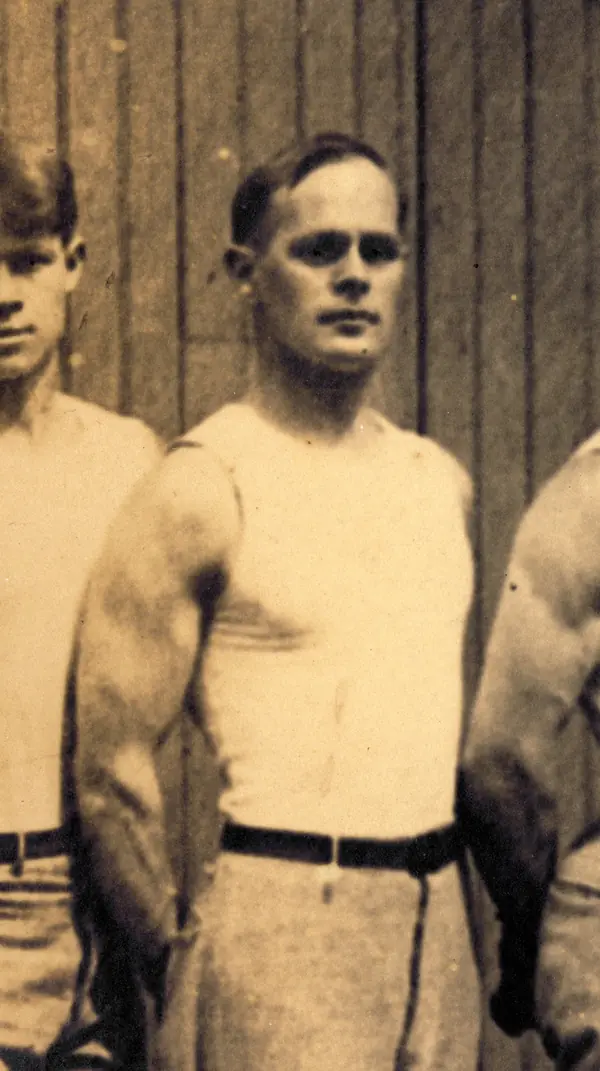
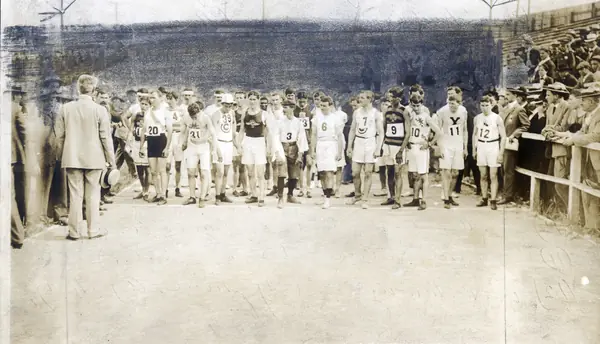
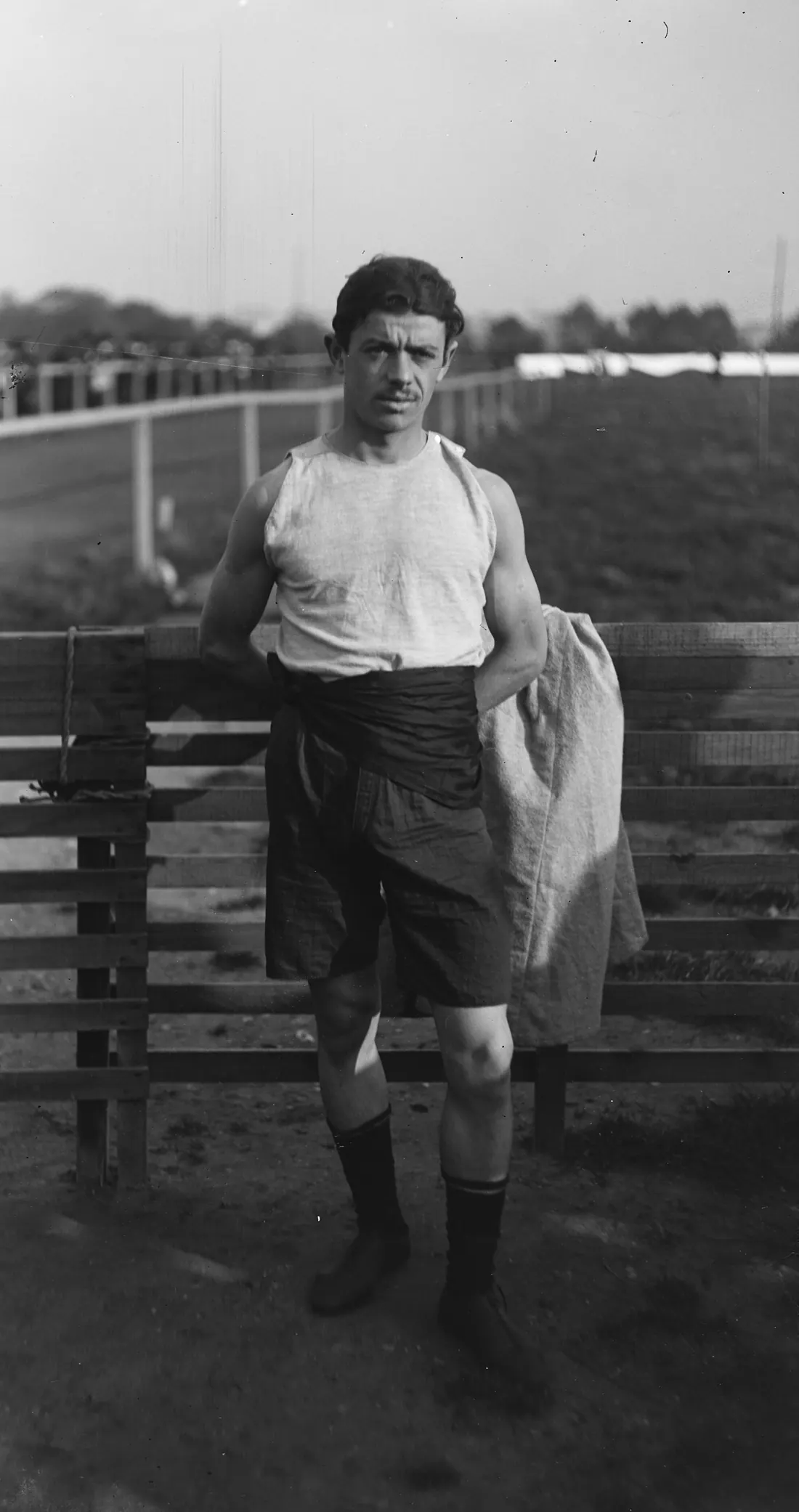
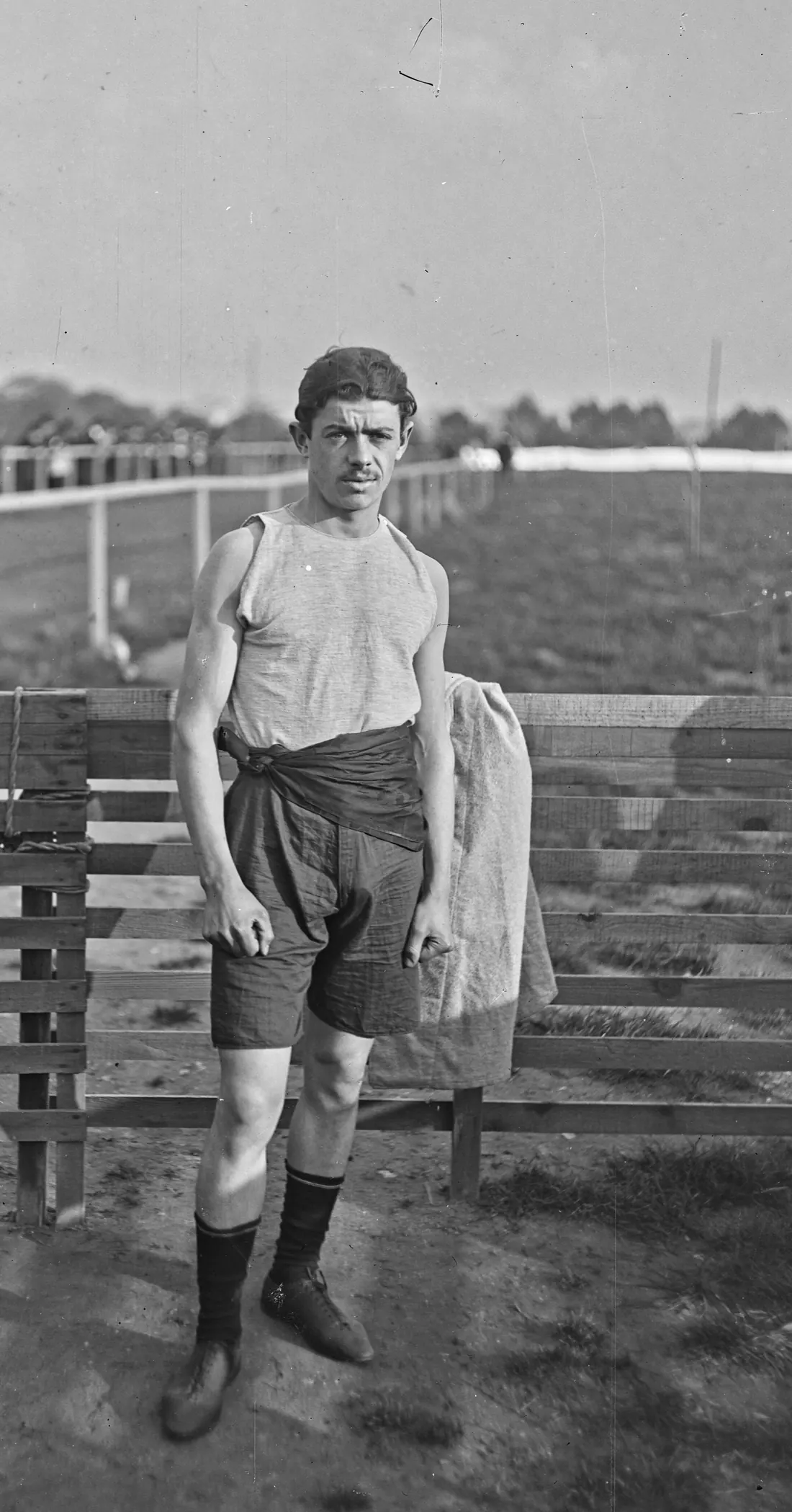
Pictures: from July 24, 1908: Dorando at the finish tape among officials (printed in Les Sports Modernes, September 1908); the finish from the front (reproduced in an Italian ENIT tourist brochure, 1958); Dorando down on the track after crossing the line, Jack Andrew with the megaphone (Le Miroir des Sports, 1930); the start at Windsor Castle, Dorando no. 19 at the bottom (La Vie au grand air, August 1, 1908); and the Official Report’s plates by Bowden Bros. of Dorando, no. 19, coming through Willesden, Charles Hefferon, no. 8, coming through Ruislip, and the north end of the Stadium. The Official Report’s plate of Queen Alexandra presenting Dorando with the cup is from July 25, 1908; the report does not say which of the two women is the Queen. The aerial view of White City Stadium is from 1908 (Le Miroir des Sports, 1920), and the American athletes, Johnny Hayes, no. 26, in the center, are from Physical Culture (1908). Dorando’s portraits are two Agence Rol plates from the Gentilly track near Paris, October 22, 1905, three years before London, and Arthur Conan Doyle was photographed by Herbert Rose Barraud in 1893. Two road photos were cropped to leave out children in the crowd; the other people in these photos are not named.
Photo credits
The archive photos in this story
All the photographs and illustrations in this story are in the public domain. Tap one to enlarge it, or follow the link to its archive page for the full record. The narration, captions and graphics in the Short are our own; its music and sound effects are credited below.
Music and sound effects
Music: Schumann, Kinderszenen, Op. 15: No. 1 'Of Foreign Lands and Peoples' (Musopen, public domain); Mussorgsky, Pictures at an Exhibition: IV. Bydlo (piano) (Musopen, public domain); Dvorak, Symphony No. 9 'From the New World': II. Largo (Musopen, public domain).
Sound effects: Freesound, CC0.