“While working at St Mary’s Hospital, London in 1928, Alexander Fleming, a Scottish physician, was investigating the variation of growth in cultures of S. aureus,” Wikipedia says. “Before leaving for his holiday, he inoculated staphylococci on culture plates and left them on a bench in a corner of his laboratory.” “He spent the summer break with his family at his country home The Dhoon at Barton Mills, Suffolk.”
“On 3 September 1928, Fleming returned to his laboratory having spent a holiday with his family at Suffolk.” “On his return, Fleming noticed that one culture was contaminated with a fungus,” and “the colonies of staphylococci immediately surrounding the fungus had been destroyed, whereas other staphylococci colonies farther away were normal.” In his own words, “The origin of penicillin was the contamination of a culture plate of staphylococci by a mould.” As NobelPrize.org puts it, “the mould had created a bacteria-free circle around itself,” and “He isolated the mould and showed that it released a substance that inhibited bacterial growth.”
“After some months of calling it ‘mould juice’ or ‘the inhibitor’, he gave the name penicillin on 7 March 1929.” “He found that a mould culture prevented growth of staphylococci, even when diluted 800 times,” NobelPrize.org says; in his Nobel lecture he said “the culture fluid could be diluted 1,000 times and it would still inhibit the growth of staphylococci.” He also told “How it was an unstable substance and how we failed to concentrate and stabilize it.” “He also kept, grew, and distributed the original mould for twelve years, and continued until 1940 to try to get help from any chemist who had enough skill to make penicillin.”
At Oxford, a team led by Howard Florey “developed a method for cultivating the mould and extracting, purifying and storing penicillin from it.” “After the team had developed a method of purifying penicillin to an effective first stable form in 1940, several clinical trials ensued.” In August 1942, Harry Lambert “was admitted to St Mary’s Hospital due to a life-threatening infection of the nervous system (streptococcal meningitis).” “Florey sent the incompletely purified sample, which Fleming immediately administered into Lambert’s spinal canal.” “Lambert showed signs of improvement the very next day, and completely recovered within a week.”
“Penicillin has saved millions of lives by stopping the growth of the bacteria that are responsible for poisoning the blood and causing many other once fatal diseases,” NobelPrize.org says. Fleming, born in Ayrshire in 1881, shared the 1945 Nobel Prize in Physiology or Medicine with Howard Florey and Ernst Chain, and died in 1955. In his Nobel lecture he said that “penicillin started as a chance observation. My only merit is that I did not neglect the observation and that I pursued the subject as a bacteriologist.”
Fact check
The facts and where they come from
- He came back from holiday to a moldy dish, but that mold would save millions of lives, through the penicillin it made. Wikipedia: “On 3 September 1928, Fleming returned to his laboratory having spent a holiday with his family at Suffolk”; “On his return, Fleming noticed that one culture was contaminated with a fungus.” NobelPrize.org: “Penicillin has saved millions of lives by stopping the growth of the bacteria that are responsible for poisoning the blood and causing many other once fatal diseases.” Wikipedia: “penicillin has saved, and is still saving, millions of people around the world.” 15
- His name was Alexander Fleming. Wikipedia: he “was a Scottish physician and microbiologist.” 41
- In 1928, this Scottish doctor was studying germs in London. Wikipedia: “While working at St Mary’s Hospital, London in 1928, Alexander Fleming, a Scottish physician, was investigating the variation of growth in cultures of S. aureus.” 21
- Before his holiday, he left dishes of bacteria on his bench. Wikipedia: “Before leaving for his holiday, he inoculated staphylococci on culture plates and left them on a bench in a corner of his laboratory.” 1
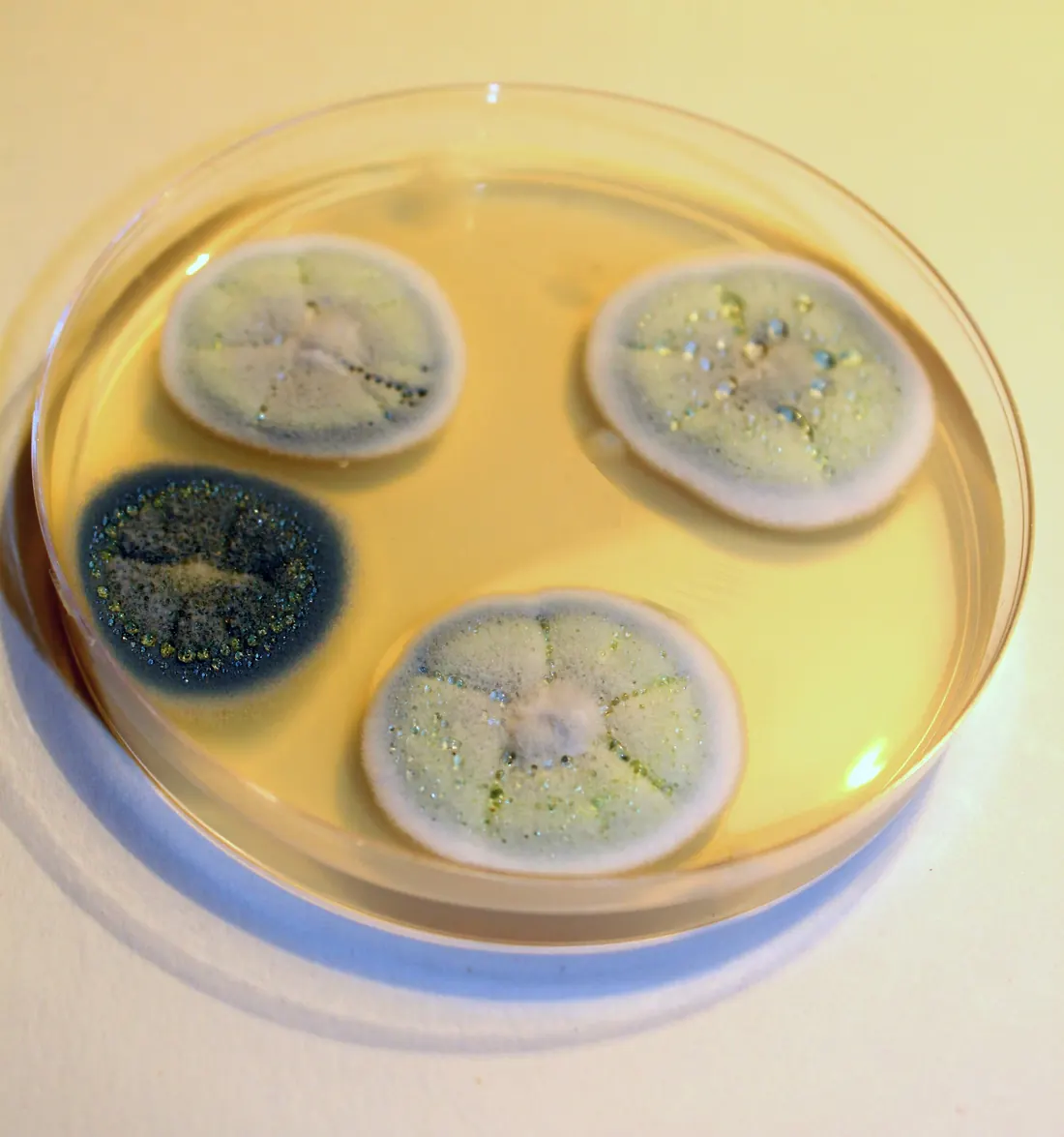
- When he came back, mold had grown on one of them. Wikipedia: one plate was found “with an open lid and the culture contaminated with a blue-green mould.” Fleming’s Nobel lecture: “The origin of penicillin was the contamination of a culture plate of staphylococci by a mould.” 261
- Around the mold, the bacteria had been wiped out. Wikipedia: “the colonies of staphylococci immediately surrounding the fungus had been destroyed, whereas other staphylococci colonies farther away were normal.” NobelPrize.org: “the mould had created a bacteria-free circle around itself.” 14
- Something in the mold was killing them. NobelPrize.org: “He isolated the mould and showed that it released a substance that inhibited bacterial growth.” Wikipedia: “the mould killed the bacteria.” 52
- He called it mold juice. Wikipedia: “After some months of calling it ‘mould juice’ or ‘the inhibitor’, he gave the name penicillin on 7 March 1929.” 1
- Even watered down hundreds of times, it still stopped the germs. NobelPrize.org: “he found that a mould culture prevented growth of staphylococci, even when diluted 800 times.” Fleming’s Nobel lecture: “the culture fluid could be diluted 1,000 times and it would still inhibit the growth of staphylococci.” 46
- He named it penicillin. NobelPrize.org: “He named the active substance penicillin.” 41
- His team couldn’t purify it, but he kept the mold alive for twelve years. Fleming’s Nobel lecture: “How it was an unstable substance and how we failed to concentrate and stabilize it.” Wikipedia: “He also kept, grew, and distributed the original mould for twelve years, and continued until 1940 to try to get help from any chemist who had enough skill to make penicillin.” 61
- In 1940, a team at Oxford finally did it. Wikipedia: “After the team had developed a method of purifying penicillin to an effective first stable form in 1940, several clinical trials ensued”; the Oxford team led by Howard Florey “developed a method for cultivating the mould and extracting, purifying and storing penicillin from it.” 12
- Then Fleming injected it into a man dying of meningitis. Wikipedia: Harry Lambert “was admitted to St Mary’s Hospital due to a life-threatening infection of the nervous system (streptococcal meningitis)”; “Florey sent the incompletely purified sample, which Fleming immediately administered into Lambert’s spinal canal.” Wikipedia (Penicillin): “Fleming cured Harry Lambert of an infection of the nervous system (streptococcal meningitis) which would otherwise have been fatal.” 13
- The next day, he was better. Within a week, he had recovered. Wikipedia: “Lambert showed signs of improvement the very next day, and completely recovered within a week.” Wikipedia (Penicillin): “Lambert showed improvement from the very next day of the treatment, and was completely cured within a week.” 13
- He said his only merit was that he didn’t ignore that dish. Fleming’s Nobel lecture: “penicillin started as a chance observation. My only merit is that I did not neglect the observation and that I pursued the subject as a bacteriologist.” 6
Sources
- Alexander Fleming Wikipedia
- History of penicillin Wikipedia
- Penicillin Wikipedia
- Sir Alexander Fleming – Biographical NobelPrize.org
- Sir Alexander Fleming – Questions and answers NobelPrize.org
- Penicillin, Nobel Lecture by Alexander Fleming (December 11, 1945) NobelPrize.org
Notes
“Millions of lives”: the page says it the way NobelPrize.org and Wikipedia do (“Penicillin has saved millions of lives”); bigger figures that circulate are estimates without a firm source. The lives were saved by the drug the mold led to, and mass production later used a higher-yield strain: Wikipedia says “Six times as much penicillin could be produced compared to using Fleming’s mould.”
How strong: NobelPrize.org says it worked “diluted 800 times,” and Fleming’s own Nobel lecture says “1,000 times,” so the Short says “hundreds of times.”
The date: Wikipedia says he returned on September 3, 1928; a popular quote dated September 28, 1928, comes from a 1994 retelling, so it is left out. He left at the end of July, and the Short says only “holiday.”
Not the first patient: Cecil Paine cured eye infections with crude penicillin in 1930, Fleming treated a student’s conjunctivitis with it in 1932, and the Oxford team began human trials in January 1941, so the page never says Lambert was the first. Oxford’s first stable purified form dates to 1940 and the pure compound to 1942 (Wikipedia); the Short’s “finally did it” means the 1940 purification.
Left out: a famous remark that rests on one later biography; Fleming’s own story of spores blowing in through the window, which his co-workers disputed (the accepted view is that they drifted up from La Touche’s lab below); a story about his education that Wikipedia calls false; Lambert’s link to Fleming’s brother; and Fleming’s warnings about resistance.
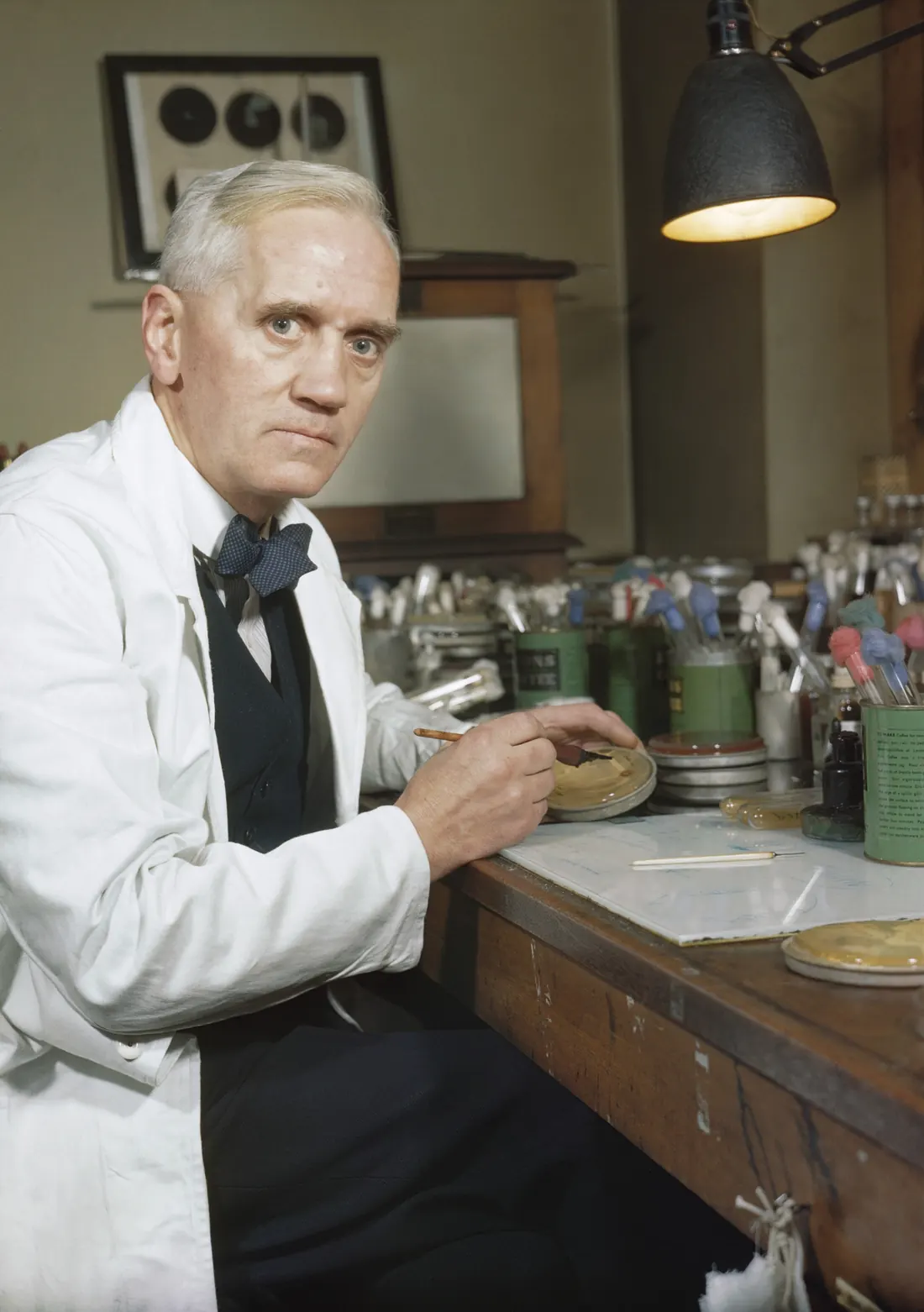
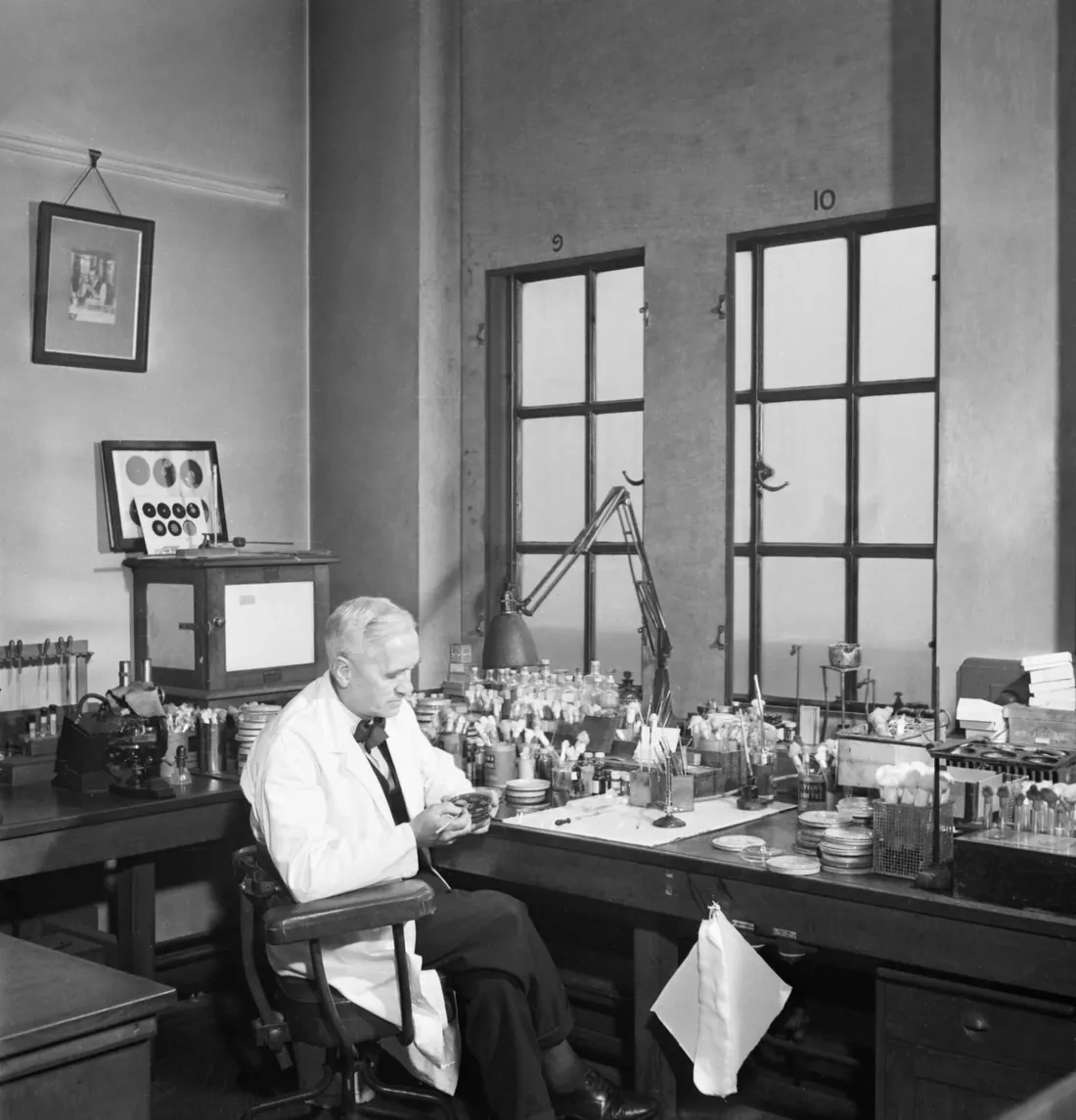
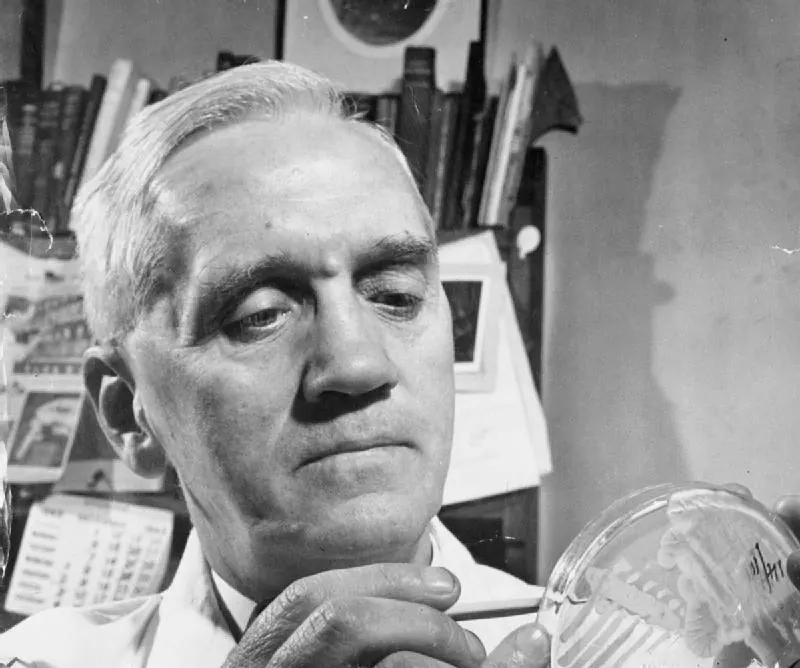
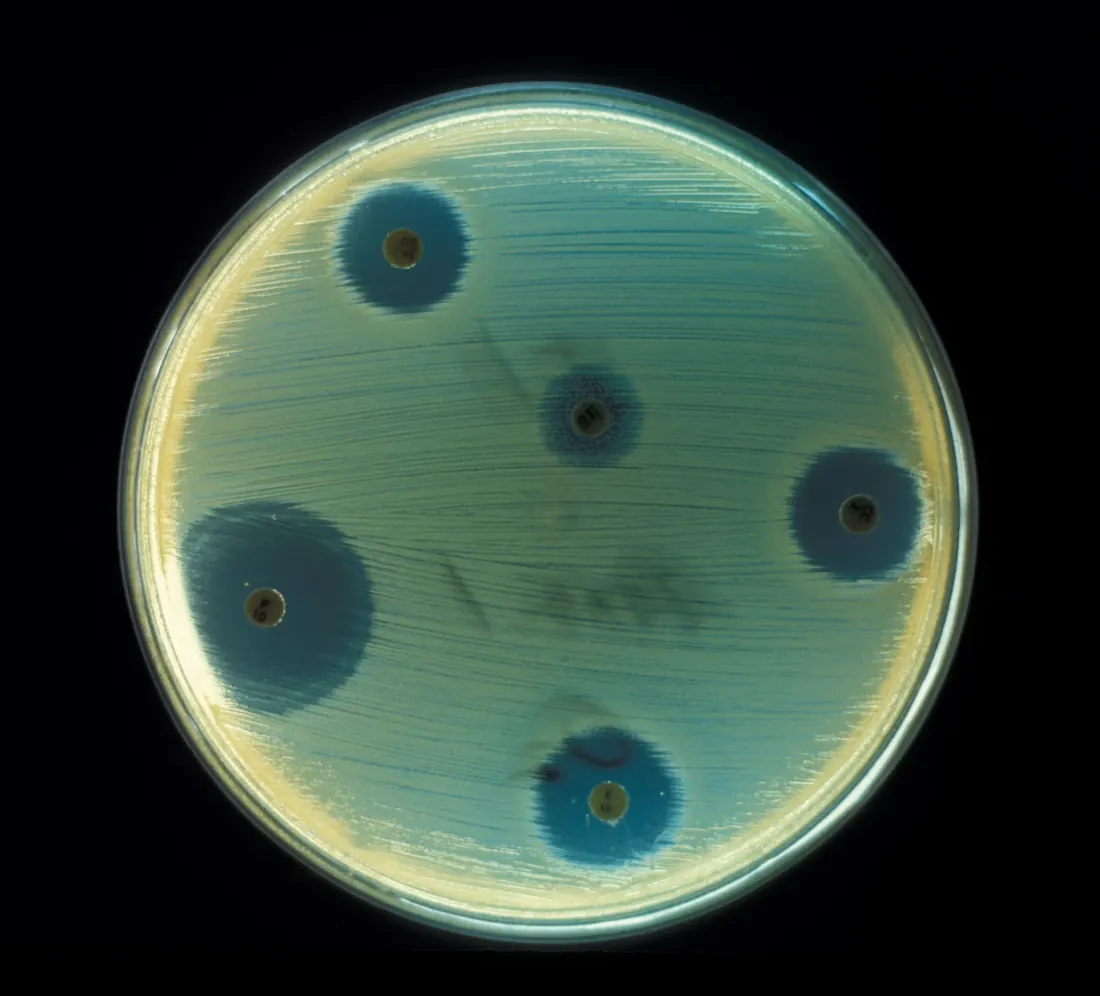
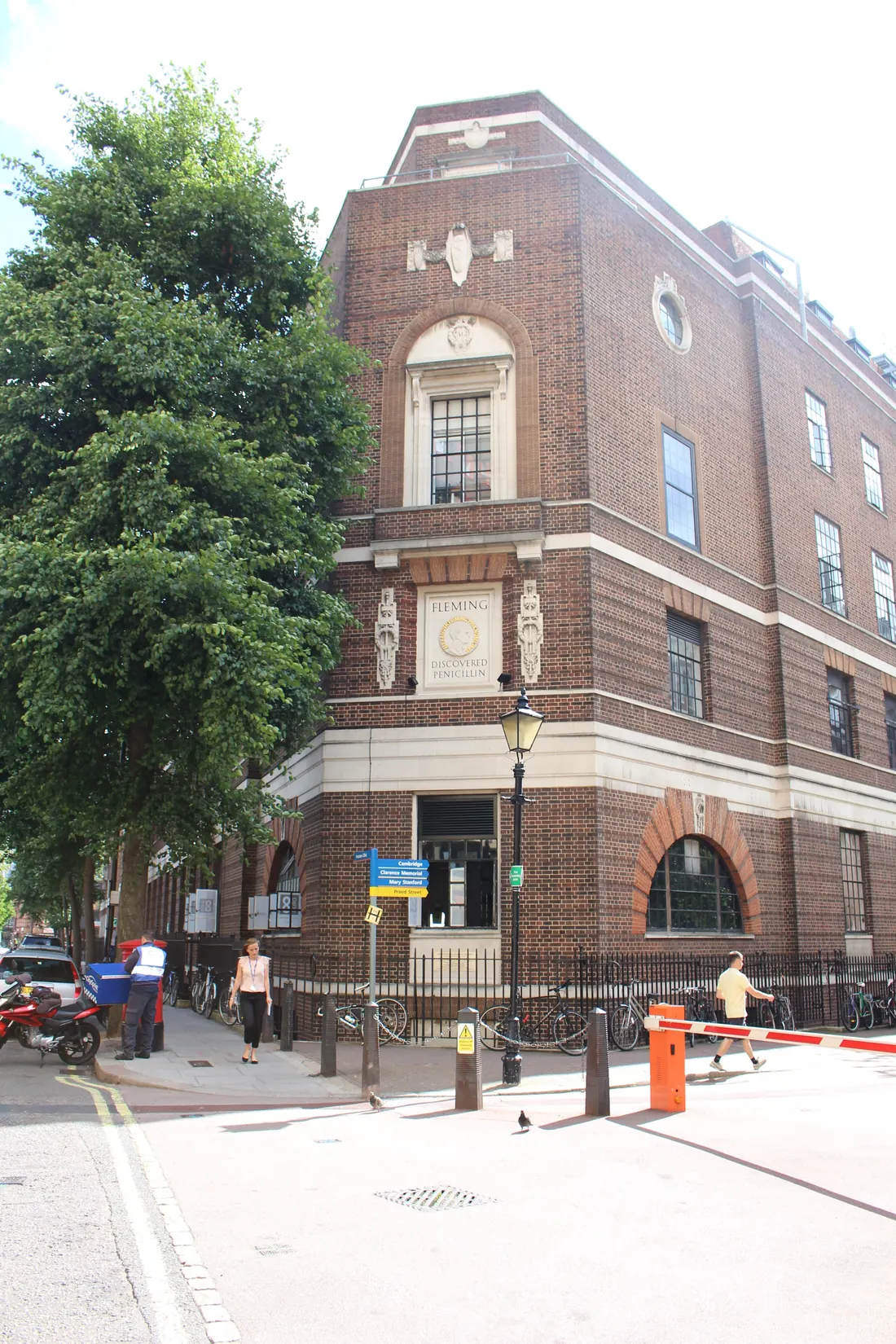
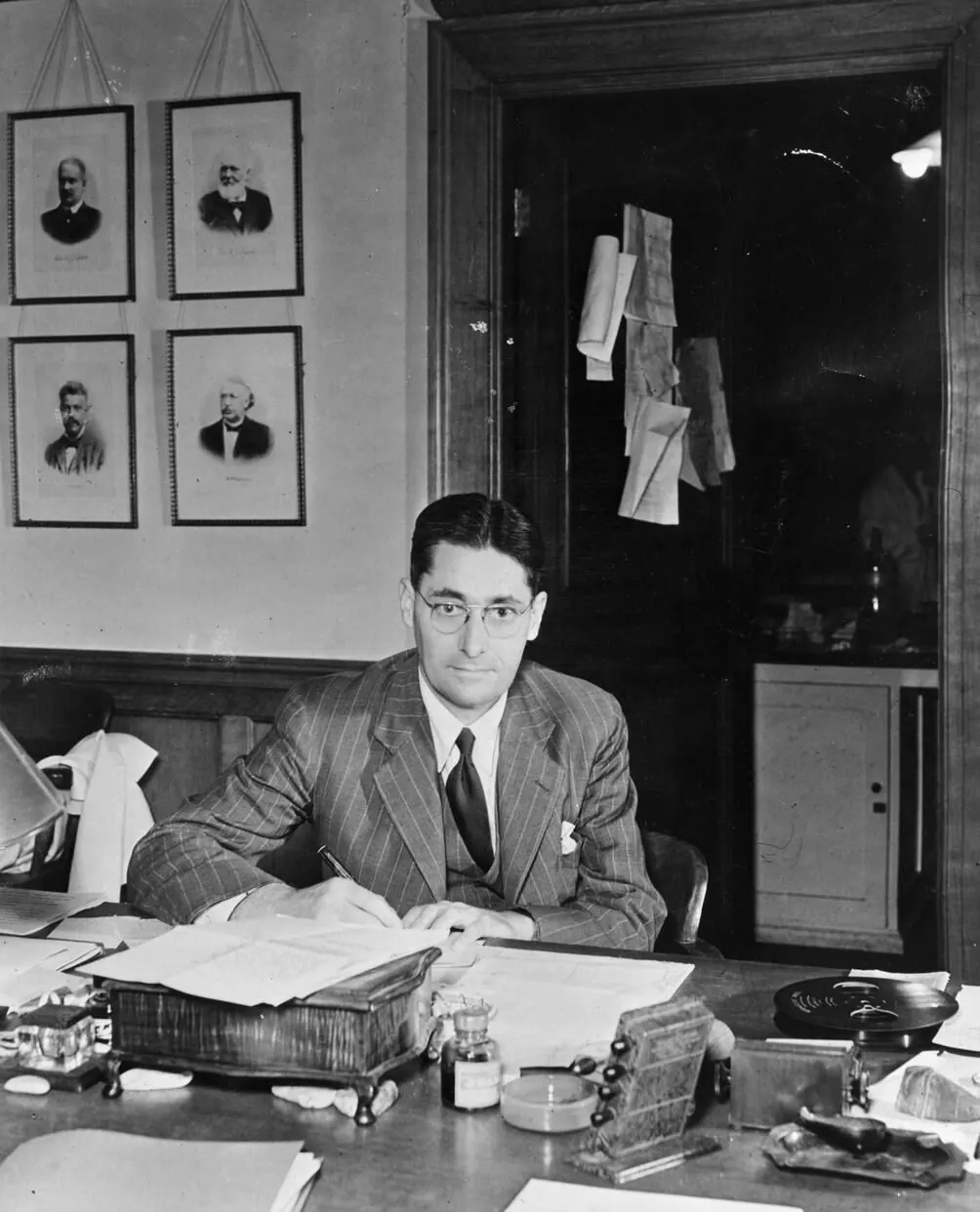
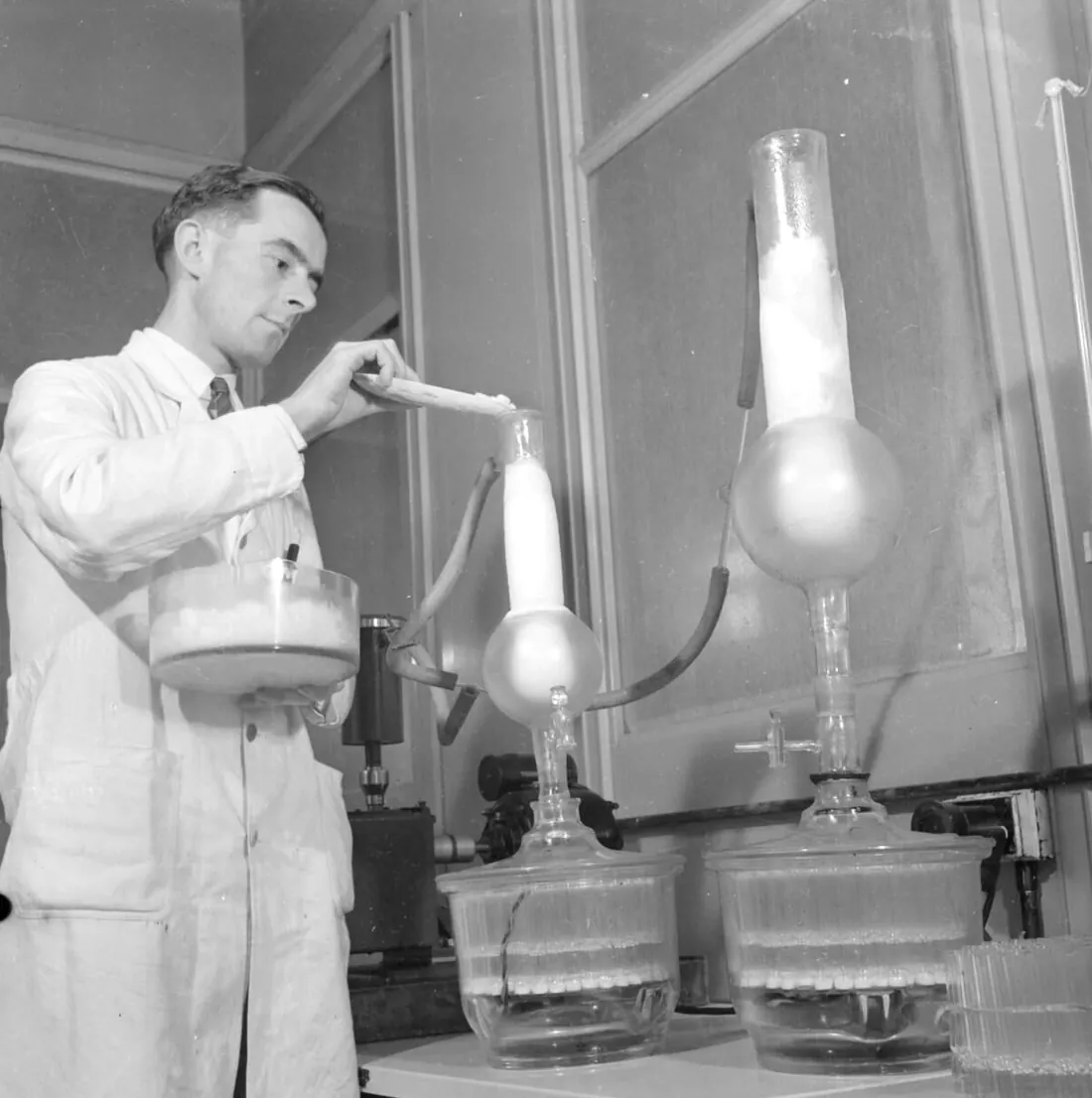
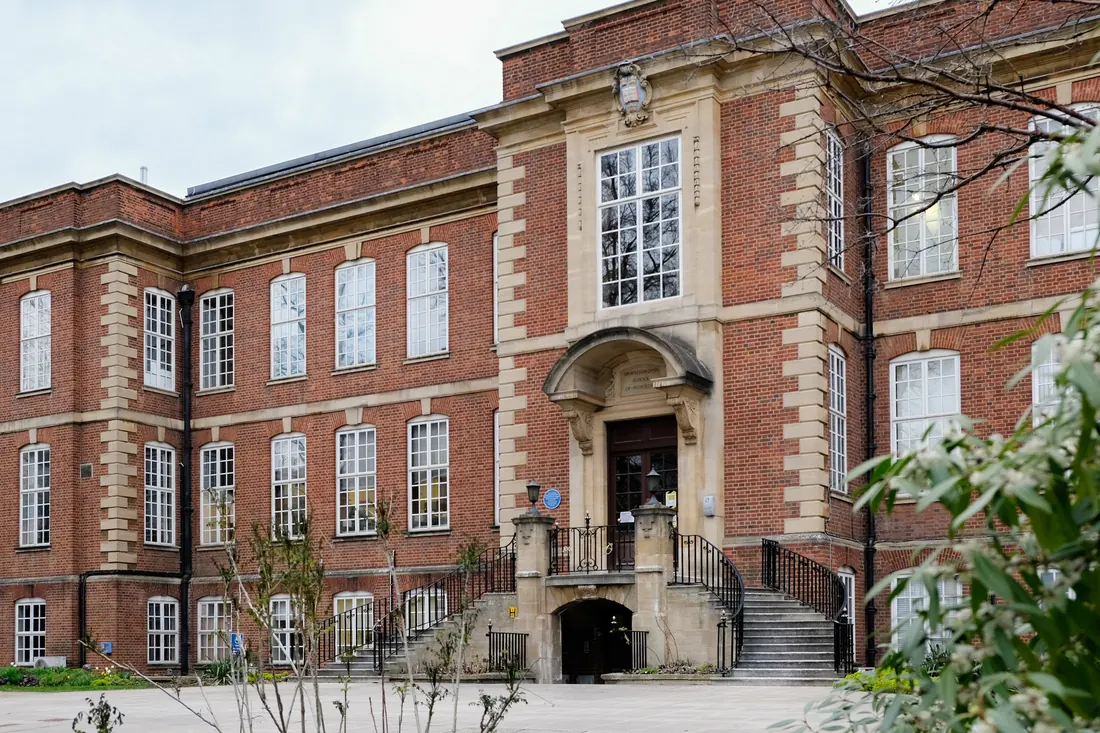
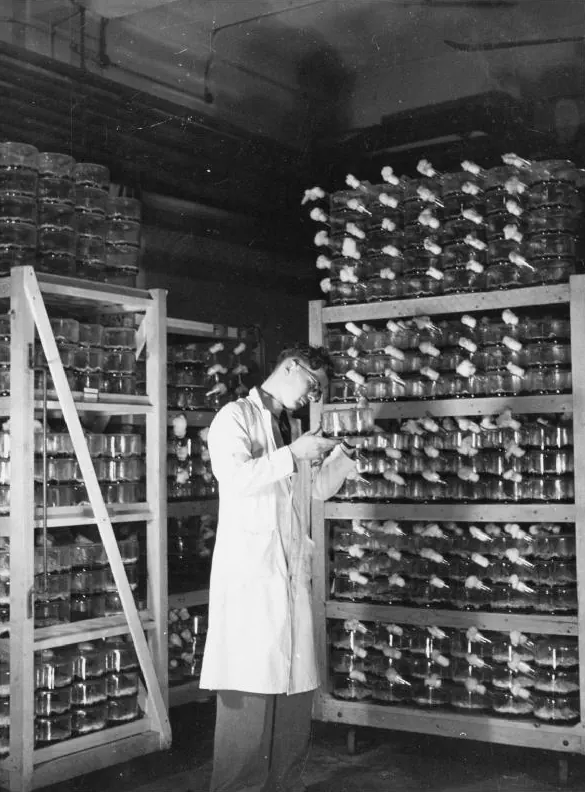
Pictures: Fleming in his laboratory at St Mary’s, Paddington, in 1943 (the color photo) and in 1942–44, and checking a culture in a petri dish in 1944, are Ministry of Information photos from the Imperial War Museums, taken long after 1928. Howard Florey is at his desk at the Sir William Dunn School of Pathology, Oxford, in 1944. Richard Stone photographed a laboratory worker checking flasks of penicillin mold broth and another measuring purified penicillin into ampoules, England, 1943; they are wartime production photos, and the workers are not named. The mold dish is a modern dish of Penicillium, photographed in 2017, and the test plate a 1972 CDC antibiotic test; both are stand-ins, not Fleming’s dish. St Mary’s Hospital, with the plaque on Fleming’s laboratory, was photographed in 2014, and the Sir William Dunn School in 2021; the passers-by are not named.
Photo credits
The archive photos in this story
The photographs and illustrations in this story are in the public domain or shared under open licenses; each one is credited below with its license. Tap one to enlarge it, or follow the link to its Wikimedia Commons page for the full record. The narration, captions and graphics in the Short are our own; its music and sound effects are credited below.
Music and sound effects
Music: Schumann, Kinderszenen, Op. 15: No. 1 'Of Foreign Lands and Peoples' (Musopen, public domain); Mussorgsky, Pictures at an Exhibition: IV. Bydlo (piano) (Musopen, public domain); Dvorak, Symphony No. 9 'From the New World': II. Largo (Musopen, public domain).
Sound effects: Freesound, CC0.